The water changed first.
Long before satellites caught the glint of runways and radar domes, before cartographers updated their maps and policy makers crafted new talking points, the sea itself began to shift. Fishermen in the South China Sea talk about it in the simplest way possible: one year, the water was just water; the next, it was strangely clouded, thick with drifting sand that did not belong in the deep.
They remember the distant silhouettes of ships on the horizon, growing more numerous each season. Enormous dredgers—steel-beamed creatures with long sucking arms—anchored over half-drowned reefs, gulping sand from the seafloor and spitting it somewhere else. They remember how the sound carried across the open water: the low, mechanical growl of engines, the metal-on-metal thrum that felt, they say, like living beside a never-ending construction site that floated.
For more than a decade, this was the background music of one of the planet’s busiest and most contested stretches of ocean. And almost no one on shore could see what was taking shape: a chain of brand-new islands, pulled from the seafloor and raised into the light, grain by grain, shipload by shipload.
How to Build an Island From Nothing
Imagine standing at the edge of a coral reef—a jagged crown of limestone rising just shy of the sea’s surface. In a storm, waves crash white over it. In calm weather, it’s invisible from a distance, a hazard known to local captains and hidden from almost everyone else. That’s where this story starts: with specks of rock and coral barely scraping the sky of the ocean.
China’s island-building campaign began in earnest around 2013, but its roots stretch back years earlier. The basic method sounds almost too simple: take sand from the seafloor and pile it on top of reefs until something solid rises above the waves. But on an industrial scale, that simplicity becomes staggering.
Specialized dredging vessels are the workhorses here. Some are cutter-suction dredgers that chew into the seabed with a rotating head, sucking up slurry—sand, mud, bits of shell—and pumping it through long floating pipes. Others are trailing suction hopper dredgers that drag giant intake heads along the bottom, filling cavernous holds with sediment before motoring over to a reef and blasting it out in a roaring slurry fountain.
Day after day, they trace patient circles over the ocean floor, turning invisible geology into architecture. The sea turns chocolate-brown around them, plumes of disturbed sediment swirling like smoke, drifting with the currents into fishing grounds and coral gardens that have evolved over millennia to thrive in clear tropical water.
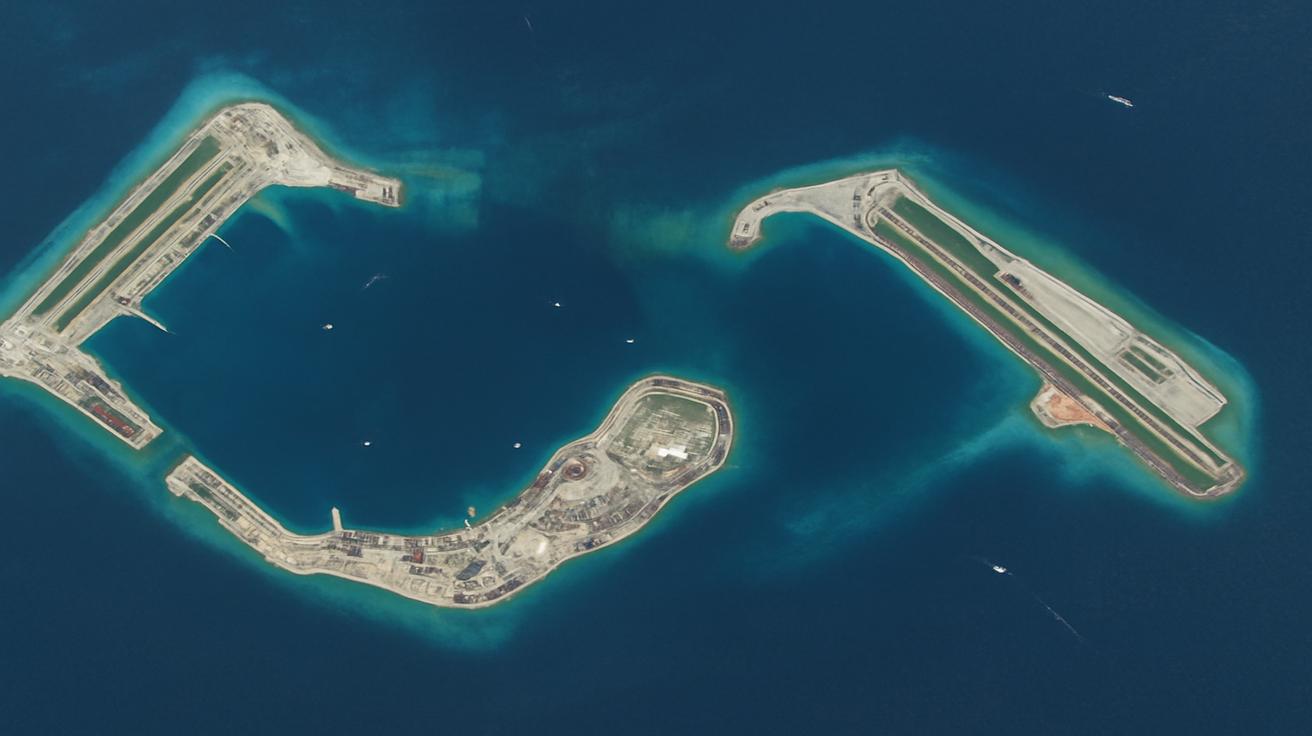
Over it all, there’s an eerie combination of brute force and extreme fragility. Each load of sand is both purposeful and precarious. Dump it in the wrong place or at the wrong depth and waves will take it back. But stack it carefully, layer by bulldozed layer, tamp it down, armour the edges with rock and concrete, and you don’t just have a heap of sand—you have something that starts to look like land: runways, roads, radar towers, and ports where none existed before.
The View From Above—and Below
The birth of these islands is perhaps most dramatic when seen from space. In satellite images from the early 2010s, you see lonely blotches of turquoise in a blue expanse—atolls, shoals, and reefs with poetic names like Fiery Cross, Subi, and Mischief, known mostly to navigators and maritime lawyers.
Scroll forward a year or two in time, and the shapes change. At first, there’s just a hazy ring of lighter blue as sand piles up on the reef. Then a crescent appears, then a blob, then something unmistakably geometric. Shorelines straighten as bulldozers push wet sand into neat edges. Before long, you can trace the sharp outline of a runway, the crisp grids of roads, the silhouettes of hangars and communication towers. Step by step, a map is rewritten.
From the waterline, the transformation feels even stranger. Fishermen talk about losing familiar stars of navigation. The reef that once lurked just beneath the surface—home to clams, sea cucumbers, and a constellation of coral heads—is suddenly hidden below rising walls of riprap and concrete. Where waves once frothed against living coral, they now slap against the grey seams of a seawall.
Beneath the surface, the change is quieter but more profound. When you overload a living reef with sand, you bury its architecture. Coral polyps suffocate under a blanket of sediment. Filter feeders clog and starve. Fish that once slipped through antler-like coral branches face a flattened, silty desert instead.
For marine biologists, these islands are a visible symbol of something larger: the idea that the ocean’s floor—home to intricate, fragile reefs—is now treated, in some places, like a raw material depot. It’s a mental shift as much as a physical one. The seafloor becomes not just a habitat, but a quarry.
The Numbers Behind New Land
When people talk about “dumping tonnes of sand into the ocean,” it’s easy to let the words slide past as an abstraction. But the scale of this work is both dizzying and strangely tangible. Think of it in shovelfuls, then multiply until your mind balks.
| Measure | Approximate Value | How to Imagine It |
|---|---|---|
| Reclaimed land area (major features) | Over 1,000 hectares | Roughly the size of a small city |
| Sand and fill moved | Tens of millions of tonnes | Millions of standard dump-truck loads |
| Time span | Around 12+ years of intensive work | An entire decade of near-constant dredging |
| Key structures built | Airstrips, harbors, housing, radar, solar arrays | A full, functioning island infrastructure |
Picture one dredging ship: a floating factory, hundreds of feet long, its hull hollowed out like a grain silo. Each cycle, it pulls thousands of cubic meters of sand from the depths and carries it to a reef. Now multiply that by multiple vessels working in overlapping shifts, month after month.
In construction terms, it’s like building several airports and harbors at once—except instead of starting from bedrock, you begin with waves.
To make that new ground stand up to the ocean’s moods, engineers deploy a suite of techniques. They compact the sand using heavy rollers and vibrating machinery. They reinforce the edges with armor rock and concrete revetments. Drainage systems are laid to bleed off trapped water so the land doesn’t slump. Over time, what started as a slurry of sand and seawater settles into something that can hold a runway and a row of apartment blocks.
On the surface, palm trees are planted, not born. Soil is trucked or barged in. Grids of streetlights appear; so do solar panels that track the sun across a sky that, a few years ago, hung above nothing but wind-scalloped water.
The Sea’s Quiet Protests
Nature does not let such things pass without a reaction, even if that reaction is slow and, at first glance, silent. Step away from the politics and maps, and you find that the islands’ fiercest arguments are being held in plankton blooms and fish migrations, in the microscopic struggles of coral larvae trying to find a clean rock to land on.
Dredging chokes the sea with suspended particles. In clear tropical water, sunlight can slice twenty, thirty, even forty meters down, fueling photosynthesis in corals and seagrasses. When the water turns murky with silt, that light is cut off. Corals, already stressed by warming temperatures and acidifying seas, suddenly face a world without enough sun.
Some reefs, scoured and buried, become underwater wastelands: flat beds of shifting sediment, inhospitable to the complex cities of life that once lived there. It’s not just beauty that’s lost. Coral reefs are nurseries and feeding grounds for countless species. Take them away, and fish populations crash or move. The food chain reknits itself in patterns we can’t fully predict.
Coastal communities, too, feel the ripples. Fishermen report catches declining or shifting away from construction zones. Traditional routes are rerouted around restricted waters patrolled by coast guard vessels. Places once treated as shared, if disputed, spaces begin to feel fenced-in, even in the apparent openness of the sea.
The islands themselves, no matter how solid they look, are always negotiating with the elements. The sea tugs at their edges. Storm surges test their seawalls. Climate change adds its own quiet pressure: rising sea levels, intensifying typhoons, creeping erosion. Engineers can design for these stresses, but they can’t make them go away.
Islands as Statements
Beyond the physics and biology, there’s another kind of reality these islands inhabit: the psychological and symbolic. They are literal markers in the water, but they are also messages, written in dredged sand and poured concrete.
From a distance, the new islands can look like any other coastal township: neat buildings, orderly roads, antennas stabbing at the sky. But their isolation gives them a different aura. Each one is a self-contained stage set, an artificial foothold far from any mainland. At night, their lights flicker in sweeping arcs as beacons turn, a kind of luminous handwriting across the dark open sea.
The idea that land can be manufactured at will unsettles old intuitions. For millennia, maps have taken coastlines and islands as given—the starting points of politics, not its products. Now, in one of the world’s most sensitive maritime regions, land itself has become negotiable, adjustable, expandable.
If you’re a sailor passing at a safe distance, binoculars steady in your hands, what you see is both ordinary and uncanny: concrete piers bristling with cranes, radar domes gleaming like white pearls, the hazy suggestion of gardens framed by blast walls. It’s as if a chunk of a mainland industrial port has been sliced free and set adrift, then pinned in place by the sheer insistence of engineering.
On the sea breeze comes the smell of diesel, hot metal, and, faintly, turned earth—soil and sand that once lay hidden in darkness, now spread under a punishing tropical sun.
Living With Man-Made Horizons
Spend long enough among people whose lives intersect this transformed seascape, and a pattern of uneasy adaptation emerges. Fishermen adjust their routes, perhaps grumbling, perhaps resigned. Naval officers and coast guards learn new patrol paths. Pilots get new waypoints in their navigation charts.
A young sailor, stationed on one of these islands, might grow used to the strangeness until it vanishes. For him, land has always been something that can be conjured where needed. His first memories of the sea include the sight of cranes on the skyline, the throb of dredgers over the horizon. An artificial island is just an island—solid under his boots, ringed by familiar waves, fixed on his phone’s map.
For older generations, the dissonance is sharper. They remember the before. Old reef names were once whispers between fishermen, not hot keywords in global headlines. There is a sense that the ocean’s grammar itself has changed: that where there used to be a simple three-part script—sky, sea, reef—there is now a fourth character on stage, dressed in poured concrete and rebar.
Nature will, in time, begin to colonize the new ground. Salt-tolerant shrubs sink their roots into imported soil. Birds learn new resting spots on their migrations, perching on radar towers and light poles. In the surf zone, algae and barnacles encrust the armor stones and seawalls. Life is opportunistic; it will take what it’s given, even if what it’s given is an island raised from the deep by the relentless work of dredger fleets.
But that colonization doesn’t erase what’s been lost, or the questions that linger. How stable is this new land in a shifting climate? What happens when the next generation wants to expand it further, to accommodate more buildings, more people, more purpose? Where is the line between managing coasts and remaking oceans?
What the Tide Remembers
Stand at the edge of one of these islands at dawn—if you’re allowed—and you might, for a moment, forget the arguments that swirl around it. The air is soft, washed clean by the night. Waves slap gently against the rockwork. Far off, you can see the fading lights of a fishing boat, the tiny silhouette of someone hauling in a net.
Under your feet, the ground is new, but it’s already begun to settle into its own kind of memory. Every high tide leaves a faint stain on the seawall. Every storm crusts another layer of salt on metal door frames, carves invisible grooves in the sand. The island is, in a sense, still in negotiation with the very sea it rose from.
For the ocean, twelve years of dredging and filling is the blink of an eye. Tectonic plates raise mountains more slowly, coral polyps build reefs more subtly, but they all work on the same principle: small units, repeated endlessly, shape the world. The difference here is speed and intent. Where nature gently coaxes land from water through eons of volcanic eruptions and reef growth, humans, with engines and steel, now redraw coastlines in a single political generation.
As the sun lifts free of the horizon, the new island looks, briefly, timeless. Light glances off the angular plane of a runway, sparkles on coils of barbed wire, finds a gleam on the water caught in tire tracks in the sand. The ocean, indifferent, keeps folding itself onto the shore and sliding back again.
Whether these islands endure for centuries or slowly slump and erode, their existence has already changed how we think about the sea. They show, in stark, sandy relief, just how far we’re willing to go to stake a claim, to draw a line, to say: here, right here, this piece of ocean will be land because we have decided it should be.
The question that hangs over the waves is not just whether we can keep doing this, technically or politically, but what kind of relationship we want with the vast blue spaces that still cover most of our planet. Are they the last wild frontier, a shared commons, a living tapestry— or a canvas on which we will keep building, pouring, dredging, and filling, until even the horizon looks man-made?
Frequently Asked Questions
Why did China build artificial islands in the South China Sea?
The islands serve multiple purposes: asserting maritime claims, hosting military and surveillance facilities, supporting coast guard and fishing fleets, and extending logistical reach in a crowded, strategically important sea. They are both practical outposts and symbolic stakes in the water.
How are these islands actually constructed?
Engineers use large dredging ships to suck up sand and sediment from the seafloor and pump it onto shallow reefs and shoals. The sand is layered, compacted, and shaped by heavy machinery. Seawalls and rock revetments are built around the edges, and infrastructure—runways, ports, buildings, power systems—is added once the ground stabilizes.
What environmental impacts do these projects have?
Major impacts include the burial and destruction of coral reefs, increased water turbidity that reduces sunlight for marine life, damage to fish habitats and spawning grounds, and long-lasting changes to local ecosystems. These effects can ripple outward, affecting fisheries and biodiversity across a wide area.
Are the new islands stable and permanent?
They are engineered to be strong, but they’re inherently vulnerable to erosion, storm surges, and sea-level rise. Over decades, they will require continuous maintenance—reinforcing seawalls, adding more fill, repairing storm damage—to remain fully functional.
Do other countries build artificial islands too?
Yes. Land reclamation is common in places like Singapore, the Netherlands, and parts of the Middle East, where artificial islands and expanded coastlines support ports, airports, and housing. What makes the South China Sea projects distinct is their location in a heavily disputed maritime region and their scale and speed on fragile coral reef systems.