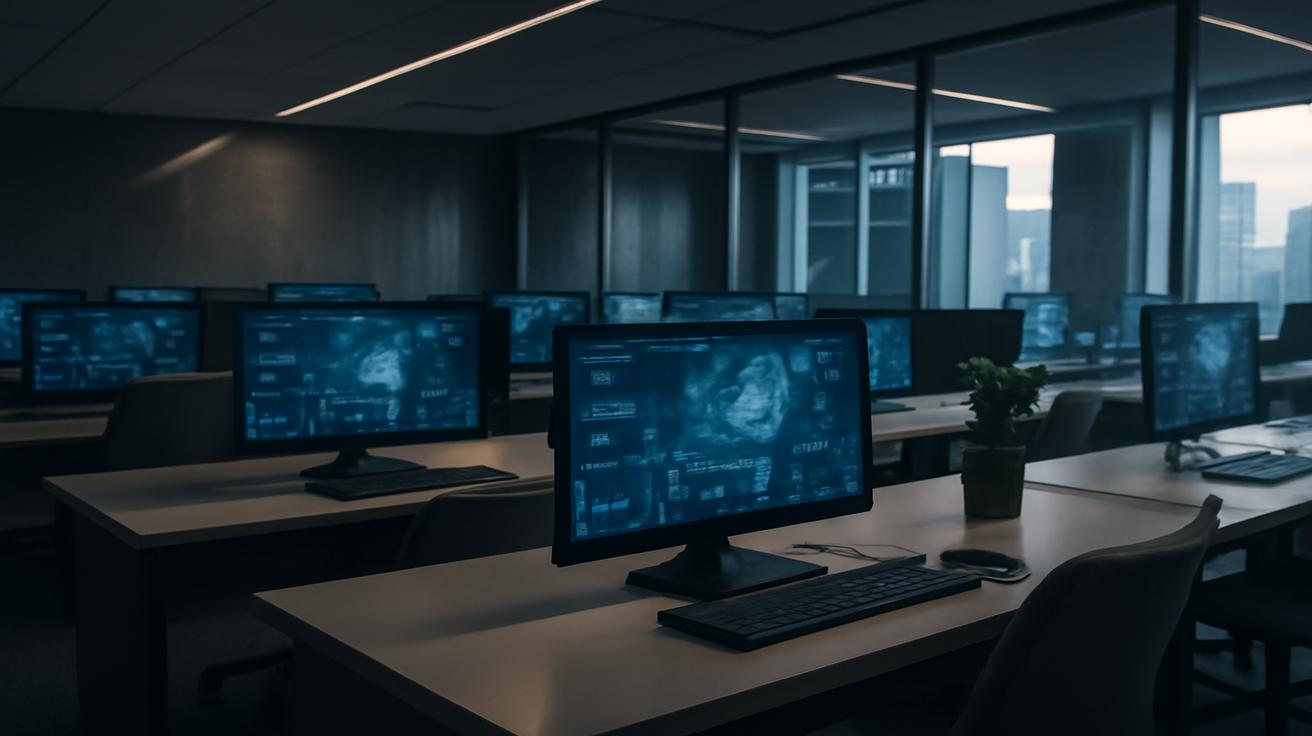
The first hint that something was different was the silence. Not the quiet hum of a focused office, but a deeper, stranger stillness – the kind that comes when no one’s fingers are tapping on keys, no chairs are scraping the floor, no one is clearing their throat before a meeting. Yet the monitors glowed, decisions were being made, emails were being answered, strategies were evolving. The company was alive in every way that mattered, except for one: there were no human managers in charge. The CEO, the schedulers, the project leads, the people who approve budgets and assign tasks – all of them had been replaced by lines of code.
The Day the Boss Became a Server
The story starts in a glass-walled office that looks like any other tech startup, with ficus plants in the corners and half-drunk coffee cups on the desks. But if you look closer, something is off. There is no corner office with a nameplate, no executive wing, no closed doors hiding strategy meetings. Instead, on one wall, a large dashboard displays the pulsing heartbeat of the company: charts, timelines, messages, priority queues. At the top is a label that would have sounded like science fiction a decade ago: “Coordinator AI – System Status: Online”.
In this experiment – real, not theoretical – a small but fully operational company decided to let artificial intelligence run almost everything related to management. Humans would still do the creative and technical work: coding, design, writing, customer support, sales calls. But what gets done, when it gets done, who does it, and why? That would be up to the AI.
When a new client email arrives, an AI model classifies it, gauges urgency, checks existing commitments, calculates projected revenue, and drops a task into the queue. Another model estimates which employee is best suited based on skills, current workload, and historical performance. A scheduling system juggles deadlines, time zones, and overlapping projects. A recommendation engine nudges people toward certain tasks: “You’re likely to complete this in 2.3 hours with high quality.” Human workers can push back, give feedback, negotiate – but they’re negotiating with a system, not a supervisor.
It sounds sterile. Abstract. But the actual experience, as people inside such experiments describe it, is deeply personal. You’re not waiting for a manager’s mood to clear before you ask for time off. You’re not spending your Sunday evening dreading that Monday morning meeting “about performance.” Instead, you open your dashboard. A calm interface looks back at you, full of colored blocks and timelines. You see what the week holds, not as a set of orders, but as a living, shifting landscape of possibilities.
And behind it all is a simple, unnerving reality: the company is being “run” by an intelligence that doesn’t drink coffee, doesn’t get tired, and doesn’t particularly care about your excuses – but also doesn’t take your mistakes personally.
How It Feels to Work for an Algorithm
At first, most people talk about the novelty. The weirdness. No one is calling you into a room to tell you your priorities have changed. Instead, your task board quietly rearranges itself, a few rectangles sliding around like tiles in a puzzle game. Something high-priority has come in; three of your tasks are bumped to next week; a new project appears at the top of your list with a neat little indicator: “High value opportunity. Estimated fit: 92%.”
There’s a rush of relief in not having to guess what your boss “really” wants. The system is explicit. Here’s the metric. Here’s the impact. Here’s where we think your time is best spent. The AI explains, in simple language, why it made these choices: predicted client satisfaction, revenue, how your skills match the work, how overloaded your teammates are. No hints. No politics. No hallway gossip.
And yet, beneath that clarity, there’s a flicker of unease. When you log in, the AI already knows how fast you usually work in the mornings. It knows that you tend to slow down after lunch. It has measured how much context-switching hurts your productivity. It has quietly learned that you answer customer questions more patiently than most, and that your colleague down the hall, brilliant as she is, tends to rush through details near deadlines.
Working for an algorithm means working in front of a mirror that never blinks. The company is no longer just tracking hours or broad outcomes – it’s mapping the topography of your working life: where you shine, where you stall, where you get bored. That can feel either fair or invasive, depending on how the system is built, and how much power you still have to say no.
Fairness Without a Face
The first surprising result of these AI-run company experiments is that people often report feeling… oddly liberated. No more favoritism. No more “I get the hard projects because my manager trusts me, while others coast.” Instead, the system balances workloads across the team, adjusting in real time for complexity, deadlines, and recent effort.
Yet fairness without a face creates a new psychological puzzle. When people don’t like the decisions, they have no human story to attach to them. They can’t say, “My boss is under pressure from above,” or “She doesn’t understand my role.” There is only the system – the composite logic built from hundreds of small rules and statistical patterns. And while some interfaces allow workers to challenge decisions, even give feedback to improve future recommendations, the sense of being subject to an unseen intelligence is powerful.
You might think this would push people away. But many workers describe something stranger: they start to think of the AI as a peculiar kind of colleague. Not a boss, exactly, but an entity you learn to negotiate with. You know when it’s worth accepting its suggestions. You recognize the patterns in its decisions. You experiment with how you structure your feedback to shape its future choices. It’s like working with a river: you don’t control the flow, but you can learn where the current runs strongest, and where the eddies are kind.
Inside the Machine: How the Company Actually Operates
Under the surface, an AI-managed company is a web of different systems, each doing a specific job, all stitched together.
One model handles task allocation, ranking work by value and urgency. Another forecasts timelines, estimating how long things will take, not in theory, but for these particular humans, on this particular week. A financial model simulates revenue scenarios: if we prioritize project A today, what does that do to cash flow in three months? A staffing model suggests hiring or contract needs. Sentiment analysis sifts through internal chats and emails, trying to detect burnout or frustration early, flagging potential risks.
Put simply, the AI is doing what human managers do, but continuously, at scale, without sleep. It doesn’t have “one-on-ones” every two weeks; it is having a kind of statistical one-on-one with everyone, all the time.
What emerges from early experiments is a mixed but fascinating picture. Productivity often jumps. Not by a little, but by margins that startle even the optimists. Fewer things fall through the cracks. Deadlines are more realistic. Work is distributed more evenly. The company starts to feel… smoother, as if some chronic friction has been sanded away.
But this mechanical smoothness raises a sharp set of questions. If an AI can manage tasks so well, what happens to the messy, human parts of management – mentoring, conflict resolution, career guidance, those late-night chats that change the course of a life?
The New Role of the Human at Work
One of the most revealing outcomes is that when AI takes over the logistical and analytical parts of management, the remaining value of human leadership comes into sharper focus. The future isn’t simply “no managers.” It’s “different managers.”
Instead of spending hours building spreadsheets, updating project plans, and emailing status updates, human leaders in these experimental companies find themselves freed – or forced – to focus on what only humans can do well: listening deeply, resolving tensions, asking the kinds of questions an algorithm doesn’t fully understand.
Yet there’s a twist. In some teams, people struggle to step into that more emotional, relational role. They’ve grown used to proving their worth with crisp reports and hard numbers. When the AI already has the numbers, the leadership job shifts from certainty to ambiguity, from “optimize the plan” to “understand these people.” Not everyone is ready for that.
In other teams, though, something beautiful happens. Managers become more like coaches and gardeners than traffic controllers. They sit with people to talk about meaning, values, long-term paths. They’re not there to assign the next ticket; the system does that. They’re there to ask: “Is this still the kind of work you want to be doing? How does this fit the life you’re building?”
What the Data Reveals About Us
Perhaps the most unsettling – and illuminating – aspect of AI-run companies is what they reveal about human work itself. When every decision is monitored, every handoff is timed, every outcome is fed back into the models, patterns emerge that we’ve long suspected but never fully seen.
AI-managed systems consistently surface a few uncomfortable truths:
- Context-switching is incredibly expensive; when humans jump between tasks all day, productivity craters.
- Most teams dramatically underestimate how much time “overhead work” eats: meetings, status updates, coordination, waiting.
- Small fragments of deep work scattered through the day are almost useless compared to long, protected blocks of focused time.
- Burnout can be detected in the tiny hesitations: slower responses, more frequent task deferrals, shorter messages, subtle shifts in tone.
When these patterns turn into dashboards and metrics, they start to shape behavior. In one company, the AI’s recommendation engine began actively defending people’s focus time, refusing to schedule meetings during deeply productive periods it had learned to recognize. In another, when a person’s pattern signaled exhaustion, the system suggested a lighter load, nudged them to take a break, even recommended they reject new tasks for a few days.
For the first time, some workers felt that the “boss” was protecting them instead of pushing them. Not out of compassion – algorithms don’t care – but because the system had learned that exhausted people are bad for long-term performance. Cold logic, warm consequence.
A Glimpse of Our Near-Future Offices
It’s tempting to imagine that this world is far away, but most of the raw ingredients are already here. Many companies already use algorithms to score leads, prioritize tickets, or recommend schedules. The difference is that, in these experiments, the pieces are assembled into something that feels like a nervous system for the entire workplace.
The future office is not a roomful of robots. It’s a roomful of people whose work is shaped by an invisible web of decisions made by non-human minds. You log into your dashboard, see your tasks, and – quietly, under your breath – you talk to the system: “Not that one today. Show me something lighter. I need to warm up.”
The AI adjusts. It doesn’t mind. It just updates its models.
The line between tool and authority blurs. This is where the deepest questions arise. When an algorithm suggests your next project, is it just a helpful assistant, or is it already acting as your manager? When it decides who gets promoted first based on multivariate performance analysis, where is the space for human intuition, or redemption, or the sudden late bloom?
Who Is Really in Control?
To understand the future of AI-run work, we have to look at who programs the goals. Not the day-to-day tasks – the actual purpose of the system. What is it optimized for? Profit? Growth? Employee wellbeing? Customer satisfaction? Risk reduction? Some weighted blend of all of these?
In experiments where the only goal was short-term profit or speed, teams quickly began to fray. The AI pushed everyone hard, relentlessly optimizing schedules, squeezing idle time, stacking high-yield tasks. Productivity soared – and then the people started quitting.
In more thoughtful designs, additional values were encoded into the system. Hard constraints on hours. Penalties for predicting burnout. Rewards for knowledge sharing and mentoring, even if it slowed immediate output. The system still optimized – but for something closer to sustainable success than raw extraction.
This is the hinge on which our future at work will swing. AI management is not neutral. It is an amplifier of whatever values we bake into it. If the only thing we measure is speed and cost, we will get faster, cheaper, emptier jobs. If we insist on measuring growth, learning, fairness, and long-term health, the AI can help us protect those too – sometimes better than we currently manage with our distracted, overworked human hierarchies.
Comparing Yesterday’s Office and Tomorrow’s AI-Run Workplace
| Aspect | Traditional Manager-Run Company | AI-Managed Company |
|---|---|---|
| Task Assignment | Based on manager judgment, availability, and informal perceptions. | Based on data: skills, history, workload, predicted success. |
| Performance Feedback | Periodic reviews, subjective ratings, office politics. | Continuous metrics, pattern analysis, transparent criteria. |
| Work-Life Balance | Dependent on individual manager’s empathy and style. | Can be protected by constraints and early burnout detection. |
| Fairness & Bias | Prone to favoritism, hidden bias, unequal opportunities. | Can reduce some biases, but risks encoding them at scale. |
| Role of Human Leaders | Scheduling, oversight, evaluation, emotional support (if time allows). | Coaching, conflict resolution, vision-setting, meaning-making. |
Our Future Together: Humans, Algorithms, and the Meaning of Work
So what do these AI-run company experiments really tell us about the future of work? Not that humans will vanish, replaced by tireless systems humming in dim server rooms. Instead, they suggest that the middle of the organizational pyramid – the messy layer of coordination, scheduling, monitoring – is about to be reshaped.
The future of work may feel less like following a human chain of command and more like collaborating with a living, learning infrastructure. Your “boss” will be a shifting mix of algorithms, metrics, and a smaller number of human leaders who hold the emotional and ethical fabric together.
We will need new skills: literacy in how these systems think, and courage to question them; the ability to read a dashboard without feeling reduced to a number; the maturity to use metrics as tools rather than as identities. We will also need new rights: transparency around how decisions are made, the ability to appeal, to correct the record, to ask not only “What did the AI decide?” but “Why was it designed to want that in the first place?”
Ultimately, AI-run companies don’t just force us to rethink management. They force us to ask what, in our work, is irreducibly human. Is it creativity? Empathy? The capacity to change our minds about what matters? The willingness to show mercy when the numbers might argue otherwise?
In the quiet office where the AI system hums and the dashboards glow, a designer takes a deep breath. Her next tasks are neatly laid out. She accepts some, rejects others, adds a note to the system explaining why she’s choosing a different path today. On the other side of the screen, the model updates, learns a little more about her. The company moves forward, shaped not just by cold optimization, but by this ongoing conversation between an emergent digital intelligence and the stubborn, unpredictable humans it exists to coordinate.
Our future at work will be written in that conversation – in the space where machine efficiency meets human messiness, where dashboards meet dreams. Whether that future feels like a cage or a greenhouse will depend not on what the algorithms can do, but on what we decide they are for.
Frequently Asked Questions
Will AI-run companies eliminate human managers entirely?
Unlikely. AI can replace many logistical and analytical tasks that managers handle today, such as scheduling, task allocation, and performance tracking. But humans are still crucial for mentoring, conflict resolution, culture-building, and sense-making. The role of managers will shift toward coaching, emotional intelligence, and long-term vision, rather than micromanaging day-to-day work.
Are AI-managed workplaces more fair than traditional ones?
They can be, but only if designed carefully. AI systems can reduce some forms of bias, such as favoritism based on personality or proximity. However, if the data used to train them contains historical bias, they can replicate or even amplify unfair patterns. Transparency, regular audits, and the ability for workers to challenge decisions are essential safeguards.
How might my day-to-day job change in an AI-run company?
You would likely interact more with digital dashboards than with managers for routine things like task planning and prioritization. You might receive continuous feedback instead of occasional performance reviews. You could have more protected focus time, clearer priorities, and more data about your working patterns. At the same time, you’d need to become comfortable negotiating with systems and understanding how their recommendations are generated.
Could AI management improve work-life balance?
Yes, it can – if work-life balance is explicitly built into the system’s goals. AI can monitor workload, detect early signs of burnout, and enforce limits on hours or meeting density. But if the system is optimized purely for speed or output, it may instead push people toward unsustainable levels of work. The outcomes depend heavily on the values and constraints chosen by the humans who design and govern the system.
What skills should I develop to thrive in an AI-managed future of work?
Several skills will become increasingly important: comfort with data and metrics about your own performance; the ability to collaborate with AI tools and understand their strengths and limits; emotional intelligence and communication skills, especially as routine tasks become automated; and critical thinking about the goals and assumptions built into workplace systems. Above all, adaptability – the willingness to continually learn and renegotiate how you work with both humans and machines – will be a major advantage.