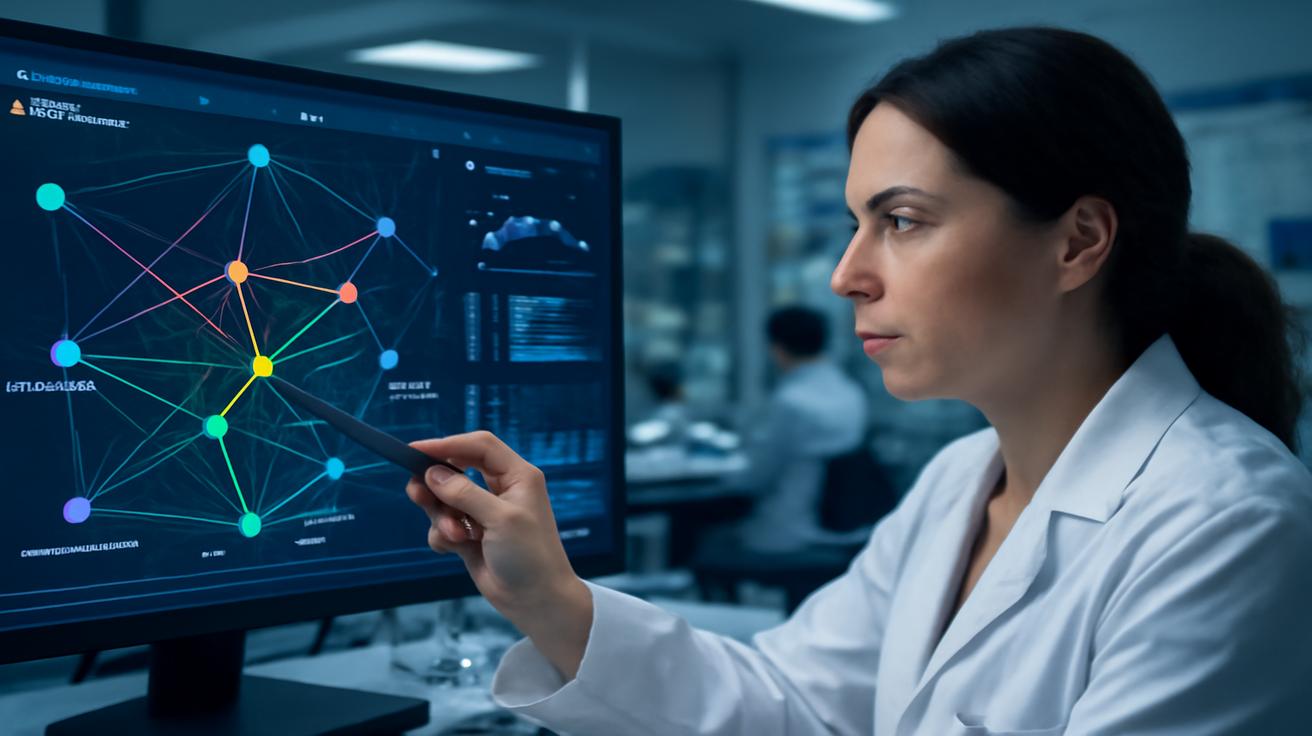
The room is the color of autumn fog: soft grays, a hush of filtered light, the faint rhythmic wheeze of a machine in the corner. On the wall, a monitor pulses with strange constellations of dots and lines—patterns no human could read at a glance. A woman in a pale blue gown sits quietly, hands folded, watching two doctors lean toward the screen as if listening to a distant weather report. But it isn’t the doctors who are really in charge of this conversation. It’s the algorithm running a few floors below, in a humming data center, sorting through millions of medical histories and molecular clues to answer a single question: What gives this woman the best chance to live?
When the Forest Fights Back
Cancer has always felt like a betrayal from within, like a forest suddenly turning on its own trees. One cell disobeys the rules, then another, until a small rebellion swells into an uprising. For decades, we’ve been hacking at the chaos with the best tools we had—surgery, chemotherapy, radiation—without fully understanding why they work for some people and not for others.
Now, artificial intelligence is walking into that burning forest with night-vision goggles.
Imagine every cancer trial ever run: all the lab notes, the fuzzy scans, the scribbled margins, the gene expression data, the side-effect reports. Imagine every tumor sample sequenced, every blood test, every radiation dose, every person who sat in a waiting room, thumbing a paper wristband while their biology became a line in a spreadsheet. That is the wilderness AI can now enter, map, and learn from at a scale we can barely picture.
Not to replace doctors, but to give them a new superpower: the ability to see patterns of cause and effect buried so deep in the medical record that no human mind could ever assemble them alone.
The Silent Conversations of Cells
Inside every tumor, there’s a kind of whispering. Cells talk with proteins and signals, passing cryptic messages that say grow, divide, evade, hide. For years, oncologists have been listening with earplugs in—able to hear only the loudest shouts: a mutation here, a hormone receptor there.
AI doesn’t just listen; it eavesdrops on every murmur. Machine learning models are fed rivers of biological data—genomes, proteomes, histology images, immune signatures—and asked not just, “Who has cancer?” but “What is this tumor really trying to do?”
Some of the most startling advances are coming from algorithms trained to stare at pathology slides, the kaleidoscopic images of stained cells under a microscope. To a human pathologist, a slide is an art piece of structure and color. To an AI model, it’s a dense text, every swirl and shadow a letter in a molecular alphabet.
These systems can now predict genetic mutations directly from images. No extra tests, no added delay—just a near-instant guess at which genes have gone rogue. They can infer how likely a tumor is to spread, how it might respond to immunotherapy, whether it’s hiding small vulnerabilities that drugs could exploit.
In this way, AI is turning static snapshots into full-blown stories, revealing the motives of the disease. And in those motives, we start to glimpse levers—specific, pressure points where medicine can push back.
Turning Chaos into Maps: The New Levers Against Cancer
The word “lever” sounds mechanical, almost quaint. Yet that’s exactly what we need: simple points of force in an overwhelmingly complex system. AI is helping to identify those levers by looking across countless dimensions of data—lifestyle, genetics, tumor biology, treatment history—and surfacing recurring patterns that say: When you push here, outcomes improve there.
Some levers are surprisingly human and practical: screening at the right time, matching the right treatment to the right person, avoiding toxicity that does more harm than good. Others burrow deeper, down to the molecular conversations between cell and immune system.
The table below summarizes a few of the most powerful levers emerging from AI-guided cancer research and care:
| AI-Discovered Lever | How It Changes the Fight | Real-World Impact |
|---|---|---|
| Ultra-early risk prediction | Finds high-risk people years before cancer appears by reading subtle patterns in scans and records. | Smaller tumors at diagnosis, less aggressive treatment, better survival odds. |
| Precision treatment matching | Links molecular profiles to therapies that worked for “patients like you” across massive datasets. | Higher response rates, fewer wasted months on ineffective drugs. |
| Immunotherapy response prediction | Identifies who is likely to benefit from expensive, intense immune-based treatments. | Spared side effects for non-responders, faster access for likely responders. |
| Adaptive dosing and scheduling | Continuously updates drug doses based on real-time data on toxicity and response. | Less damage to healthy tissue, more time on effective therapy. |
| New drug target discovery | Searches billions of molecular relationships to find critical vulnerabilities in cancer cells. | More focused experimental drugs, fewer blind alleys in research. |
Each lever is the result of thousands of invisible calculations, but their meaning is tangible: catching cancer when it’s still a whisper, weakening its defenses before it shouts.
The Art of Seeing Before It Hurts
In a dim mammography suite, a radiologist scrolls through breast images, eyes narrowed, looking for the telltale white smudges that mean trouble. It’s exhausting work. Human vision wasn’t designed to parse endless grayscale textures for hours a day. Tiny cancers hide in the noise; mistakes creep in when fatigue does.
AI systems now sit beside these specialists as tireless second readers. Trained on millions of scans, they’ve learned to detect patterns so subtle they border on imperceptible, the faint rearrangement of tissue architecture, the ghostly outlines that may precede a tumor by years.
In some trials, these AI agents have flagged high-risk lesions that even experienced radiologists passed over—lesions that later declared themselves as full-blown cancers. In others, they’ve reduced the number of false alarms, sparing people from stressful biopsies that prove unnecessary.
The real power isn’t that AI is “better” than humans; it’s that the combination of human judgment and algorithmic vigilance is more than either alone. The radiologist brings context, nuance, the knowledge of the person in front of them. The algorithm brings pattern memory on an inhuman scale. Together, they bend the arc toward earlier, more accurate detection—a lever we have long known to be crucial, but only now can fully optimize.
Rewriting the Rules of Treatment Choice
Choosing a cancer treatment has always felt a bit like stepping into a storm with an umbrella chosen from guesses and guidelines. Protocols are based on what has worked “on average” for large groups. But no one is average when the disease is living in their own body.
AI is starting to personalize that storm forecast.
In modern oncology centers, machine learning models sit behind the scenes, digesting clinical trial data, electronic health records, genetic results, and imaging studies. When a new patient is diagnosed, their information becomes a query: Among all the people who have come before—with similar tumors, similar genes, similar bodies—what has worked best?
Sometimes the recommendation reinforces the doctor’s instinct. Sometimes it quietly challenges it. A particular drug combination that looked mediocre in the general population might have worked dramatically well in a small subgroup—people with a specific mutation, or with a certain immune profile. Without AI, those subgroup patterns are often too subtle to tease out confidently. With it, the patterns sharpen, revealing new rules of thumb and, occasionally, new rules altogether.
This isn’t about pushing a “treatment button.” It’s about equipping clinicians with a deeper, data-backed hunch: If you pull this lever for this patient, here’s how the story is likely to unfold.
Listening to the Immune System’s Murmur
Of all the levers AI is helping to uncover, immunotherapy might be the most mysterious and hopeful. These treatments, which awaken the immune system to attack cancer, can produce almost miraculous recoveries in a fraction of patients. Others, with seemingly similar diagnoses, see no benefit at all—and sometimes experience serious side effects.
Why does one person’s immune system roar to life while another’s remains strangely indifferent?
AI is sifting through the noise for answers. It looks at the shape of tumors in images, the density of immune cells at their borders, the genomic scars left by past cellular battles. It finds correlations we never expected: specific patterns of mutations that mean the immune system has more “flags” to recognize, subtle arrangements of tissue suggesting that killer T cells are already pacing near the tumor, waiting for a signal to strike.
These insights translate into practical levers. Before starting immunotherapy, a model might estimate the chances of response for a particular person. In the near future, AI-guided tools may even propose combination strategies—pairing immunotherapy with radiation or targeted drugs in a sequence designed to coax the immune system into action, instead of simply hoping it will wake up on its own.
Behind each recommendation is a story written in code, but its impact is intensely human: fewer people enduring months of side effects for treatments that were never going to work for them, and more people gaining access to life-changing responses that once seemed like rare miracles.
From Trial-and-Error to Learning Systems
For most of medical history, progress has inched forward through slow, meticulous trials. We test one new idea against the standard of care, wait years for results, then adjust our guidelines. It works, but at a pace that often feels cruel when lives are hanging in the balance.
AI offers the possibility of turning cancer care into a learning system—less like chiseling new instructions into stone tablets, more like updating a living map.
In such a system, every treatment decision, every side effect, every remission and recurrence feeds back into models that are constantly recalibrating. What worked in one hospital can inform decisions in another, thousands of miles away. Rare cancer subtypes, once so scarce that no single center had enough cases to draw strong conclusions, can finally be studied at scale through pooled, anonymized data.
This shift doesn’t only affect futuristic cancer centers with towering glass facades. Even small clinics, rural hospitals, and overstretched oncology practices can plug into AI-guided decision-support tools. In those places, where specialists are scarce and case loads heavy, having an invisible partner that has “seen” millions of cases could be transformative.
But for this vision to work, trust is essential. Patients need to know their data is protected, that algorithms are tested and audited, that human clinicians remain accountable. Doctors need to understand how models reach their conclusions, not just what those conclusions are. Transparency—explainable AI, open validation, diverse training datasets—is itself a lever. Pull it, and we might unlock not just better tools, but the public willingness to use them.
The Ethics in the Engine Room
Walk into the server rooms that power many of these models and you won’t find drama—just rows of humming machines, green and blue LEDs blinking softly like distant fireflies. Yet the decisions generated here ripple out into chemo wards and radiology suites, into kitchen tables where families pore over treatment plans late into the night.
With that power comes the most difficult question of all: Who gets to benefit, and on what terms?
AI is only as fair as the data that shaped it. If historical records reflect disparities—delayed diagnoses in some communities, under-treatment in others—then naïve models will reproduce and even reinforce that bias. If genomic datasets are dominated by people of certain ancestries, predictions may falter for those who aren’t represented.
Researchers are now building counterweights: algorithms that check for bias, frameworks that require representation across populations, policies that insist AI be a force for equity, not a magnifier of old injustices. The goal is not mere efficiency but justice: ensuring that every new lever we discover against cancer can be pulled for everyone, not just those who already live closest to advanced care.
There is also a subtler ethical demand: humility. No matter how advanced the model, no matter how accurate the prediction, cancer remains partly a landscape of uncertainty. AI doesn’t cancel that; it just illuminates more of the terrain. The people in the exam room still make the decisions, with all the weight and wonder that choice entails.
Standing at the Edge of the New Forest
So we return to the quiet room, the muted beeping, the woman in the blue gown waiting to hear what comes next. Somewhere beneath her feet, silicon chips have been working through her scans, her lab values, her biopsy slides, her DNA. Not to dictate her future, but to trace the outlines of possible futures a little more clearly.
The doctor sits across from her, not with a single script, but with a map: here is the path most likely to shrink the tumor; here is the path with fewer side effects; here are the odds, uncertain but better informed than they would have been even a decade ago. They talk about family, work, what she fears and what she hopes for. The levers are technical, but the choice among them is deeply human.
Outside the hospital, the world goes on. Children race their bikes past hedge-lined streets. A stranger laughs into a phone at a bus stop. Someone, somewhere, receives a diagnosis today that feels like a storm breaking over their life. Yet, invisibly, the forest is changing. It is no longer just a place where cancer hides; it is becoming a place where patterns emerge, where levers become visible, where knowledge accumulates not in dusty journals but in living systems that learn from each heartbeat, each data point, each brave decision.
Artificial intelligence will not end cancer in a single, cinematic breakthrough. The disease is too varied, too clever, too much a part of our own biology. But AI is helping us discover the most effective places to push back: the habits of early detection, the nuance of tailored treatment, the choreography of immune awakening, the discipline of fairness and transparency.
We are, in a sense, teaching our machines to read the secret language of cells. And in return, they are teaching us where to place our hands on the levers of this vast, intricate fight—so that when we pull, together, the balance shifts just a little further toward life.
Frequently Asked Questions
How exactly does AI help detect cancer earlier?
AI analyzes medical images—like mammograms, CT scans, and MRIs—as well as patterns in lab tests and health records. By learning from millions of examples, it can spot extremely subtle signs of early disease that humans might miss, and can also estimate a person’s future risk, prompting earlier or more frequent screening when needed.
Does AI replace oncologists or radiologists?
No. AI acts as a decision-support tool, not a replacement. It provides additional pattern recognition, predictions, and suggestions, while human clinicians interpret results, consider the full context of the patient’s life and values, and make final decisions together with the patient.
Can AI tell me which cancer treatment will work best for me?
AI can’t guarantee an outcome, but it can compare your specific tumor characteristics, genetics, and health profile to large datasets of previous patients. From this, it estimates which treatments have historically worked best for people similar to you, helping your care team choose a more personalized plan.
Is my data safe when used for AI in cancer care?
Hospitals and research centers typically use strict privacy protections, including de-identifying data, securing storage, and following regulations about how information can be shared. However, practices vary, so it’s reasonable to ask your care team how your data is used and protected if AI tools are involved.
Will AI make cancer care more equal or less?
It could go either way, depending on how it’s built and deployed. If AI is trained on diverse data and deliberately checked for bias, it can help reduce disparities by bringing advanced decision support to more places. If built carelessly, it can reinforce existing inequalities. Many researchers and clinicians are actively working to ensure AI becomes a tool for greater equity in cancer care.