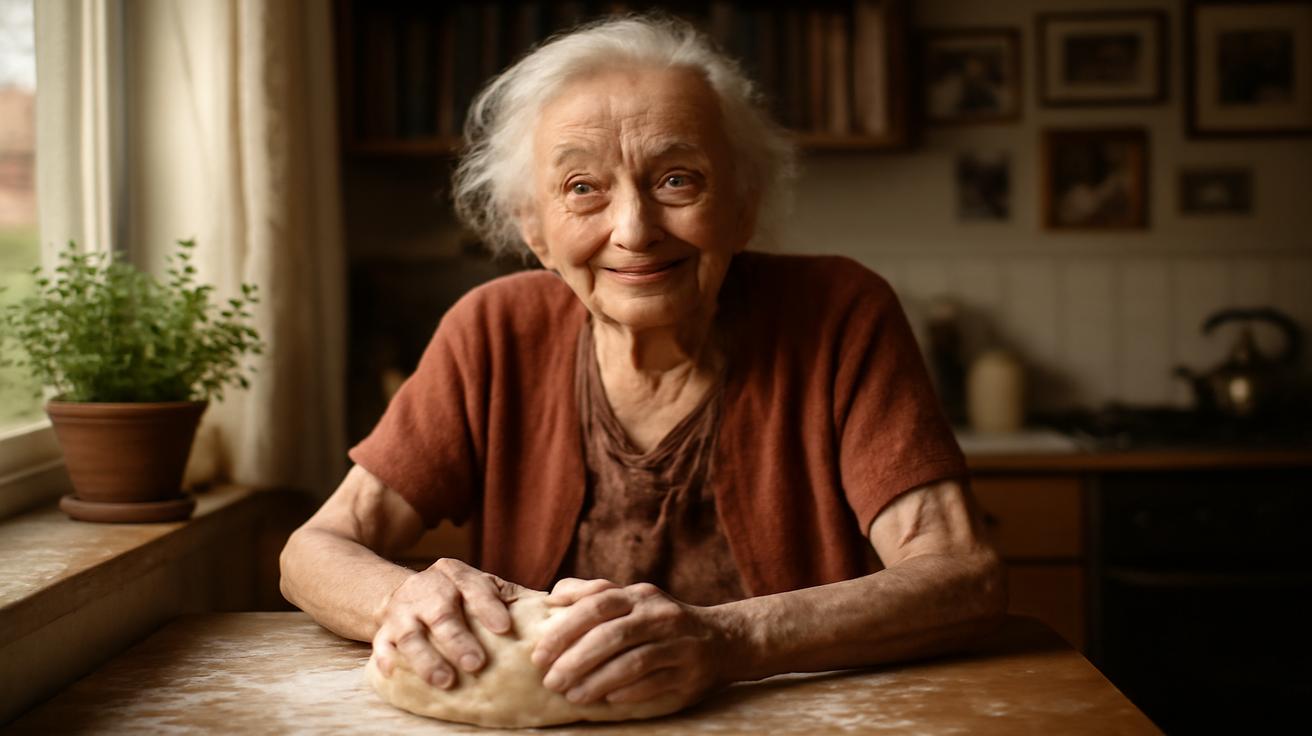
The first thing you notice about her is the way she stands up. Slowly, yes—she’s a hundred years old, after all—but without the wobble you might expect, without the apologetic hands reaching for furniture. She presses her palm into the wooden arm of the chair, draws in a breath that seems to come from her toes, and rises like someone who has done this thousands of times with great intention. “I refuse,” she tells me, eyes clear as winter sky, “to end up in care. I’ve got things to do.”
The Woman Who Outlived Everyone’s Expectations
Her name is Margaret, though everyone in the village calls her “Maggie from the lane.” The postman has known her since he was a teenager; the pharmacist keeps her favorite tea bags behind the counter. When she turned one hundred, the neighbors brought over homemade cakes and flowers, and someone stuck a gold balloon to her front gate that still squeaks against the paint when the wind blows.
Inside her small brick cottage, the air smells faintly of lavender polish and toast. The clock in the hallway ticks with the steady, unrushed rhythm of a life practiced in patience. A walking stick leans discreetly by the door, but she only uses it outdoors “when the pavements get cheeky,” as she says.
“People think living long is luck,” she begins, shuffling towards the kettle. “It is, partly. No one dodges every bullet. But habit,” she taps the countertop with a bony knuckle, “habit is what gets you to ninety. Stubbornness gets you to a hundred.”
As the kettle hums to a boil, she moves around her kitchen with a purposeful, almost ritualistic rhythm: mug, teabag, spoon, the splash of milk set out before the water’s ready. Watching her is like watching a quiet choreography, built not for show but for survival. Every motion is small but deliberate, practiced into muscle memory.
“Write this down,” she says, lowering herself back into her chair, the steam from her tea curling between us. “I’m going to tell you exactly what I do every day. Not because I think everyone should copy me—half of you would hate it. But because people keep asking, and I’m tired of saying, ‘oh, just luck and good genes.’ That’s only half the story.”
The Morning Ritual That Anchors Her Day
The Quiet Hour Before the World Wakes
“I always wake up before the sun,” she says. “That’s not discipline, that’s just what happens when you’ve seen a lot of sunrises.” In winter, it’s the gentle creak of the house and the distant hum of the boiler that greet her; in summer, it’s birds—“the rude ones, the blackbirds that think they own the hedge.”
She lies still for a moment, waiting. Not doomscrolling, not checking messages—her mobile phone lives in the hallway “so it doesn’t boss me about.” She listens: to the wind, to her own breathing, to the faint thump of her heart. “If those three are still going,” she laughs softly, “it’s a good day.”
“People jump out of bed like they’re late for something,” she continues. “That’s where they go wrong. I start with what I call a body roll call.” She wiggles her toes under the blanket, flexes her ankles, circles her wrists. Knees, hips, shoulders, neck—each joint is gently tested, greeted like an old friend. “I ask, ‘Can you work today? Are you going to complain?’ If something hurts more than usual, I adjust my plans. But I always have a plan.”
Only when she’s sure her body has more to give does she swing her legs out of bed. Her slippers are always placed in the same spot. “That’s one of my tricks,” she confides. “Make your room so predictable that you could walk it with your eyes shut. At my age, tripping is more dangerous than almost anything. So I don’t leave danger lying about. No clutter on the floor. Ever.”
In the bathroom, more ritual: a splash of cool water on her face; three slow, deep breaths with her hands braced on the sink. “I greet myself in the mirror every day. ‘Still here, are you?’ I say. And she,” Maggie gestures vaguely towards the hallway mirror, “usually looks back like she means business.”
Moving Like You Plan to Use Your Body for a Long Time
The Tiny Workouts That Add Up to a Century
Ask her about exercise, and she doesn’t talk about gyms or training plans. “I’ve never stepped on a treadmill,” she says. “I walk to places. That’s my treadmill.”
Her morning stretches take place in the narrow strip of carpet between the lounge and the window. She holds onto the back of a sturdy chair and lifts herself up on her toes ten times. Then she marches in place, lifting her knees a little higher than feels entirely comfortable. “If it’s easy,” she shrugs, “it’s not helping.”
On days when the weather behaves, she steps outside for a slow circuit of her small garden. The air, especially in the cooler months, snaps at her cheeks; the light creeps over the hedges with a kind of gentle insistence. Dew collects on her slippers if she forgets to change into sturdier shoes. “Fresh air is free medicine,” she says. “People sit indoors, breathing each other’s old breath, watching other people live on television. I go outside and let the birds insult me instead.”
But it’s not just the deliberate exercise that keeps her moving; it’s the way she’s woven motion into every part of her day. She refuses to buy anything with a remote control that allows her to avoid standing up. “If I want the radio louder, I walk to it. If I want the curtains shut, I stand on my own two feet to do it.”
In her words, “Use it, or it leaves you. That’s true of legs and friendships and teeth and everything else.”
| Time of Day | Habit | Purpose |
|---|---|---|
| Early Morning | Body roll call, light stretches, deep breaths | Check-in with body, maintain mobility, calm mind |
| Late Morning | Walk to the shop or garden circuit | Cardio, fresh air, social contact |
| Afternoon | Light chores, reading, brain games | Strength, balance, cognitive health |
| Evening | Phone calls, gratitude, gentle stretches | Emotional connection, better sleep, pain relief |
The Way She Eats: “Nothing Fancy, Just Respectful”
Food as Fuel, Not a Battle
There’s a bowl of apples in her kitchen that looks like it belongs in a painting—nothing polished, just misshapen, local, quietly beautiful. “I grew up when wasting food was a sin,” she says. “And now I see people throwing away more than we ate in a week.” She doesn’t follow any named diet, but her plate tells its own story.
Breakfast is always simple: porridge in colder months, yogurt and fruit when the air warms up, and tea “properly strong, not that pale nonsense.” She takes sugar, but only one teaspoon. “I’m not perfect, I’m alive,” she chuckles.
Lunch is usually soup—vegetable, mostly, sometimes with leftover chicken or lentils. She cuts her bread into small pieces, not because she has to, but because “it slows me down, makes me notice when I’m full.” Her biggest meal is often midday. “Eating heavy at night is asking for trouble,” she says. “Your body is tired, why give it a big job?”
Dinner might be an omelette, a piece of fish, or a baked potato with beans. Always, there is something green; even in winter, she finds a way. “Frozen peas are the working man’s vegetable,” she insists, “and the centenarian’s, too.”
What you won’t find in her cupboards is a parade of sugary snacks. A bar of dark chocolate lives at the back of a shelf “for guests,” though her eyes betray that she’s occasionally also the guest. She pours herself a small glass of red wine on Sundays and birthdays—“doctor’s orders from 1974, I see no reason to stop obeying now.”
“I don’t eat to be thin,” she says, tapping her chest lightly. “I eat so this old machine has what it needs. You wouldn’t fill a classic car with rubbish fuel and expect it to make it to the next town. I never starved myself, never stuffed myself. Just… listened.” She pauses, then adds, “And I cook. As long as I can stand up to cook, I tell myself I’m not done yet.”
The Fierce Independence Behind “I Refuse to End Up in Care”
Owning Her Choices, One Task at a Time
The sentence she repeats most often—“I refuse to end up in care”—is not spoken with bitterness, but with a kind of quiet defiance. “Care homes aren’t evil,” she clarifies. “Some are very kind places. But I watched my own mother fade when she left her home. It was like someone took the thread out of her days. I promised myself I’d do everything I could to keep my own thread intact.”
That promise shows up in the smallest details. Her prescription medications are arranged in a simple organizer, checked every Sunday afternoon. “I know what each one does,” she says. “I ask questions. I take them at the same time every day. I don’t hand my life over and just hope.”
She has grab rails in the bathroom—“stubborn isn’t the same as stupid”—and a lightweight vacuum cleaner that she can manage without wrestling. Friends’ children set up larger-print labels on her oven and washing machine so she can read them easily. “Independence doesn’t mean doing things the hard way,” she insists. “It means being able to do them your way.”
Every day, she gives herself at least one “non-negotiable” task. It might be changing her bed linen, walking to the postbox, trimming the herbs by the back door, or tackling a drawer that’s grown quietly chaotic. “If I can still do the boring things,” she says, “then I’m still in charge of my life. Other people can bring me flowers and cake; I’ll handle the dust and the laundry.”
But she’s not reckless. She has an emergency button on a cord around her neck, which she wears tucked politely inside her cardigan. “Insurance,” she calls it. “If I fall, I want help fast. But I don’t plan my life around that happening. I plan it around not falling in the first place.”
Training the Mind Not to Grow Old Before the Body
The Mental Habits That Keep Her Present
On the coffee table, between a jar of wool and a pair of well-used knitting needles, lies a thick book of crosswords, its corners softened and curling. “I do one a day,” she says. “Sometimes I cheat and look things up. But my brain doesn’t know the difference; it still has to go hunting.”
She reads constantly: novels, nature writing, the occasional biography. “I like to live more lives than the one I’ve got,” she explains. The radio murmurs through the day—classical music in the morning, talk shows after lunch. “I shout at them sometimes,” she admits, “so I know I’m still paying attention.”
Maggie is ruthless about her news intake. “Enough to know what’s happening,” she says, “not so much that I think the world is only suffering and noise.” If a story sticks in her chest like a splinter, she writes it down in a notebook and adds one good thing that happened that day to balance it. “Gratitude,” she says, “is not some fluffy nonsense. It’s survival equipment. If you don’t notice the good, the bad will crush you.”
She also practices a kind of everyday mindfulness, though she has never called it by that name. Hanging the washing, she feels the texture of the damp fabric against her fingers, smells the detergent, watches the way the wind snatches at each shirt. Making tea, she listens for the pitch of the kettle, waits for the precise moment the leaves bloom in the water. “I can’t live fast anymore,” she shrugs. “So I live deep instead.”
At night, before bed, she runs through the day in her mind. “What went well? What hurt? Who did I speak to? What made me laugh?” It’s a kind of personal daily audit, anchoring her in her own story. “If my memory ever starts to fray,” she says, looking down at her intertwined fingers, “I want the last thing to go to be that I had a good life, and I knew it while it was happening.”
The Quiet Power of Not Doing It Alone
Relationships as Lifelines, Not Safety Nets
For all her fierce independence, Maggie is the first to admit that she doesn’t live in a bubble. The doorbell rings often—neighbors dropping in with spare courgettes or questions about knitting patterns, a local volunteer checking that her smoke alarm batteries are fresh, a former colleague popping by with newspapers and gossip.
“I don’t see people because I’m lonely,” she insists. “I see people because I like them. There’s a difference.” On her wall hangs a calendar crowded with biro notes: tea with Sarah, choir concert at the church, doctor’s check-up, call with her niece. “If there’s nothing on the calendar,” she says, “I pick up the phone and put something there.”
She has a small, rotating cast of younger friends whom she refers to as “my apprentices in growing old.” She teaches them how to mend a sock, how to make soup from almost nothing, how to write a letter that people will keep in a drawer for years. In exchange, they bring her stories from a world that changes faster than she can watch. “They set up my television when it misbehaves,” she concedes. “Fair trade.”
Yet the line she draws is clear. “Help is welcome,” she says. “Being taken over is not. If someone starts doing things for me that I can still do myself, I stop them. Kindly, but firmly. That’s how people end up in care before they have to—everyone assumes they can’t manage, so they stop managing.”
On her hundredth birthday, the village hall filled with people she had helped in a hundred small ways over the years: meals she’d cooked after funerals, babysitting offered at the last minute, quiet cups of tea poured for those whose lives had just been broken open. “I didn’t live long just for me,” she says, recalling the moment they all sang to her. “I lived long so I could keep showing up. That’s the point, isn’t it?”
What Her Life Quietly Teaches the Rest of Us
The Thread Running Through Every Habit
There is no single magic habit that explains why Maggie is still here, her hair a fine snow cap, her hands a map of every decade she’s traveled. It isn’t the porridge, or the garden walks, or the crosswords alone. It’s the way she has chosen, again and again, to be an active participant in her own life, not a passenger.
“I can’t control everything,” she acknowledges. “I’ve buried friends younger than you. I’ve had scares. I know I might still end up needing more help one day. But every morning I ask myself: ‘What can I do today, with the body and mind I’ve got?’ And then I do it. That’s my secret.”
Her day winds down as the light fades. She shuffles to the kitchen, washes her few dishes by hand, feeling the warmth of the water against her skin. She checks the locks twice. One last slow look around the room: the chair she rose from earlier, the window now reflecting her own face instead of the garden outside.
“Write down that I wasn’t brave,” she says, almost as an afterthought. “I was just consistent. People underestimate that. Consistency is just stubbornness used well. And stubbornness,” she smiles, “is the only real luxury we old women can still afford.”
When she turns off the light, the house settles, but her habits remain, tucked into every corner: the shoes by the bed, the crossword book on the table, the packed-away teacup ready for tomorrow’s first brew. A century of days, each one ordinary on its own, strung together into something quietly extraordinary.
Somewhere between the first careful stretch of the morning and the last slow breath before sleep, you begin to understand: Maggie’s long life isn’t an accident. It’s a daily vote, cast over and over, in favor of movement, curiosity, connection, and the stubborn belief that as long as she can still do for herself, she will.
Frequently Asked Questions
Does she really have no help at all?
No. Maggie accepts practical help for things that are no longer safe or realistic for her—like someone else climbing ladders, heavier house repairs, and occasional lifts to appointments. Her independence is about doing what she safely can, not about refusing all assistance.
What are the main daily habits she credits for her long life?
She highlights consistent movement (walking and light strength work), simple home-cooked food, regular mental challenges (reading and puzzles), social contact most days, and a strong sense of personal responsibility for her routines and health decisions.
How does she manage health issues at her age?
She keeps a clear medication routine, attends regular check-ups, asks questions about treatments, adapts her activity on higher-pain days, and uses simple home adaptations like grab rails and good lighting to reduce risks such as falls.
Is her approach realistic for younger people with busy lives?
Not every detail will fit busier schedules, but the principles scale: build small movements into the day, protect sleep, eat mostly simple, real food, stay mentally curious, nurture relationships, and avoid handing over all control of your routines to convenience or technology.
Does she think everyone can avoid residential care?
No. She’s very clear that illness, disability, or lack of support can make care homes the best and safest option. Her refusal to “end up in care” is a personal motivator, not a judgment; what she believes most people can do is delay that dependency by caring deliberately for body, mind, and community long before crisis hits.