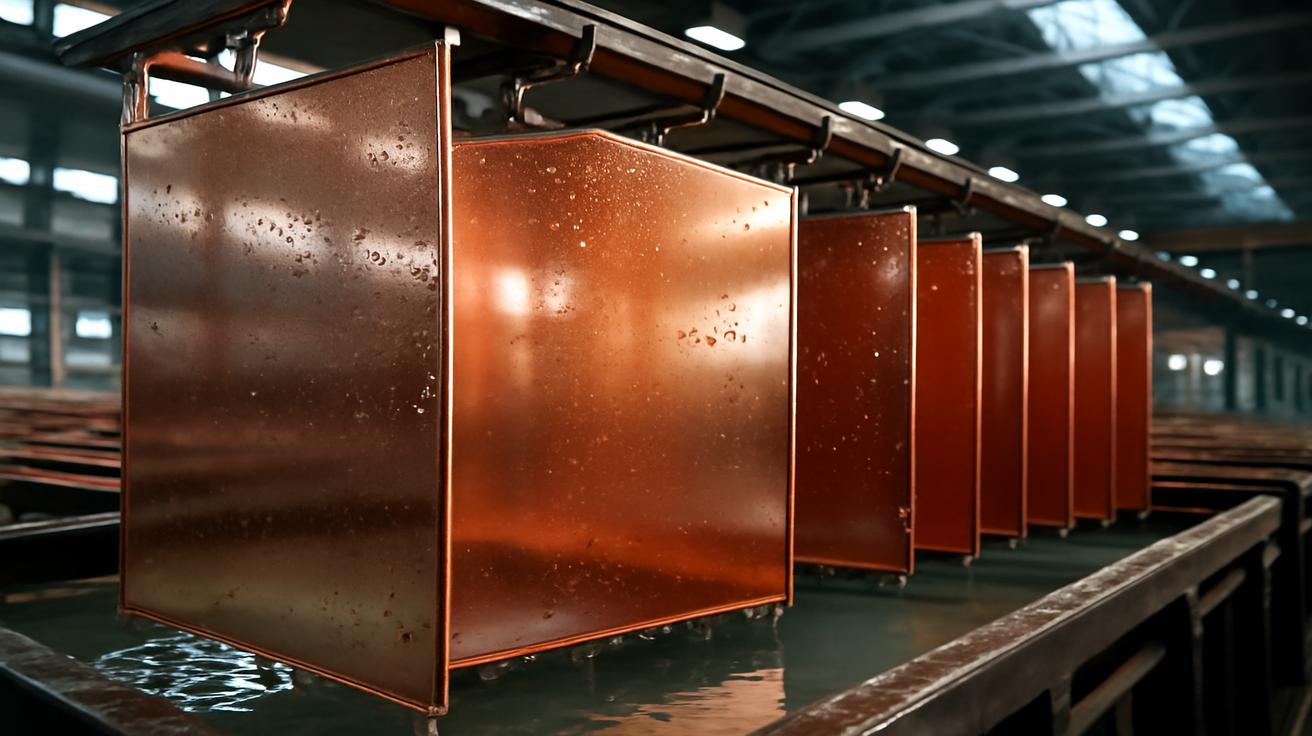
The man in the orange hard hat pauses, just for a second, on the catwalk that hangs above a sea of molten metal. Below him, a copper cathode the size of a door shimmers in the dim light, its surface rippling with heat, turning the color of dusk clouds as it cools. Forklifts whine, cranes swing, sparks flare, and somewhere in the distance a loudspeaker calls out instructions in Mandarin. This is not a rare earths plant in Inner Mongolia. This is a copper refinery on China’s coast, feeding the quiet hunger of the world’s green transition.
The Metal That Runs Beneath Everything
Copper has a way of hiding in plain sight. It threads through walls as wiring, lives inside smartphones, sleeps under roads in buried cables, and spins in the guts of wind turbines and electric vehicles. You rarely see it, but you are always touching its influence.
For decades, copper was the metal of plumbers, power lines, and heavy industry. Today, it has become something closer to a bloodstream for the energy transition. Electric vehicles use up to four times more copper than conventional cars. Offshore wind farms swallow up thousands of tons for cables and generators. Even the humble heat pump and solar inverter rely on copper’s easygoing talent for carrying electrons with minimal fuss.
That rising demand has sent the world scrambling for copper ore—from the high Andes of Chile and Peru to the open pits of the Democratic Republic of Congo and Zambia. Mining companies boast about new projects, governments worry about shortages, and investors talk of “the coming copper crunch.” But there is a quieter, less visible story unfolding further down the chain, where ore becomes something useful. It is here, in the smoky realm of smelters and refineries, that China has quietly become irresistible.
Not Just the Mines: The Power of the Middle
The headlines tend to linger on where metals are dug out of the ground. Chile produces the most copper ore. Peru, the DRC, and others follow. But ore is not what powers an EV or lights a city. What matters is refined copper—clean, consistent metal that manufacturers can trust to behave exactly the same every time it carries a current.
This step from rock to refined metal sounds simple enough: crush ore, smelt it into blister copper, refine it into high-purity cathodes, ship them to factories. In reality, it is a chain of energy-sucking, capital-intensive processes that demand expensive equipment, abundant electricity, and an army of engineers and technicians willing to work in heat, noise, and metallic dust.
That is where China stepped in—and not timidly, but with the full force of industrial ambition.
From Smelter to Superpower
Walk through the major copper-producing regions of the world and you will often see a pattern: the biggest mines do not always have the biggest refineries next door. Much of their concentrate—semi-processed copper ore—heads to ships. Those ships often head to one place.
Over the last two decades, China has built an enormous network of copper smelters and refineries along its coasts and river systems. Provinces like Jiangxi, Anhui, and Shandong have become industrial lungs, inhaling copper concentrate from Latin America and Africa and exhaling gleaming cathodes, wire, and semi-finished products.
The numbers tell the story with a kind of quiet brutality. While exact shares shift year to year, China now accounts for a huge slice of global copper smelting and refining capacity—often well over a third, and in some segments approaching half. In a world that is trying to electrify everything, that is not just dominance; it is leverage.
A Second Act After Rare Earths
For those who follow minerals, there is something déjà vu about this. The world has already watched China corner the market in rare earths—those obscure elements with sci-fi names that power magnets, lasers, and batteries. Western companies once pulled rare earth ore from Australian deserts and American mountains, then sent it to China for the dirty, technically tricky refining work. Over time, these countries lost their own refining capacity. Mines closed. Knowledge withered.
By the time policymakers noticed, China controlled the vast majority of global rare earth processing. When Beijing hinted at export restrictions during diplomatic spats, alarm bells rang in Tokyo, Brussels, and Washington. Suddenly, everyone understood that the world’s clean energy dreams could hinge on decisions made in a handful of Chinese provinces.
Copper is not a boutique metal like neodymium or dysprosium. It is industrial, massive, and politically louder. Mines are more widely distributed. The market is deeper and more liquid. Yet the pattern is hauntingly similar: once again, many countries have outsourced the “messy middle” of the supply chain to China, comforted by cheap costs and a steady flow of metal—until they start wondering what happens if that flow slows, or stops.
Why the World Let This Happen
On paper, it looks irrational. Why would Chile, Peru, or the United States allow so much refining muscle to accumulate somewhere else? Why not build refineries close to the mines, collect more value at home, and reduce dependence on foreign plants?
The answer is not a conspiracy; it is a slow-motion story of economics and politics. Copper refineries are expensive to build and painful to permit. They eat electricity, emit pollution, and require intricate infrastructure. Environmental standards in Europe and North America climbed. Local opposition stiffened. Investors grew wary of projects that might take a decade to approve and another decade to pay back.
China, by contrast, took a different gamble. It poured state-backed money into smelters and refineries, accepted the environmental burdens (at least at first), and built sprawling industrial parks where a refinery might sit beside a wire mill, which sits beside a motor plant. Each step fed the next, lowering costs and speeding up innovation. Over time, the world’s “rational” choices to slim down heavy industry meant that China became the place where things got processed.
| Stage in Copper Chain | Typical Location Before | Where China Now Dominates |
|---|---|---|
| Mining (ore extraction) | Chile, Peru, DRC, Zambia, USA | Limited, but growing overseas stakes |
| Concentrate smelting | Producers’ home countries, Japan, Europe | Large-scale smelters along Chinese coast |
| Refining to cathode | Distributed across industrial economies | China as the single largest hub |
| Manufacturing wire & components | Close to end-use factories globally | Deeply embedded in Chinese manufacturing clusters |
Inside the Refineries: Heat, Chemistry, and Leverage
To understand why this matters, you have to step inside one of those refineries, if only in your imagination. The air is thick with humidity and aerosolized acids. Rows of metal plates hang like laundry in long tanks of turquoise liquid—electrolyte solution where copper moves in silence from one plate to another, atom by atom.
Electricity hums through the system, stripping impurities and depositing pure copper onto starter sheets. Over days, they thicken into cathodes: heavy, reddish-brown sheets that are hoisted out, washed, and stacked. Somewhere in that building, a control room full of screens tracks current flows and temperatures, while outside a rail spur waits to carry away the finished product.
China’s edge here is not just the number of such facilities, but the ecosystem around them. Many refineries sit near ports, lowering shipping costs. The state has nudged power prices and financing terms in their favor. Over time, these operations drove down refining charges—the fees smelters and refiners collect for turning ore to metal—making it even harder for rival plants in higher-cost countries to compete.
The result is a subtle form of dependency. A mining company in South America may own the rocks. A battery factory in Europe or a cable maker in India may need the copper. But between them stands a bottleneck of capacity, a choke point located, very often, in China. If that refining capacity were to go offline, for economic, environmental, or geopolitical reasons, the system would shudder.
From Underground Mines to Above-Ground Risks
That risk is not just theoretical. In recent years, the language of minerals has shifted from “resources” to “security.” Governments now publish lists of “critical minerals,” build stockpiles, and talk about “friend-shoring” and “de-risking.” Yet the focus still lands heavily on mines—on where new deposits might be found or how quickly new pits can be permitted.
But refining is where timelines stretch and costs snowball. You can announce a new mine and still find yourself stuck a decade later in regulatory purgatory. Refineries are no easier; in many communities they are politically even more toxic. Meanwhile, China already has the facilities, the workforce, and the know-how. It has not just metal underground, but capacity above ground—and in the world of industrial power, that can be just as strategic.
Copper in a Fragmented World
Now layer geopolitics on top of this industrial landscape. Relations between China and many Western countries are strained. Sanctions, export controls, and tariff threats swirl through the news cycle. Each side quietly maps its vulnerabilities: microchips, pharmaceutical precursors, rare earths—and increasingly, the refined metals necessary for the energy transition.
Imagine a future where diplomatic tensions spike, and copper becomes an unspoken bargaining chip. Export inspections slow. Quotas appear. Domestic demand in China surges as it accelerates its own grid build-out and electric vehicle boom, leaving fewer tons available for export. Prices jump. Projects in faraway countries that depend on affordable copper—from offshore wind farms in Europe to new transmission lines in India—suddenly look far more expensive.
Even without overt restrictions, concentration carries risk. A pandemic, a power crunch, or an environmental clampdown on Chinese refineries could ripple through the copper market. A storm in one country could darken cities half a world away.
Can the World Catch Up?
Recognizing the problem is one thing; unwinding it is quite another. Building new copper smelters and refineries outside China requires patience, money, political will, and an honest conversation about trade-offs. Cleaner technologies are emerging—more efficient furnaces, lower-emission processes, smarter waste handling—but they demand upfront investment and social acceptance.
Some countries are starting to act. In Latin America, there is renewed talk of adding more local smelting and refining, not just shipping raw concentrate. In North America and Europe, policymakers are exploring incentives for “midstream” projects, trying to revive industrial skills that have withered. India, Indonesia, and others see an opportunity to carve out a role in this part of the value chain, hosting new plants that serve both domestic and export markets.
None of this will dislodge China overnight. It took decades to build its current position; it will take decades to balance it. But the alternative is to drift further into a world where the energy transition—a project sold as a path to resilience and independence—rests on refining capacity concentrated in one country.
Beyond Numbers: The Human and Environmental Cost
There is another layer to this story that rarely appears in market reports: the people and landscapes that bear the brunt of refining’s dirty work. For years, China’s refining boom left a trail of smoggy skies, contaminated water, and toxic tailings. Some communities near smelters paid for the world’s cheap copper with compromised health and damaged ecosystems.
In recent years, China has tightened environmental rules. Older, dirtier facilities have been closed or upgraded. Emissions controls have improved. But the legacy pollution is still there in soil and rivers, and the fundamental reality remains: turning ore into pure metal is a messy business. If other countries want more refining on their own soil, they will have to wrestle with similar tensions—how to protect air and water while building the hardware of a green future.
In that sense, global dependence on China’s refining is not just about geopolitics; it is also about a kind of moral outsourcing. Wealthier consumer markets have been happy to import the clean end products—phones, cars, turbine parts—while another country shoulders the dirtiest stages of production. Bringing that work home, or at least diversifying where it happens, means facing up to the hidden costs of our electrified lives.
The Copper Thread in Your Pocket
Take your phone out of your pocket for a moment. Slide your finger along the cool glass, feel the weight in your hand. Inside, a hidden network of copper traces, almost like the branching of a tree, routes signals and power. That copper was once a rock, crushed and smelted, bathed in acids and electricity, turned into wire so fine it vanishes to the naked eye.
Follow that thread backward. There is a decent chance that at some point—whether as concentrate in a ship’s hold or as an anode plate hanging in a tank—it passed through China. The same is true for the copper in your laptop charger, in the transformers that guard your street corners, in the wind farm you drive past on the highway, and the EV you might be saving up to buy. Copper is the quiet infrastructure of the modern world, and more often than not, China has had its hands on it.
Rewriting the Story of Copper
The story of copper has usually been told as a tale of geology: where the richest deposits sit, how deep, how costly to bring to the surface. But the age of energy transition demands a different lens. The decisive battles are no longer only at the mine mouth; they unfold in ports, smelters, refineries, and the policy rooms where governments decide what kind of industrial base they are willing to live with.
China does not just dominate rare earths; it has woven itself into the center of the copper story with the same patience and intensity. It has turned the “boring” middle stages of the supply chain into a source of quiet power. That power is not absolute—markets are fluid, new players can emerge, technologies change—but it is real, and it will shape the pace and cost of the global green transition.
The question now is whether the rest of the world is content to let that story continue on the same trajectory, or whether it will invest, negotiate, and experiment its way toward something more balanced. That means reimagining copper not simply as a commodity, but as a strategic artery; not just a price on a screen, but a network of furnaces, tanks, ships, and people whose choices will determine how—and how quickly—we build the future we keep promising ourselves.
Somewhere, in a refinery half a world away, another copper cathode is cooling, its surface turning from orange to deep, familiar red. It will be cut, shipped, rolled, drawn into wire, bent into coils, hidden in machines. You will never see it. But the path it took to reach you is one of the defining stories of our era, running, quietly, through China’s refineries and straight into the circuitry of the twenty-first century.
Frequently Asked Questions
Why is copper refining so important compared to mining?
Mining produces ore and concentrate, but manufacturers need high-purity refined copper to make wiring, motors, and components. Refining is where value, reliability, and consistency are created, and it is often the main bottleneck in the supply chain.
How much of the world’s copper refining does China handle?
The exact share varies by year and by whether you count smelting or final refining, but China is by far the single largest player, handling a substantial portion of global smelting and refining capacity—often exceeding a third and, in some segments, approaching half.
Is copper as strategically important as rare earths?
Yes, but in a different way. Copper is more common and used in far greater volumes. It is foundational to electricity, EVs, renewable energy, and digital infrastructure. While it does not grab headlines like rare earths, disruptions in copper refining would have broad, immediate impacts.
Can other countries realistically build their own copper refineries?
They can, but it takes time, capital, political support, and environmental approvals. Some countries are starting to invest in new smelting and refining capacity, but catching up with China’s scale and ecosystem will be a long-term project, not a quick fix.
What does this mean for the energy transition and green technologies?
Because green technologies are copper-intensive, dependence on a concentrated refining base adds risk. Price spikes or supply disruptions could slow grid upgrades, EV rollouts, and renewable energy projects. Diversifying refining capacity is increasingly seen as part of making the energy transition more resilient.