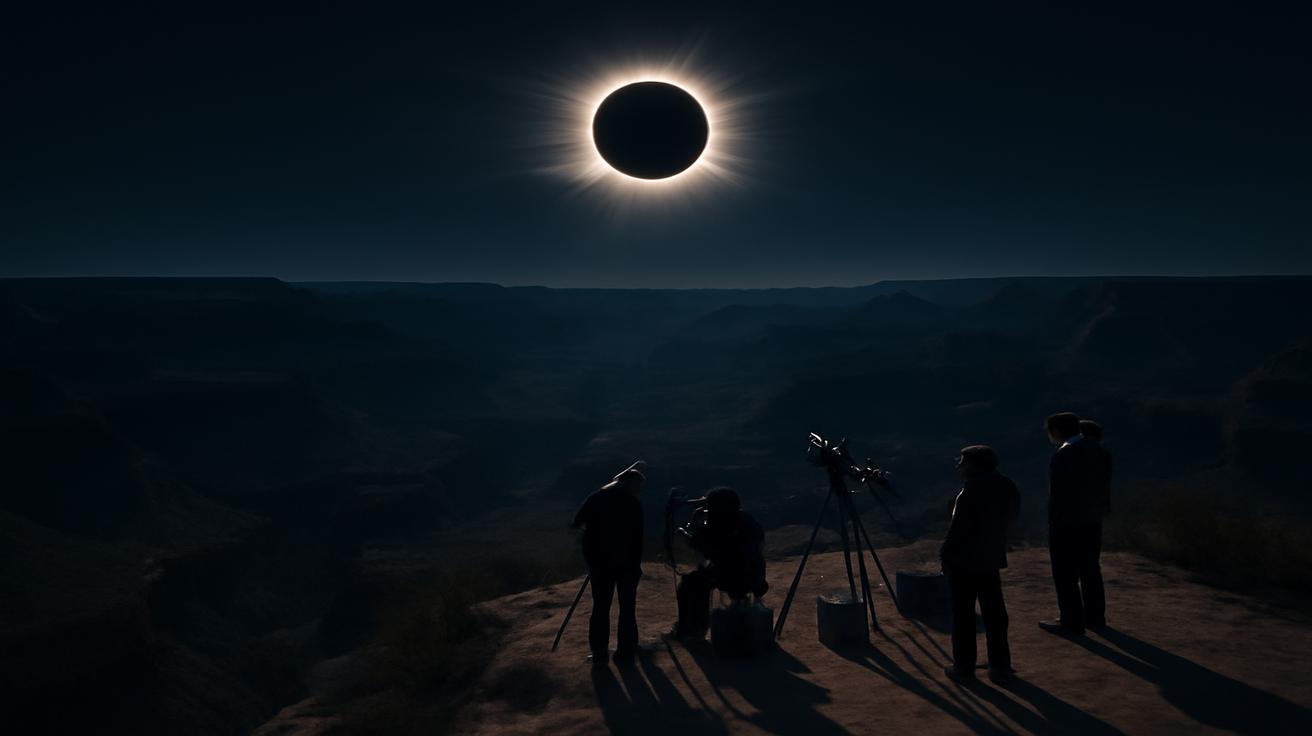
The first time you see day turn to night in the middle of the afternoon, it does something to you that’s hard to explain. Birds go quiet, the air cools, the color drains from the world as if some unseen hand has turned down a cosmic dimmer switch. For a breathless moment, you’re standing under a different sky—black as velvet, rimmed with a ghostly halo of the Sun’s hidden fire. Now imagine that moment not lasting just a fleeting couple of minutes, but stretching on and on for almost six. Six full minutes of daytime darkness. Six minutes to feel the Earth tilt underneath your feet. Six minutes to realize, in your bones, that you live on a small, moving rock under a clockwork sky. That’s what astronomers are already calling the “eclipse of the century.” And it’s coming.
What Makes This Eclipse So Extraordinary?
Total solar eclipses aren’t rare in the grand scheme of things. Somewhere on Earth, one happens roughly every 18 months. But for any given place, they are rare jewels—returning only once every few centuries, if that. Even among eclipses, this one stands apart. It will offer a potential maximum of about six minutes of totality—an unusually long span of time when the Sun is completely covered by the Moon.
To understand why that’s a big deal, you have to think about the cosmic geometry involved. A total solar eclipse happens when three things line up perfectly: the Sun, the Moon, and Earth. The Moon’s shadow sweeps across our planet in a narrow path, often only a couple of hundred kilometers wide. If you’re inside that path—known as the path of totality—the Moon appears just large enough in the sky to completely cover the Sun, plunging the world into a strange imitation of twilight.
But here’s the catch: usually, this “totality” lasts only two to three minutes at most. The Moon is constantly moving in its orbit, and Earth is turning beneath it, so the shadow doesn’t linger long over any one place. To stretch totality past five minutes, a delicate set of circumstances has to fall into place. The Earth must be near its farthest point from the Sun (making the Sun look slightly smaller), and the Moon needs to be near its closest point to Earth (making it look slightly bigger). The alignment must also be nearly perfectly centered.
When all of this happens together, we get what’s known as a “long-duration” total solar eclipse. They’re the marathoners of the eclipse world—and they’re rare. The upcoming one, forecast to offer roughly six minutes of totality at its peak, is expected to be one of the longest of the 21st century. For many people alive today, it will be their only chance to stand under a total eclipse this long.
When It Will Happen: The Date Astronomers Are Watching
Eclipses are among the most precisely predictable events in nature. Using centuries-old cycles and modern orbital data, astronomers can tell you not only the year and the day, but the second when the Moon’s umbral shadow first touches Earth’s surface—and when it departs.
The “eclipse of the century,” as many skywatchers have nicknamed it, will occur in the middle of the 21st century, during a time when our understanding of the Sun and its influence on Earth’s climate will matter more than ever. It will unfold over a few precious hours as the Moon’s shadow races across oceans and continents, but the heart of the event—the core of darkness known as totality—will last up to six minutes for observers near the center of the path.
If you’ve seen recent eclipses that offered one, two, or three minutes of totality, imagine doubling that time. Imagine not just a gasp and a shout as the Sun’s last sliver disappears, but an extended, deep silence. Enough time to watch the solar corona—those delicate, feathery white streamers of plasma—shift and ripple. Enough time to notice stars and planets popping out, to feel the temperature slide downward, to really look around you and see how the living world responds to a false night.
You will want to mark this on your calendar far in advance. Future eclipses are like appointments with the universe; the date doesn’t budge, and it will keep coming whether we are ready for it or not. By the time the century’s longest eclipse arrives, people will have been talking about it for years. Communities along the path will have prepared festivals, science outreach events, and viewing parties. Hotels will have been booked. Yet the very best preparations might be much simpler: a safe pair of eclipse glasses, a modest telescope or camera if you’re inclined, and the time and willingness to look up.
The Best Places to Watch: Chasing the Path of Totality
Every total solar eclipse carves a unique track across Earth, a narrow ribbon where day briefly becomes night. Outside that ribbon, you’ll still see a partial eclipse—interesting, but not the same thing. Partial eclipses never bring on the hush of darkness, the sudden appearance of stars, the surreal 360-degree sunset that wraps around the horizon. For that, you have to stand in the path of totality.
For the “eclipse of the century,” the Moon’s shadow will cross a swath of the globe that includes ocean, islands, and densely populated land. Along its route, some locations will get just a taste of totality—two or three minutes—while a smaller stretch near the geometric sweet spot will be treated to nearly six minutes of perfect alignment.
In practical terms, the “best” place to watch depends on a few key factors: likely weather, accessibility, safety, and your own sense of adventure. Some eclipse chasers will head to remote coasts, where weather patterns historically favor clear skies. Others will prefer bustling cities or smaller towns within the path, pairing the cosmic spectacle with culture, food, and community events. A few will book cabins, campgrounds, or house rentals years in advance, staking their claim near the zone of maximum totality.
There is also the option of mobility. Many modern eclipse travelers adopt a strategy of flexibility: they arrive in the general region days early, study the forecast, then drive or ride a few hours the night before or the morning of the event to find clearer skies. Because the path typically spans thousands of kilometers, a shift of only 50–100 kilometers can mean the difference between seeing the Sun’s corona blazing against a dark sky—and staring up at a solid sheet of clouds.
How Long Will It Be Dark Where You Are?
While the maximum duration of totality may reach roughly six minutes near the midpoint of the path, most locations will experience somewhat less. People nearer the edges of the path may get only a minute or two. That’s still extraordinary—but if you’re able, it’s worth positioning yourself closer to the centerline, where the Moon’s shadow lingers longest.
To give a sense of how totality changes across the path, imagine a journey along that centerline. At one end, as the shadow first touches land, you might see totality lasting around three and a half minutes. Hundreds of kilometers later, the duration might stretch to four and a half, then five, then climbing toward that magical six-minute window as you approach the heart of the eclipse. Beyond the midpoint, the duration gently tapers again as the geometry shifts and the alignment becomes less central.
Here is a simplified example of what different observers along the path might experience:
| Region (Example) | Approx. Totality Duration | Viewing Notes |
|---|---|---|
| Coastal Area Near Path Entry | 3–4 minutes | Good for dramatic sunrise or low-Sun eclipse views. |
| Large Inland City on Centerline | 4–5 minutes | Easy access, strong community events, more light pollution during totality. |
| Rural Heart of Path | 5–6 minutes | Darker skies, quieter atmosphere, ideal for stargazing during totality. |
| Mountain Region Along Path | 4–5 minutes | Unique landscapes and temperature drops, but weather can be less predictable. |
| Coastal Area Near Path Exit | 2–3 minutes | Possibility of sunset eclipse as shadow departs. |
The exact locations and durations will depend on the final, precise path calculations, but this gives a sense of what’s at stake. Moving yourself only a small distance toward the centerline can add precious seconds—or even a full extra minute—of totality.
What It Will Feel Like: Six Minutes Under a Different Sky
If you’ve never seen a total solar eclipse, it’s easy to underestimate how strange it feels. The event unfolds in stages. The first contact is subtle: the Moon begins to nibble away at the Sun’s bright disk. With proper eclipse glasses, you’ll notice a small dark notch. Over the next hour or so, that notch grows. The world doesn’t change much at first. People continue talking. Cars drive by. Life goes on.
Then, somewhere around 80–90 percent coverage, the light starts to feel wrong. Not dimmer at first—just different, like a filter has been laid across the day. Colors become flatter, shadows sharpen, and your body may register a slight chill as the Sun’s warmth ebbs. Animals notice. Birds cut their songs short and drift toward roosts. Flowers that track the Sun may begin to close.
In the final minute before totality, the tension in the air is almost electric. The landscape is dipped in a heavy twilight. If you’re watching carefully, you may see crescent-shaped sun images in the shadows under trees. On the horizon, in every direction, the sky takes on the golden-pink hue of a permanent sunset. The last beads of sunlight sparkle along the Moon’s jagged limb—a phenomenon called Baily’s beads—before collapsing into a single radiance, the famed diamond ring.
And then—darkness. The world drops into a soft, unreal night. The Sun’s corona, invisible on ordinary days, explodes into view as a delicate, white crown spread across the black sky. Planets become visible: perhaps brilliant Venus, ruddy Mars, or even Jupiter depending on where they lie in the sky that day. Stars flicker into existence around the eclipsed Sun, forming an unfamiliar daytime constellation.
In a typical eclipse, this moment rushes by in a breathless two minutes. You might find yourself gasping, glancing between the sky and your surroundings in a frantic attempt to take everything in. With nearly six minutes, something different happens. After the initial shock, your sense of time begins to stretch. You can breathe, really stare into the corona (with your naked eyes; during totality only, it’s safe) and pick out its structures—long streamers, looping arcs, delicate feathering. You can scan the horizon and see that band of sunset color all the way around you. You can listen to the sound of your own heartbeat, to the quiet murmur or wild cheering of the people around you.
It feels as though the universe has paused on one astonishing frame. And just when you begin to believe you could live in this strange twilight forever, a new spark flares along the rim of the Moon. The diamond ring returns. Daylight begins to flow back, and the spell breaks. In reverse, the world wakes up. Birds resume their calls, as if deciding the false night is over. People laugh, cry, hug, or just stare upward as the last traces of the cosmic alignment unwind.
Preparing for the Big Day: Safety, Planning, and Weather
Despite the drama, total solar eclipses are gentle on everything—except your eyesight if you’re careless. The single most important rule is simple: never look directly at the Sun without proper eye protection, except during the brief phase of totality when the Sun is completely covered.
For every instant before and after totality, when even a thin crescent of the Sun is exposed, you must use certified eclipse glasses or a proper solar filter for telescopes and binoculars. Ordinary sunglasses are not safe. If you’re photographing the event, your camera sensor needs protection too, with a solar filter over the lens during all partial phases. Once totality begins, you can remove your glasses and filters and look directly at the eclipsed Sun. The moment you see the first reappearance of bright sunlight, the glasses must go back on.
Planning also means thinking ahead about where you will be and how you’ll get there. The “eclipse of the century” will draw crowds. Expect busy highways, packed trains, and sold-out lodging across the path. If you prefer solitude, look for smaller communities or rural regions inside the totality zone and book early. If you thrive on shared wonder, consider a city or town hosting public viewing events and gatherings.
Weather can make or break the experience, so flexibility is a powerful ally. In the days before the eclipse, watch regional forecasts closely. Having a car, bus route, or train option that allows you to move 50–200 kilometers along the path can dramatically increase your odds of finding a hole in the clouds. Keep your kit simple enough that you can pack quickly and relocate if needed: glasses, a small chair or blanket, water, snacks, warm layers (it can feel surprisingly cool during totality), and whatever camera or binoculars you’re comfortable using.
Finally, consider how you want to balance recording and experiencing. It’s tempting to spend the entire event fiddling with camera settings. But more than anything, this is a moment to be present for. Many seasoned eclipse chasers recommend taking a few photos, then deliberately putting the devices down for at least part of totality to soak in the sensation of standing on a turning planet under a transforming sky.
Why This Eclipse Will Be Remembered
Centuries from now, people will look back at eclipse records from our era the way we read accounts from ancient Babylon or medieval China. They’ll see patterns, calculations, and cold data—but also human reactions. Even today, we have clay tablets describing strange daytime darkness, European chronicles of “the Sun being eaten,” and early scientific notes marveling at the corona’s ghostly light.
The longest eclipses tend to anchor themselves in those records. They are the ones people write about, paint, and tell stories of well into old age. A six-minute totality is long enough to leave a deep impression even on those who didn’t expect to care. Children who see it will reach old age still able to recall that single, perfect pocket of darkness. Adults will remember where they stood, who they were with, and what the air felt like on their skin when a star went out above their heads.
There is a quiet lesson hidden in these experiences. The Sun, the Moon, and Earth know this dance so well they have been performing it for billions of years. We, by contrast, flicker in and out of existence with the fragile brevity of mayflies by comparison. To witness such a meticulous alignment, to know it has been calculated across centuries and that it will not repeat in the same way in your lifetime, is to feel both small and rooted. You are here, alive, on this one day when the sky changes.
When the “eclipse of the century” finally arrives, millions of eyes will turn upward. Some will be on balconies in crowded cities, others on windswept hills or quiet beaches. The Moon’s shadow will sweep over oceans, land, fields, skyscrapers, forests, and rooftops, not pausing for anyone but touching everyone who stands beneath it with the same impossible, shared twilight.
Six minutes of darkness in the middle of the day. It will pass quickly, of course—the universe doesn’t linger. But for those who step into its path, it may stretch into a lifetime of memory.
Frequently Asked Questions
How often do long total solar eclipses like this occur?
Long-duration total solar eclipses, with totality approaching or exceeding six minutes, are quite rare. While total eclipses happen roughly every 18 months somewhere on Earth, only a small fraction last longer than five minutes. For any single location, such an event may not repeat for many centuries.
Is it safe to look at the eclipse during totality?
Yes, but only during the brief window when the Sun is completely covered by the Moon. During totality, you can safely look at the eclipsed Sun with your naked eyes and see the corona. Before and after totality, when any part of the Sun is visible, you must use proper eclipse glasses or solar filters.
Why is the path of totality so narrow?
The Moon’s central, darkest shadow—the umbra—is smaller than Earth, so it only covers a narrow strip as it sweeps across the surface. Outside that strip, observers are in the Moon’s lighter shadow, the penumbra, and see only a partial eclipse.
What if it’s cloudy where I am on eclipse day?
Clouds can block the direct view of the Sun, but you may still notice the eerie dimming and change in light during totality. To improve your chances of a clear view, consider being mobile: monitor forecasts, and be prepared to travel along the path of totality the day before or the morning of the eclipse to find clearer skies.
Do I need special equipment to enjoy the eclipse?
You only truly need one thing: certified eclipse glasses for the partial phases. Beyond that, binoculars with a proper solar filter, a simple camera, or a small telescope can enhance the experience, but they’re not necessary. Many people find that watching with the naked eye during totality is the most powerful way to experience the event.