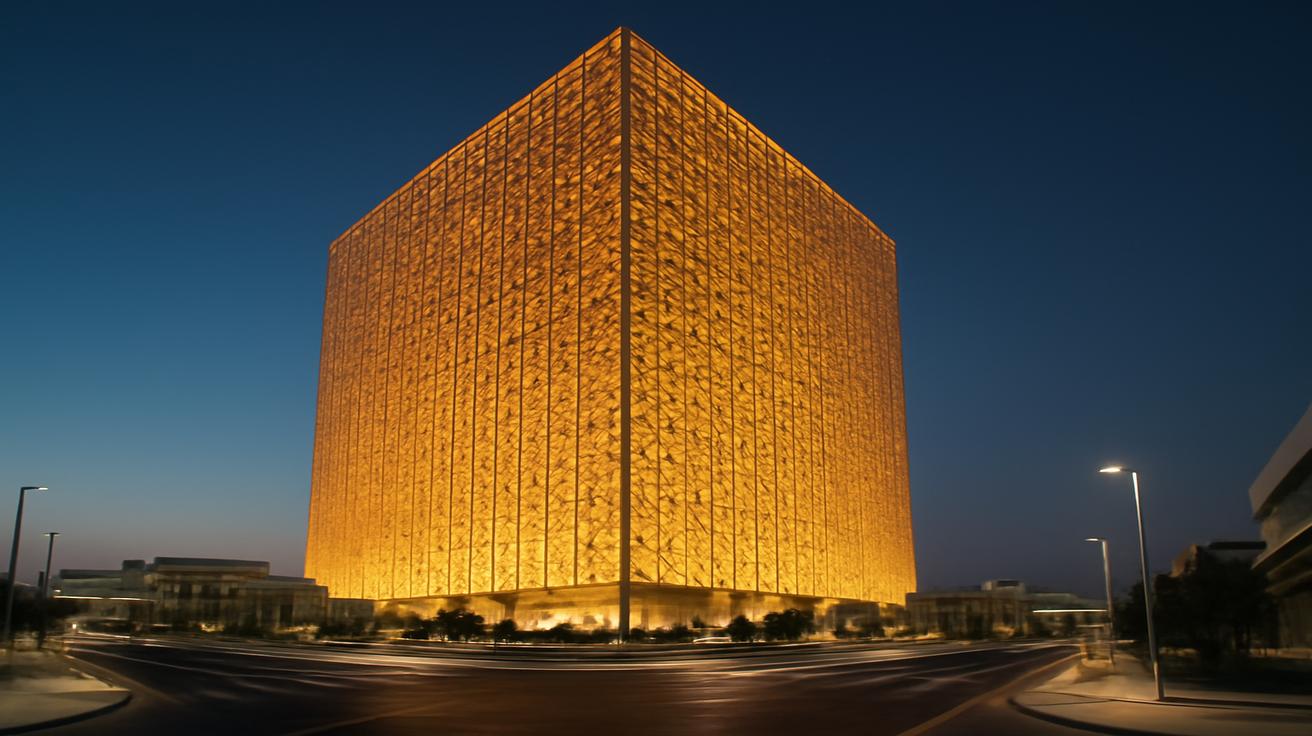
The desert is quietest just before dawn. A thin blue band clings to the horizon, and for a brief, trembling moment, the world feels empty and endless. Then the first call to prayer drifts across the sand, cranes begin to groan awake in the distance, and somewhere on the outskirts of Jeddah, men and machines turn their eyes upward toward something almost impossible: a tower that will try to touch a kilometer of sky.
The Day the Sky Got a New Ceiling
Forget the Burj Khalifa’s gleaming spear and Shanghai Tower’s graceful twist for a second. Picture instead a hazy, clay-colored sky over the Red Sea coast. It’s hot, but not yet hellishly so, and the wind carries the smell of dust, diesel, and distant saltwater. Off a new highway that didn’t exist a decade ago, a forest of cranes marks the outline of ambition itself: a structure that, if completed as planned, will become the first human-made building to break the one-kilometer mark.
This is the Jeddah Tower—once called Kingdom Tower—Saudi Arabia’s entry in an unspoken race to redraw the skyline of human possibility. For years it has existed in a kind of architectural limbo, part myth, part concrete skeleton climbing out of the desert. Its story is tangled with oil money, political shifts, global pandemics, and a nation trying to reinvent its future. Yet every time the project stirs back to life, one question hums beneath the surface: how tall is too tall?
To stand anywhere near its footprint is to feel strangely small. The foundations are thick with steel and concrete, dug so deep they almost seem to anchor into geological time itself. Dust clings to boots, and the heat radiates off every surface, but above all that—above the hum of generators and the chatter of workers—there is this overwhelming sense of vertical intent. Humans, once awed by mountains and minarets, are now trying to carve a peak of their own straight out of the sky.
The New Hierarchy of Height
It helps to understand just how radical a one-kilometer tower really is. The Burj Khalifa in Dubai, which has reigned as the world’s tallest building since 2010, stands at 828 meters. Shanghai Tower hovers at 632 meters, its spiraling glass skin twisting through the clouds of Pudong. By comparison, the Jeddah Tower’s proposed height—about 1,000 meters—isn’t just a bit taller; it’s a category shift, a new rung in the ladder of height that didn’t previously exist.
These are not gentle increments. Every extra meter at that scale carries an exponential cost in engineering complexity, structural reinforcement, and environmental adaptation. Wind alone becomes a merciless sculptor. At such altitudes, gusts cease to be mere weather and start to behave like a continuous, invisible earthquake, pressuring glass and steel in ways that earlier generations of builders couldn’t have imagined.
For a sense of where this new giant fits in, consider the existing titans of the sky:
| Building | City / Country | Approx. Height | Floors | Completion |
|---|---|---|---|---|
| Burj Khalifa | Dubai, UAE | 828 m | 163 | 2010 |
| Shanghai Tower | Shanghai, China | 632 m | 128 | 2015 |
| Makkah Royal Clock Tower | Mecca, Saudi Arabia | 601 m | 120 | 2012 |
| Jeddah Tower (planned) | Jeddah, Saudi Arabia | ~1,000 m | 170+ (projected) | Under construction |
On a phone screen, those numbers might seem neat and tidy—another trivia table to scroll past. But if you were to stand at the base of what one kilometer actually means and tilt your head all the way back, your neck would protest before your eyes found the top. The tower would disappear into heat haze and, on certain days, into the soft-edged blur of clouds.
Drawing a Needle in the Desert
There’s a moment, driving the new arterial roads outside Jeddah, when the city’s low sprawl gives way to this abrupt pocket of the future. Billboards show sleek renderings: a crystalline spire rising from a carefully gridded landscape of boulevards, parks, and reflective pools. The marketing language is lush—“vision,” “gateway,” “future”—but under it lies something more visceral: a desire to be seen from very, very far away.
Saudi Arabia is in the middle of a transformation that is part economic pivot, part cultural reboot, and part architectural theater. Oil, the country’s long-standing lifeblood, still flows, but there is an urgent need to diversify before the wells of global demand start to run dry. The answer, at least in part, has been to turn toward tourism, finance, and spectacle-level urbanism: new megaprojects along the Red Sea, futuristic cities etched into desert canyons, and now a needle of glass and steel that will proclaim, in no uncertain terms, that Saudi Arabia is done playing small.
The Jeddah Tower is envisioned as the anchor of a broader development called Jeddah Economic City, a kind of glossy urban experiment stitched onto the existing fabric of the port metropolis. Offices, hotels, luxury apartments, retail districts—they’re all meant to cluster around the tower like ships around a lighthouse. Its presence is designed to be psychological as much as practical: a fixed point in the sky that says, “This is where things are happening now.”
Yet this is not just about ego, though ego is undeniably in the mix. It’s also about repositioning a nation’s narrative. For decades, global conversations about Saudi Arabia have circled oil fields and geopolitics. A kilometer-tall skyscraper—audacious, fragile, dazzling—offers a different storyline: innovation, engineering, world records, architectural daring. It is hard to dominate the global imagination with pipelines and refineries; a glass mountain in the sky is another thing entirely.
Engineering in Thin Air
To build in the desert is to wrestle with extremes. Heat that can warp metal and cook electronics. Sand that infiltrates machinery like a slow, relentless rust. Winds that come barreling in from the Red Sea, gathering speed over open water before slamming into anything foolish enough to stand tall in their path. To build a house here takes care. To build a one-kilometer tower demands obsession.
The tower’s design, pieced together by an international team of architects and engineers, leans into a triangular, tapering form—like a desert plant, broad at the base and narrowing as it rises. This shape is not only aesthetic; it’s a shield against wind. The narrowing tiers scatter vortices, softening the invisible hands that would otherwise push and twist at its upper reaches.
The foundation disappears deep into the earth, a lattice of reinforced concrete piles drilled into bedrock to resist not just standard vertical loads, but the immense lateral forces of wind. Above, the core—essentially the tower’s spine—is a thickened shaft designed to bear both structural and mechanical weight: elevators, emergency systems, vertical circulation, and the endless arteries of wiring and plumbing that make any skyscraper feel alive.
Then there’s the simple, maddening question of getting people up and down. Elevators become vertical trains at this scale, with speed limits not just set by machinery but by the human body. Go too fast and ears pop, stomachs lurch, and the daily commute becomes a fairground ride. To avoid that, designers juggle multiple elevator zones, sky lobbies, and transfer points—little horizontal neighborhoods suspended hundreds of meters above the sand.
At a certain height, even maintenance turns surreal. Cleaning windows means operating in high-altitude winds. Replacing glass, fixing external lights, checking façade panels—these jobs will eventually fall to people whose daily office will be the open air a half-mile above the nearest sidewalk. What feels like science fiction from the ground will, for them, just be Tuesday.
Life at the Edge of the Sky
Stand in the imagined lobby of the finished Jeddah Tower and you can almost feel the temperature shift. Outside: blistering sun, the glare of asphalt, the bright chaos of traffic and construction. Inside: cool marble, filtered light, and the hush that only thick glass and thick money can buy. Somewhere a fountain murmurs. Elevators blink patiently. A screen loops rendered images of what’s waiting somewhere high above the clouds.
The tower is meant to be more than a view platform on steroids. According to its grand vision, it’s a vertical city: offices on intermediate floors, luxury residences stacked toward the upper third, a five-star hotel, observation decks, restaurants, maybe even sky gardens where a carefully controlled oasis of green will sip recycled water and hum under grow lights. On the clearest days, the Red Sea will slice the horizon with a blue so sharp it almost looks artificial.
There’s a particular kind of stillness you find in very tall buildings, especially away from the elevator banks. The air feels a bit thinner, even when the HVAC system is silently doing its best to pretend the atmosphere hasn’t changed. Sound doesn’t carry the same. Cars disappear into abstract streams of light. Waves on the shore become vague, shivering bands of movement rather than individual crests. At a kilometer up, the human world shrinks into a relief map: textured, intricate, but distant. You are both inside the city and completely removed from it.
It’s easy to romanticize that distance as pure luxury. But the higher you go, the more dependent you become on systems you can’t see: pumps and filters, power grids and backup generators, emergency procedures, security protocols. In a structure this tall, resilience isn’t a buzzword. It’s survival. Engineers must plan for fire, flood, sandstorms, power outages, even the mundane frustrations of a jammed elevator or a faulty smoke sensor—multiplied by several hundred meters of height.
People who end up living here may develop an intimacy with altitude in the same way villagers know their hills and fishermen know the moods of the tide. They will learn how the light changes at their floor level from month to month, how certain winds rattle the windows just so, how the city’s noise reaches them differently on humid nights. The building may be an icon to outsiders; for its inhabitants, it will be a living, groaning, humming companion.
The Cost of Reaching Higher
There’s a quieter conversation that murmurs underneath all the excitement about record-breaking towers: why keep going taller at all? At a time when much of the world is grappling with climate change, rising sea levels, and questions of sustainability, what does it mean to pour millions of tons of concrete and steel into a single vertical gesture?
Super-tall buildings are expensive not just in money, but in carbon. Cement production alone is a major contributor to global emissions, and long glass façades in a hot climate demand energy-hungry cooling systems. Even with efficiency measures, smart façades, and renewable-energy integrations, a kilometer-tall skyscraper will always struggle with its footprint. It is, by definition, a concentration of resources.
Supporters argue that density is, in itself, a greenish idea: building upward can reduce urban sprawl, concentrate infrastructure, and create walkable, transit-friendly environments below. If people live and work in the same vertical cluster, they may drive less. If the surrounding district is built with thoughtful shading, green spaces, and public transport, the tower can serve as a catalyst for more sustainable patterns of life.
Critics counter that such projects often end up as islands of privilege, more symbol than solution. The risk is a kind of vertical segregation—a gilded altitude for the few, watched from below by many who will never cross the threshold. In that reading, the kilometer mark becomes less a triumph of humanity and more a mirror of inequality, reflecting the gap between those who can buy the view and those who only ever see the silhouette.
The desert has its own long memory of grand constructions. From ancient trade routes to pilgrimage roads, from fortresses to caravanserais, this region has always hosted structures that tried to anchor human presence in a harsh landscape. The question hanging over this new spire is whether it will be remembered as a turning point toward a more diverse, sustainable future—or as an extravagant monument to a moment of surplus.
What Happens When We Touch the Clouds?
Late in the day, when the sun begins to relax and the air cools from furnace to oven, the construction site takes on a different mood. Shadows lengthen. The skeletal outline of the rising tower—still a work in progress, draped in scaffolding and temporary platforms—catches the low light. It glows faintly, not yet the polished crystal promised in the renderings, but something rougher and somehow more honest: a work of human hands, straining upward.
In those moments, when cables swing gently and the clatter of tools slows, it’s possible to stand at the edge of the site and imagine the future. A finished tower, its tip piercing a thin layer of cloud. Tourists queuing for the observation deck, pressing their faces to glass and trying to make sense of the miniature city below. Office workers sending emails from desks seventy stories above sea level, barely thinking about the gulf of air beneath their feet. A family padding barefoot across polished floors in an apartment suspended almost half a mile up, their windows framing sunsets that seem to set the whole sky on fire.
But it’s also possible—necessary, even—to imagine something more subtle. Workers heading home to neighborhoods farther inland, their faces and clothes dusty, their muscles sore from another day building someone else’s view. The desert wind steady as ever, indifferent to human scale. The Red Sea breathing in slow tides, as it has done for millennia, long before the idea of a skyscraper existed and long after, perhaps, these towers will have had their time.
Reaching for the sky has always been part of our nature. From cathedral spires to radio masts, lighthouses to rocket launch pads, we’ve used height to speak to the divine, to send signals, to see further, to declare our presence. The Jeddah Tower is the latest, and perhaps boldest, entry in that lineage: not just a building, but a statement, a bet that the future will reward those who rise fastest and highest.
Standing there, with grit under your nails and the sun sinking behind cranes that look almost delicate against the last orange band of daylight, you might wonder whether there’s a limit—an invisible line where ambition should pause and ask itself why. Maybe one kilometer is that line. Maybe it’s just another stepping stone and, years from now, people will gaze up at some even taller marvel and shrug at how small the Jeddah Tower now looks.
For now, though, it is enough to know that somewhere in Saudi Arabia, as the desert cools each night, there is a place where humanity is quietly redrawing the ceiling of its world. The cranes will swing again in the morning. Concrete will pour, steel will rise, and day by day, meter by meter, a new peak will push its way into the sky, daring us all to decide what we think of a world where a thousand meters of vertical is not a fantasy, but an address.
Frequently Asked Questions
What is the Jeddah Tower, and how tall will it be?
The Jeddah Tower is a planned skyscraper in Jeddah, Saudi Arabia, designed to be the first building in the world to reach approximately one kilometer in height. When completed, it is expected to surpass the Burj Khalifa in Dubai by more than 150 meters.
Why is Saudi Arabia building such a tall skyscraper?
The tower is part of Saudi Arabia’s broader push to diversify its economy beyond oil, attract investment and tourism, and position itself as a global hub. As the centerpiece of Jeddah Economic City, it is intended to signal innovation, ambition, and a new national narrative focused on modern urban development.
How does Jeddah Tower compare to Burj Khalifa and Shanghai Tower?
Burj Khalifa stands at 828 meters, and Shanghai Tower at 632 meters. Jeddah Tower is planned to reach roughly 1,000 meters, creating a new height category. Structurally, it uses a tapered, triangular form to handle desert winds, and it will likely have more than 170 floors, combining offices, residences, hotels, and viewing decks.
Is the project environmentally sustainable?
Super-tall buildings are resource-intensive and carry a significant carbon footprint, especially given the concrete and glass required and the cooling needs in a hot climate. Designers aim to incorporate efficient systems and dense, mixed-use planning around the tower, but the environmental trade-offs remain a subject of active debate.
When will the Jeddah Tower be completed?
The project has experienced several pauses and delays due to economic, political, and logistical factors. While construction has reportedly resumed in phases, no definitive public completion date is firmly set. Timelines can shift with funding, technical challenges, and broader market conditions, so the final opening is still uncertain.