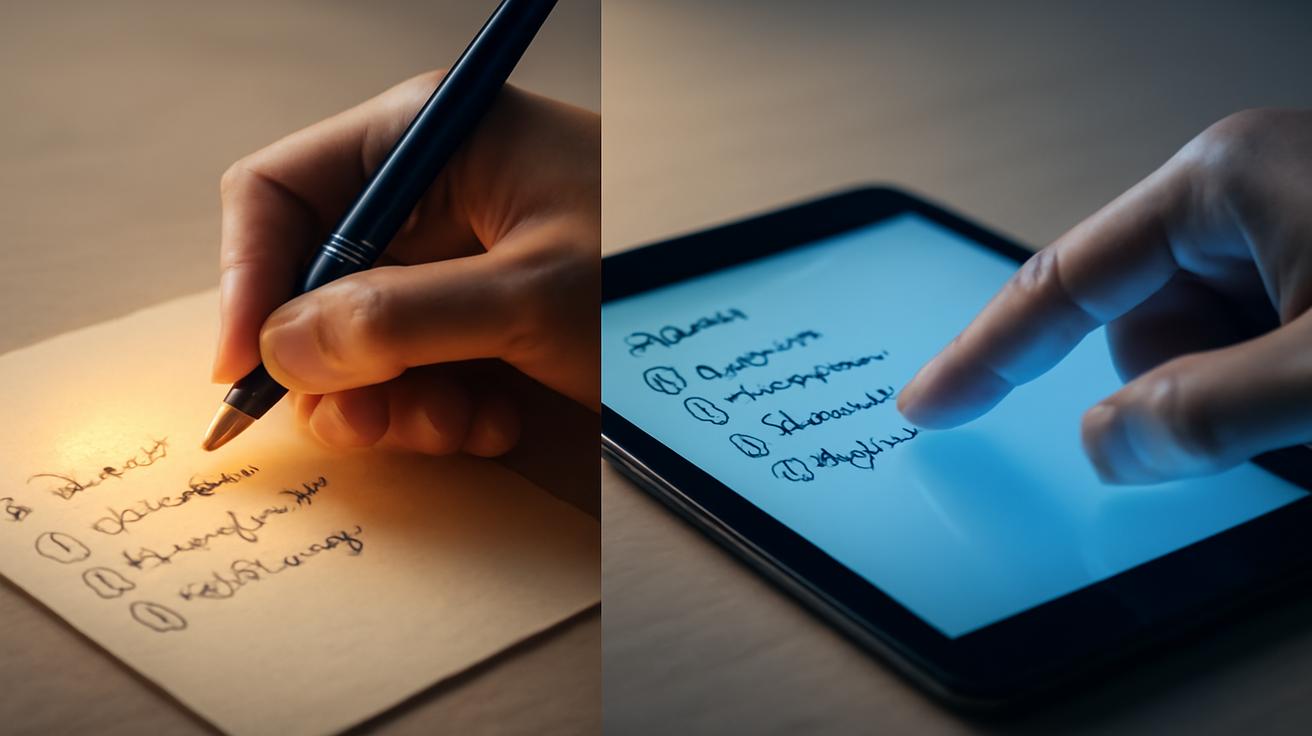
The list begins with a pen hovering over paper. Maybe it’s the back of an envelope, maybe a page torn from a notebook that already carries a few faint ink ghosts from old ideas. You write down “milk,” and the word lands with a tiny weight, like a pebble placed carefully on the shore of your mind. Then come “eggs,” “dish soap,” “call Sam,” “finish report.” By the time you place the pen down, the paper feels less like scrap and more like a map. You fold it, slide it into your pocket, and there is an odd, quiet satisfaction in knowing that your day has a shape now—inked in your own hand.
The Quiet Electricity of Pen on Paper
Handwriting a list is such a small act that it almost disappears into the background of your day, but inside your head, it is anything but small. When you curl your fingers around a pen and drag it across the page, your brain lights up in a particular kind of way—like a string of old bulbs flicking on across a dark barn ceiling. Motor planning regions, visual centers, memory networks: all of them start talking to each other.
Each letter you form is a micro choreography. Your hand muscles trace loops and angles, and your brain must anticipate every curve. That physical effort—however tiny—creates a sensory imprint. You’re not only thinking about “buy spinach”; you’re feeling it as your hand scrawls the word, and you’re seeing it appear in your own style. The result is a trace your memory holds more deeply, like tracks pressed into fresh snow rather than footprints on a crowded sidewalk.
There’s also the subtle resistance of the paper, the faint scratch of the pen, the smudge threat of wet ink. These sensations are not just decorative. They’re signals that help your brain bind together the idea and the movement. Psychologists call this multisensory integration, but you might know it as that simple fact that you remember things better once you’ve written them down by hand—even if you never look at the list again.
And then there is the ritual of it. The sit-down moment. The slow pause as you decide what actually matters enough to make the page. In a world that offers a thousand digital shortcuts, the act of handwriting stands stubbornly slow. It coaxes your nervous system out of the quicksand of constant notification pings and into something closer to still water.
When the List Lives Behind Glass
Now imagine the same list born on a glowing screen. You open your favorite app. A small plus sign. A blinking cursor. Instead of loops and curves, your fingers tap plastic. Your eyes absorb a uniform font that never changes its mood, whether you are buying birthday candles or drafting a breakup text.
This, too, has a brain story. Digital lists lean heavily on visual and cognitive processing but offer far less bodily involvement. Your fingers move, yes, but their motion is repetitive: tap, flick, tap. Your hand doesn’t have to remember how to make a letter; it just has to hit the right rectangles in roughly the right order. Autocorrect steps in like an overhelpful friend, smoothing out your mistakes, erasing their tactile memory along the way.
The result is that the words you type may feel more distant. They’re clean, uniform, efficient—almost too efficient. Your brain processes them more as items on a dashboard than characters in a story. They are there, but they don’t feel as though they belong to your unique mind-body signature in the same way scribbled ink does.
There’s also what might be called the “glass wall” effect. The screen that holds your list is the same screen that offers news, messages, social feeds, and that tempting little game you downloaded “for the train ride.” Your brain has learned that this surface is a portal, every swipe potentially leading somewhere new. So even while you’re trying to focus on the simple task of capturing errands, another part of your mind is alert, restless, waiting for the next thing that might appear.
The Memory Difference You Can Feel
Think about a time you scrawled a messy list before a road trip or a big family dinner. Later that day, you might have realized you left the paper at home—and still managed to recall most of what was on it. That’s not just luck; that’s the handwriting effect.
When you write by hand, your brain isn’t just storing the words; it’s storing the layout, the quirks, the whole tiny scene of the page. Maybe “wine” was tucked in the lower right corner, crooked because you squeezed it in at the last minute. “Ice” might have a star next to it, drawn with a flourish. Your mind encodes this visual and spatial pattern like a small map, and that map helps you reconstruct the list later.
With digital lists, the memory imprint is smoother but shallower. You see the words, but each one sits in a neat little row, identical to the row above and below. The spatial cues are weaker. You probably couldn’t close your eyes and picture exactly where “batteries” landed on the screen or how it looked. You might remember opening the app, the wash of blue or white interface, but not the precise arrangement that makes recall easier.
Curiously, this doesn’t mean digital lists are “bad.” They are short-term champions. The notification that buzzes your wrist, the little red badge reminding you something’s undone—these are direct injections of urgency. Your brain loves urgency. It’s just that, once the moment passes, the memory often does too, evaporating faster than ink left in the rain.
Here is a quick side-by-side view of some of these differences:
| Aspect | Handwritten Lists | Digital Lists |
|---|---|---|
| Body involvement | High: fine motor control, sensory feedback | Moderate: tapping/typing, minimal variation |
| Memory support | Strong: spatial layout and personal script aid recall | Good for short term; weaker spatial cues |
| Distraction risk | Low: paper rarely pings or scrolls | High: same device as messages, apps, alerts |
| Emotional tone | Personal, nostalgic, grounded | Efficient, interchangeable, detached |
| Long-term imprint | Often vivid; easier to reconstruct | Fades quickly once task is done |
Stress, Satisfaction, and the Checkmark Question
There is a tiny spark of pleasure when you cross something off a handwritten list. The pen strokes a line through “laundry” and your brain sends out a little burst of reward chemicals, acknowledging the goal met, the box metaphorically ticked. But this feeling runs deeper than a quick dopamine pop; it has to do with closure.
A handwritten list has a finite shape. Everything you write sits within clear borders—a page, a card, a sticky note slapped onto the fridge. When you cross an item off, you see its ghost. It doesn’t vanish; it transforms. Your brain reads this as a visible story of progress: once a task, now an accomplishment. Over the course of a day, that page becomes a record of effort, some items slashed triumphantly, others waiting like patient stones in a river.
Digital lists handle completion differently. Tap to check a box and the item may turn gray, slide down, or disappear entirely. Clean, yes. Satisfying, sometimes. But it can feel like throwing a pebble into deep water: the moment of impact is there, then gone. You lose the arc, the before-and-after that your brain instinctively uses to gauge “Have I done enough today?”
This shapes stress in subtle ways. With a paper list, you may end the day gazing at a crumpled page that shows both what you did and what you didn’t. There’s honesty in that. Your brain sees a landscape with hills climbed and ones left for tomorrow. With a digital list, especially one that syncs, repeats, and recurs, the horizon can feel endless—items slide in and out with hardly any trace. You are always in the middle of it, never quite arriving.
The difference might be as simple as this: handwritten lists often make your life feel like a series of completed chapters. Digital lists can make it feel like one unbroken scroll.
Attention: The Brain’s Most Stolen Currency
Consider the environment around each kind of list. The paper one might live on a wooden table, next to a coffee mug with a cooling ring, near a window where the light shifts slowly as the morning passes. Your attention can rest on it and then drift out to the world: to the hum of a fridge, distant traffic, a bird tapping at the glass. It’s almost quaint, how few things compete for your focus in that scene.
The digital list, on the other hand, floats in a dense forest of stimuli. Your brain doesn’t only see your to-dos; it also senses the entire digital neighborhood. There’s an unread message count, a banner announcing a sale, the faint ache of curiosity about what might be happening in the apps you’re not currently looking at. Simply by opening your list, you’ve walked into a busy marketplace when you meant to stroll through a quiet garden.
Neuroscientists talk about “switching costs” when our attention hops between tasks. Each time your focus toggles from “What groceries do I need?” to “Who just texted me?” your brain pays a tax, a small drain of mental energy. Handwritten lists, being blissfully analog, naturally lower that switching rate. The brain gets to stay longer in one groove: planning, remembering, sequencing.
That matters. Attention is not just a static resource; it affects how deeply we encode what we’re doing. When our concentration is fractured, our brain often stores things in a shallower, more fragile way. This is one reason you might walk into a store with a digital list and still feel oddly unsure, double-checking, scrolling twice, comparing apps. Your mind may be splitting its bandwidth, and your memory encoding simply doesn’t get the same clean run.
Emotion in the Margins
Every now and then, a list becomes something else. On paper, this is easy to see. You start with “fix lamp,” “clean car,” and somehow “write poem about the river” sneaks in at the bottom. Or you doodle a spiral when your mind wanders, or you jot down a sentence that isn’t a task at all but a thought you don’t want to lose. The list turns into a small journal, a roadside sign that marks how you were feeling that day.
Your brain registers this too. Handwritten lists invite a softness around the edges of productivity. They welcome stray emotions, tiny creative outbursts, self-reminders that have nothing to do with groceries. Over time, flipping through old lists can feel like flipping through snapshots of past selves, each page holding not just what you needed to do, but who you were when you needed to do it.
Digital lists tend to be stricter. They like categories, due dates, clean bullet points. They are excellent at keeping track of tasks but less welcoming to the mess of human feeling. You can write anything in a note, of course, but the design subtly nudges you toward efficiency: add, check, archive, repeat. A sense of impermanence hovers; old lists vanish into folders you rarely visit, or get replaced by new versions before they’ve had time to settle into memory.
In this way, your brain may come to treat digital lists as temporary scaffolding, functional but not sentimental. Handwritten lists, by contrast, often carry a faint emotional patina—coffee stains, hurried slants of handwriting from rushed mornings, neat careful lettering on slow evenings. These traces remind your nervous system that life is not only about managing tasks; it’s also about inhabiting the moments around them.
Choosing the Right List for the Brain You Have Today
None of this means you must swear off apps and return to a pocket notebook for the rest of your days. It does suggest, however, that you can choose your list style as intentionally as you might choose your morning beverage: depending on what your brain most needs.
On days when your mind feels scattered, and you crave something solid, the slower ritual of handwriting might be the anchor. It will give your attention a single, tactile place to land. Your brain can savor the embodied act of putting things in order, letting memory and motor skills braid together to build a deeper sense of control.
On days when speed matters more than depth—when deadlines cluster like storm clouds and tasks change by the hour—a digital list might be the better ally. Your brain can leverage the quick-edit flexibility, the reminders, the ability to rearrange priorities on the fly. You’ll trade some memory richness for adaptiveness, but that may be exactly what the moment calls for.
You can also blend the two. Some people handwrite a broad, meaningful list in a notebook each morning—almost like a daily manifesto—then break that down into smaller, time-stamped tasks in a digital app. The brain gets the grounding and memory benefits of pen and paper, plus the real-time responsiveness of technology.
In the end, your lists are not just tools; they are quiet conversations between your brain, your hands, and the world you’re trying to shape. Whether you’re dragging ink across a crinkled page or tapping a glowing checkbox on a train, you’re doing more than organizing tasks. You’re rehearsing who you want to be in the hours ahead.
Frequently Asked Questions
Does writing lists by hand really improve memory?
Yes, for many people it does. Handwriting engages more brain areas at once—motor control, vision, and spatial processing—which helps lock information into memory more securely than typing or tapping alone.
Are digital lists worse for my brain?
Not inherently. Digital lists are powerful for managing complex, changing information and for sending reminders. The trade-off is that they often encourage multitasking and offer fewer sensory cues, which can reduce deep recall and focus if you rely on them exclusively.
Which type of list is better for reducing stress?
Handwritten lists often feel more calming because they are finite, tangible, and less surrounded by digital distractions. Seeing items crossed off a physical page can create a stronger sense of progress and closure, which helps ease stress.
Can I get the benefits of handwriting while still using my phone?
You can approximate some of the benefits by using a stylus to write on a tablet or by combining methods: for example, handwrite your main priorities in a notebook, then use a digital app for details, reminders, and scheduling.
What’s the best approach if I have a very busy schedule?
A hybrid approach usually works best. Use a handwritten list for big-picture priorities and grounding yourself at the start of the day, then rely on a digital system for time-sensitive tasks, shared projects, and reminders. This lets your brain enjoy both depth and efficiency.