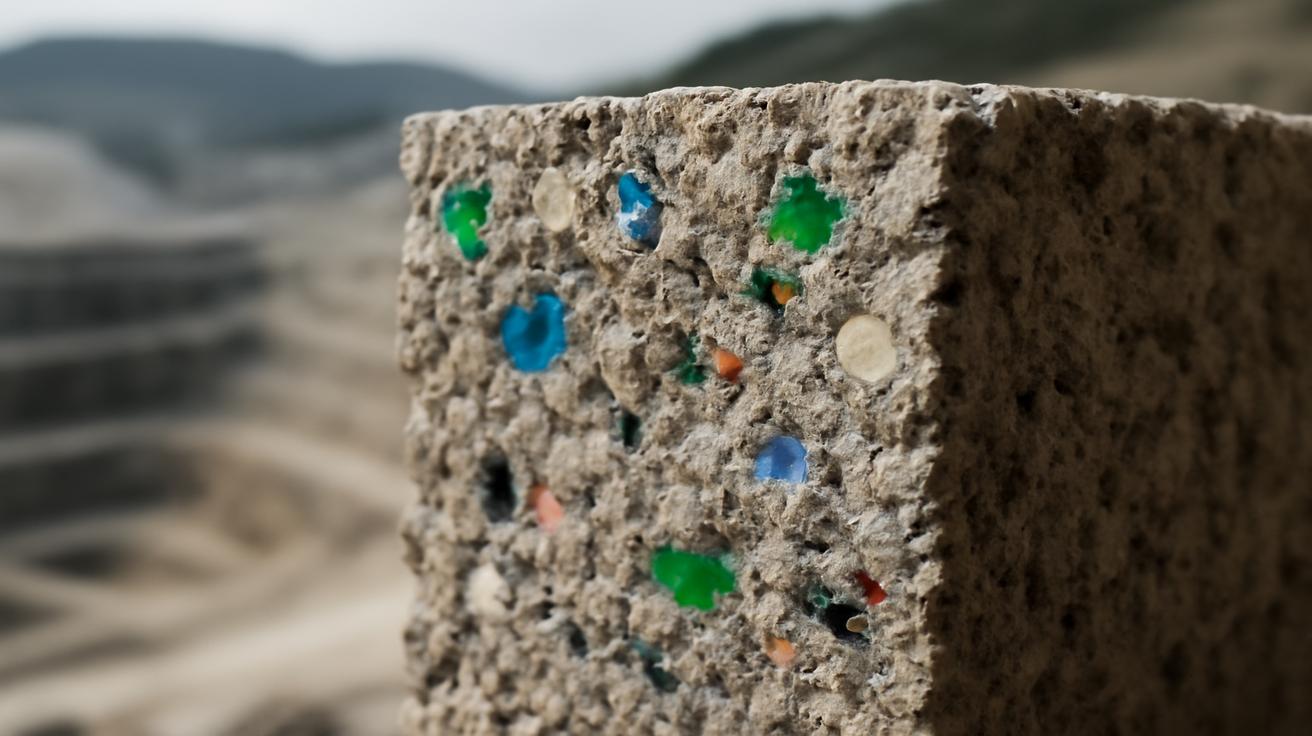
The cement truck growls to a halt on a dusty roadside in suburban Melbourne. It’s a cool morning, the kind where your breath hangs in the air and the smell of wet earth clings to everything. A small crew in high-vis vests gathers around the spinning drum as the first slick grey slurry begins to pour. To a passing driver, it looks like every other concrete pour on every other building site in the world.
But this concrete is different.
It hardens like concrete, holds weight like concrete, and will cradle cars and boots and bikes the way concrete has done for more than a century. Yet hidden inside this ordinary-looking mix is an experiment that could, in its own quiet way, change the mathematics of the planet’s warming.
The invisible giant under our feet
We like to talk about the big, visible emitters: planes streaking across the sky, chimneys exhaling plumes of white, traffic locked like arteries through city centres. Concrete, by comparison, just sits there. It is the background of our lives – walls, bridges, tunnels, footpaths, schools, hospitals. It’s the stone skeleton of modern civilisation, so familiar we don’t even see it anymore.
But invisible does not mean innocent.
Humanity now pours so much concrete that the world produces around 952 tonnes of it every second. Pause reading for a heartbeat. Another 952 tonnes. And another. By the time you reach the end of this sentence, several small apartment blocks’ worth of concrete will have been mixed, poured, and set on this spinning planet.
Each of those tonnes carries a remarkable climate price tag. Cement – the “glue” in concrete – is responsible for roughly 7–8% of global CO₂ emissions, more than global aviation and shipping combined. A single material we almost never think about is quietly reshaping the chemistry of the atmosphere.
Australians, with their sprawling cities, long highways, and thirsty infrastructure, know concrete intimately. It helps hold back the ocean along Gold Coast beaches, frames the skylines of Sydney and Melbourne, and stretches across the continent in strips of highway that shimmer in the summer heat.
And now, from this concrete-loving nation, a small revolution is emerging – a cleaner kind of concrete that doesn’t just emit less, but in some cases can even lock away carbon that would otherwise be floating above us as an invisible, warming veil.
Australia’s quiet concrete rebellion
The story doesn’t begin in a gleaming lab. It starts, as many Australian stories do, somewhere a bit scruffier: on the edge of a demolition site, downwind of a coal power plant, beside the rusting bins where industry throws away the stuff it no longer wants.
For decades, all sorts of industrial leftovers – fly ash from burning coal, slag from steelmaking, red mud from alumina refineries, glass cullet, crushed construction rubble – piled up in vast mounds and settling ponds. They were somebody else’s problem, someone else’s cost, leaching into the soil or blowing into nearby towns as fine, nagging dust.
A few Australian engineers began to look at these waste materials with a different kind of attention. They crumbled them between their fingers, mixed them with water, heated them, cooled them, and watched what happened. Some of these powders, it turned out, didn’t want to stay powders at all. Under the right conditions, they could react and harden, forming networks of minerals strong enough to bear loads, resist fire, and endure weather – a lot like the minerals that form when Portland cement hydrates.
The question lodged in their minds: what if concrete didn’t have to lean so heavily on traditional cement at all?
From that question came a family of materials with names that sound more at home in a chemistry textbook than on a construction site: geopolymers, alkali-activated binders, supplementary cementitious materials. In plain language, they are concretes that replace much of the carbon-intensive clinker in cement with those industrial by-products that used to sit in waste ponds or be trucked to landfill.
In Australia, where coal-fired power and heavy industry left behind a long, troubling legacy of ash and slag, this idea struck something powerful: a chance to solve two environmental problems at once. Use the waste; cut the carbon.
What cleaner concrete actually feels like
Step into a test facility on a cool morning outside Brisbane and you’ll see it – long beams of experimental concrete lying in rows on steel racks, each tagged with a code. Some are pale and smooth, others darker, speckled with tiny bits of crushed glass or shimmering black from steel slag. Stand close and you can smell it: that faint, chalky tang of fresh cement, but changed somehow, edged with the scent of wet metal and stone dust.
A technician runs a finger along the edge of a sample. “People think it’ll be fragile because it’s ‘eco’,” she says, tapping it with a hammer. The dull ring that comes back sounds very familiar – the sound of something dense, solid, and unforgiving. “But it behaves like the real thing. In many cases, it’s stronger.”
Cleaner concretes don’t win on charm. They win on chemistry.
Traditional Portland cement is made by heating limestone and clay to about 1450°C in enormous kilns. That heat usually comes from burning fossil fuels. At the same time, the chemical reactions inside the kiln release CO₂ directly from the limestone. The result is a double hit: fuel emissions plus process emissions.
The Australian alternatives take a different route. Instead of making so much new clinker, they use finely ground waste materials that already contain the right mix of silica, alumina, and other minerals. Add an alkaline activator – often a carefully designed solution based on sodium silicate or sodium hydroxide – and you get a chemical environment where those minerals can rearrange themselves into a hardened binder without the need for such high-temperature firing.
From the outside, it’s still concrete. On the inside, in those microscopic jungles of crystal and gel, it’s something new.
| Type of Concrete | Typical CO₂ Emissions per m³* | Main Binder Ingredients |
|---|---|---|
| Conventional Portland cement concrete | ~300–400 kg CO₂ | Clinker from limestone and clay |
| Blended cement concrete | ~220–320 kg CO₂ | Clinker plus fly ash/slag |
| Geopolymer / alkali-activated concrete | ~150–250 kg CO₂ | Fly ash, slag, industrial by-products |
| Emerging carbon-mineralised concrete | Lower, sometimes net-negative (depending on CO₂ curing) | Blends with CO₂ injection or mineralisation |
| *Values are indicative only; actual emissions vary by mix design, transport, and energy source. | ||
This shift translates into substantial savings. Depending on the exact mix and local energy sources, these Australian-developed concretes can cut embodied CO₂ by 30–70% compared with traditional mixes. Some experimental systems go further, using captured CO₂ during curing to lock carbon directly into the structure of the material, like sealing away tiny ghosts of exhaust inside every slab.
From lab bench to bridge deck
Scientific papers, no matter how impressive, don’t hold up railway lines or motorways. The real test for any new concrete happens when it escapes the laboratory and meets rain, sun, salt, and the unromantic impatience of project managers who just want something that sets on time and doesn’t crack.
In Australia, this proving ground has already started to take shape. Segments of highway, precast bridge girders, footpaths, and industrial floors have been laid with low-carbon or geopolymer concretes. In one project, a regional council replaced conventional mixes in a series of culverts and roadworks, quietly testing how the materials handled seasonal floods and scorching summers. In another, port infrastructure – where saltwater and heavy loads usually batter concrete into submission – was built with by-product-based binders.
If you walk these places, you’d never know. The surfaces feel the same underfoot – that faint grit beneath your sole, the thermal shock as heat rises from a sun-baked slab, the way sound echoes differently off a concrete wall than off timber or soil. Trucks roll over them. Cyclists whir past. Kids kick balls against them.
The big question – will it last? – can only truly be answered by waiting. Concrete is, by nature, a slow material. It takes decades, even generations, to reveal its weaknesses fully. But so far, the performance has been promising enough that standards bodies and infrastructure agencies are taking notice. Some specifications now explicitly allow, and even encourage, lower-carbon concretes in certain applications.
Yet, there’s a friction here. Building codes grow slowly, like trees. Construction culture, too, is conservative; when your mistakes could mean a bridge fails or a building cracks, you tend to stick with what you know.
So Australia’s cleaner concrete movement often proceeds not with fanfare but with careful, quiet demonstration: one project here, another there, a pilot mix for a footpath upgrade, a test pour for a warehouse slab. Each success chips away at the old anxieties. Each finished structure, still standing and solid after a few years of weather and use, buys more trust.
The emotional weight of 952 tonnes a second
Numbers like “952 tonnes of concrete every second” are almost designed to bounce off our brains. They’re too big, too abstract. So try this instead.
Imagine a single cubic metre of concrete: a block roughly the size of a household fridge, weighing about 2.4 tonnes. Imagine placing one such block on the ground each second. In under ten minutes, you’d have a solid wall taller than a house stretching the length of a city block. In an hour, you’d surround entire neighbourhoods. In a day, you’d be laying down enough mass to remake the contours of a coastline.
Now remember that every block carries its own invisible plume of carbon, released months earlier when the cement for that concrete was fired in some distant kiln. That plume drifts, mixes, and joins the planetary blanket of CO₂ already wrapped around us, trapping more heat, thickening the storms, sharpening the droughts.
In that light, each decision to use a lower-carbon concrete mix is no longer some small, technical substitution. It becomes a quiet political act; a practical line drawn between the old way of building and a different future.
Australian engineers and material scientists know this weight intimately. They talk about megatonnes of CO₂ in the way farmers talk about lost rain. Every time they manage to swap out a conventional mix for one based on fly ash or slag, they can calculate the difference not only in dollars, but in tonnes of avoided emissions.
On paper, these are spreadsheets. In the field, they are feelings: the relief of knowing that a new bridge carries thousands of tonnes less embodied carbon than it might have; the pride of watching a truck pour experimental concrete into the foundations of a school or a hospital, planting a small seed of change in the daily landscape of a community.
What it takes for cleaner concrete to go mainstream
If this all sounds quietly hopeful, there’s still a more complicated side to the story.
One challenge is consistency. Industrial by-products are, by definition, not manufactured primarily for concrete. Fly ash from one power station may differ subtly from that of another – in chemistry, fineness, and impurities. Slag qualities can vary depending on the ore and the furnace conditions. Researchers in Australia have spent countless hours characterising these materials, adjusting activator recipes, and creating testing protocols to make sure a contractor in rural New South Wales can rely on the same performance that a big city firm in Perth sees.
Then there’s supply. Ironically, as the world rightly shifts away from coal-fired power, the long-term availability of fly ash is likely to shrink. This pushes the search further: toward other industrial wastes, toward calcined clays and mineral residues, and toward CO₂ mineralisation, where captured carbon reacts with rock powders to form solid carbonates buried forever inside concrete and aggregates.
Cost is another sticking point. While some by-products are cheap – companies are sometimes happy just to get rid of them – the activators and additional quality control can make mixes more expensive up front. Yet when governments look at whole-of-life costs, including durability and lower maintenance, the calculations can flip. Cleaner concretes often resist chemical attack and fire better, and their improved lifespan can pay off over decades.
In this dance of chemistry, economics, and risk, Australia has become a kind of open-air lab. Projects in different states, backed by universities, local councils, and infrastructure agencies, feed data into models. Each successful structure becomes an argument: if it works here, why not there?
Regulators, meanwhile, slowly update standards to reflect the new science. Design guides start to mention alternative binders, carbon budgets, and performance-based criteria instead of rigid recipe-based rules. Every line revised in these documents is a small, bureaucratic revolution in how we think about building materials.
A new way of seeing the hard things around us
Stand on a freshly poured footpath made with low-carbon concrete, somewhere on the outskirts of Brisbane or Adelaide, as the sun slips low and the surface still holds a faint warmth. The smell of curing cement hangs in the air – a mix of damp stone and something almost metallic. Birds hop along the safety fencing, heads cocked, as if puzzled by this new ribbon of ground cutting through their patch of grass.
Under that smooth grey skin, inside the microstructure of the hardened paste, a quiet miracle is taking place. Waste that once sat as a problem on the edge of town has been folded into the fabric of the city. Carbon that might have drifted overhead as heat-trapping gas is instead caught and locked away in harmless minerals. The structure itself is doing work for the climate, not just for the people who will walk and drive upon it.
We tend to think of climate solutions in terms of shiny technology: solar panels, batteries, wind farms, electric cars. Concrete is at the other end of the spectrum: gritty, heavy, and unapologetically unglamorous. But because it is everywhere, small improvements multiplied across its global use can have outsized effects.
Australia’s experiments with cleaner concrete hint at a broader shift, one that goes beyond chemistry. They invite us to look at the hard surfaces of our lives – the car parks, stadiums, retaining walls, airport aprons – and see not just their function, but their unseen histories and futures. How many tonnes of CO₂ did this wall represent when it was born in a kiln? How many could the next one avoid?
In this new way of seeing, every building site becomes a crossroads. At one end, the familiar truck with its conventional mix, the way we’ve always done it. At the other, a truck carrying something slightly less familiar: a cleaner concrete, maybe tinged a fraction darker with slag, maybe using ash that once belonged to a coal plant now slated for closure. The crew chooses one truck or the other. Tonnes of carbon ride on that choice.
Somewhere in Australia right now, as you read this, that choice is being made on a dusty lot or beside a new railway line. An engineer signs off on a spec sheet that leans into lower emissions. A council officer approves a tender that gives preference to recycled or low-carbon mixes. A scientist in a lab analyses the core sample from last year’s trial, nodding slowly at the graphs that show strength holding, porosity low, durability high.
In those small, steady actions, the vast machine of 952 tonnes per second begins to shift – not to stop, because our built world still needs materials – but to change direction, just enough to matter.
Concrete may never feel romantic. But it might, if we let it, become one of the quiet heroes of our climate story – not with drama, but with countless grey, unremarkable slabs poured a little more wisely than before.
Frequently Asked Questions
Why is concrete such a big contributor to climate change?
Concrete itself is a mix of cement, sand, aggregate, and water. The climate problem comes mostly from cement, whose production involves heating limestone to very high temperatures. This both burns fuels and releases CO₂ from the rock itself, making cement one of the most carbon-intensive materials we use at scale.
How can Australian “cleaner concretes” reduce emissions?
They replace much of the traditional cement clinker with industrial by-products like fly ash and slag, or use alternative binders such as geopolymers. These materials don’t require the same high-temperature processing, cutting CO₂ emissions, and in some cases can incorporate captured CO₂ into the concrete during curing.
Is low-carbon concrete as strong and durable as normal concrete?
When properly designed and tested, yes. Many Australian trials have shown equal or higher strength and good durability, especially in aggressive environments. Performance depends on careful mix design, quality control, and appropriate use in structures that match the material’s properties.
If fly ash comes from coal, won’t it run out as we phase out coal power?
Over time, yes, fly ash supplies will likely decline. That’s why researchers are also exploring other sources: different industrial wastes, calcined clays, and methods that mineralise captured CO₂ with rock powders. Cleaner concrete is a moving frontier, not a single fixed recipe.
Can ordinary builders and councils use these new concretes now?
In many parts of Australia, they already are, especially in roadworks, precast elements, and non-critical structures. Availability varies by region, and some applications still require updated standards or extra approvals, but the door is increasingly open for builders, councils, and developers who want to reduce the carbon footprint of their projects.