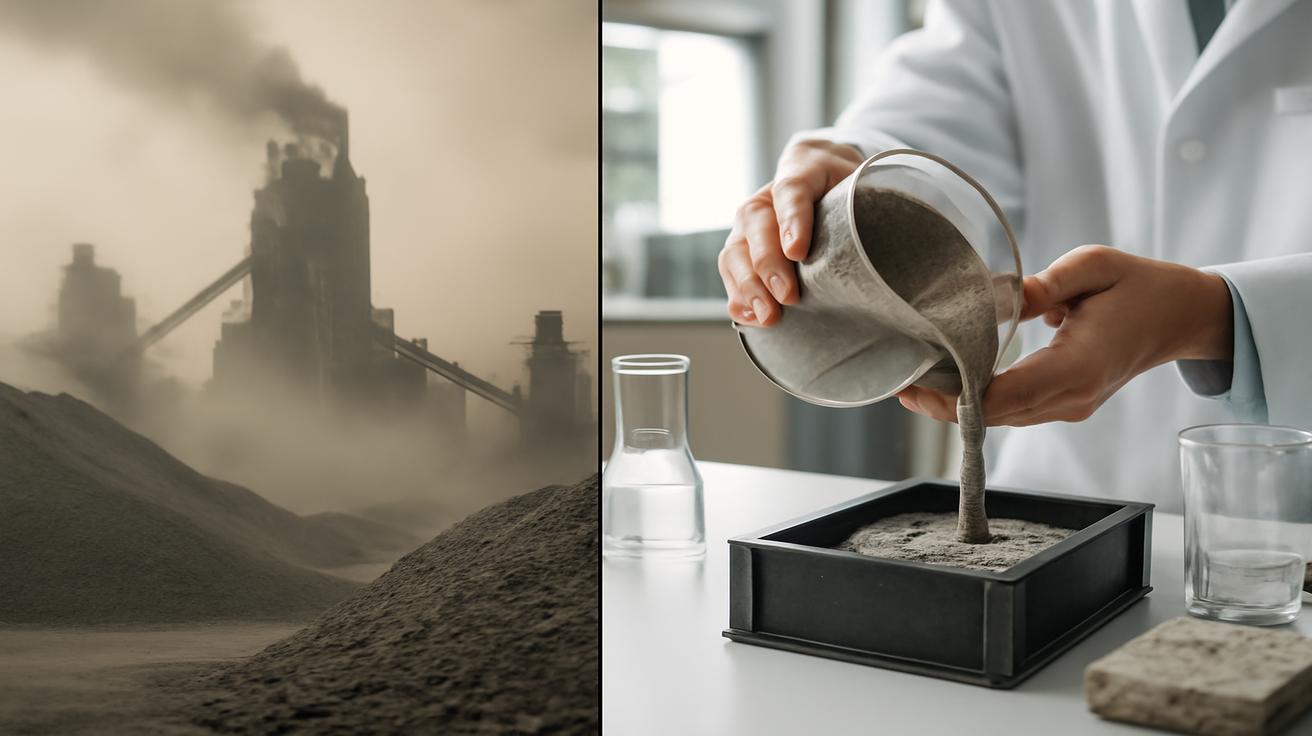
The air above the cement plant shimmers, even on a cool morning. A low hum vibrates through your chest — the grind of stone, the thrum of conveyor belts, the impatient cough of trucks waiting to be loaded. Somewhere beyond the grey dust and steel, carbon dioxide is rolling invisibly into the sky. You can’t see it. You can’t smell it. But for every breath you take, humanity has already produced another few tonnes of the stuff.
Concrete — the unglamorous backbone of modern life — is quietly one of the biggest climate culprits on Earth. And right now, as you read this sentence, humans are making roughly 952 tonnes of cement-linked CO₂ every single second. Not every minute. Every second. It pours from chimneys and stacks, fanning out across the atmosphere like a slow, suffocating tide.
But in a lab in Australia, and in a handful of dusty test sites scattered around the continent, a different story is starting to set. It still looks like concrete. It still feels like concrete. But woven into its grey body is a quiet rebellion: less limestone, less fossil fuel, less carbon. If you stand close enough, you can almost imagine you hear it hardening into the foundations of a different kind of city — one that builds without burning quite so much of the future.
The Problem We Poured Everywhere
If you were to strip back the glass and steel from almost any city, you’d find it resting on a simple recipe: cement, water, and aggregate. Stir it, pour it, let it cure, and you get concrete — a material so strong, so cheap, and so obedient that we’ve used it for everything from backyard patios to skyscrapers and sea walls.
But cement, the “glue” that holds concrete together, comes with a hidden bill. To make it, limestone is crushed and heated to dizzying temperatures — around 1,400–1,500°C. That takes a lot of energy, usually from burning coal, gas, or other fossil fuels. And as limestone is heated, it chemically breaks apart, releasing CO₂ in a process called calcination. So you get emissions not just from the fuel, but from the rock itself.
Put all of that together and cement production alone contributes around 7–8% of global CO₂ emissions. It’s more than every plane, ship, and truck combined in some estimates. We don’t often think of it this way, but in climate terms, concrete is one of the loudest machines on Earth — we’ve just tuned out its roar because it’s everywhere and it looks so ordinary.
And we’re still pouring. We pour it into new housing, new highways, new runways, new seawalls to protect against the very sea-level rise that concrete helped to fuel. Humanity is effectively trying to build a life raft out of the same material that’s making the waves higher.
The Australian Twist: Rethinking the Recipe
In university labs and industrial yards across Australia, a different approach has been gathering momentum. The starting point isn’t to abandon concrete — that’s unrealistic for the near future — but to change how it’s made, grain by grain, molecule by molecule.
Imagine, for a moment, a handful of volcanic ash drifting through your fingers. To the Romans, that ash was magic. Mixed with lime and water, it created a sort of ancient concrete that still holds up harbours and aqueducts two thousand years later. Modern scientists have a new term for that kind of material: supplementary cementitious materials, or SCMs. They don’t replace cement completely, but they can substitute for a large chunk of it — lowering emissions while sometimes improving durability.
Australia has its own trove of modern “ashes”: industrial by-products like fly ash from coal-fired power stations, slag from steelmaking, and finely ground waste glass. In the past, much of this was dumped or underused. Now, Australian researchers are grinding, heating, and remixing these leftovers into the backbone of new low-carbon concretes.
Some of the most intriguing work has focused on geopolymer concrete — a binder that can be made with little or even no traditional Portland cement. Instead, it uses aluminosilicate-rich materials (things like fly ash or slag) combined with alkaline activators. The end product can be as strong as conventional concrete, sometimes stronger, while slashing CO₂ emissions associated with production.
Stand in one of these pilot plants and it doesn’t look revolutionary at first. The same mixers churn. The same moulds wait. Workers still wear hi-viz and hard hats. Yet the chemistry inside those drums tells a different story: cement ratios dropping, waste materials rising, emissions graphs bending downward.
How “Cleaner” Is Cleaner?
The numbers vary depending on the exact mix, but many Australian low-carbon concretes report emissions reductions of 30–50% compared to standard mixes — sometimes even more in special applications. A geopolymer concrete made primarily from fly ash and slag, for example, can slash embodied carbon dramatically because there’s so little conventional cement involved.
That 952-tonnes-per-second figure suddenly looks a little less inevitable when you imagine replacing half, or more than half, of global cement content with smarter alternatives. The trick is getting from lab-scale success to world-scale adoption.
The Feel of a Future Footpath
On a bright Australian morning in a new housing estate, a small construction crew gathers around a concrete truck that doesn’t quite match everyone’s expectations. The drum spins, the chute swings out, and the mix that slides into the formwork is… grey, slightly sticky, utterly familiar. If no one told you it was different, you might never guess.
One worker runs a trowel along the edge, listening for the telltale rasp on the aggregate. Another checks slump with a practiced eye. There’s a pause — that small, nervous moment whenever a new material hits the real world. Will it set properly? Will it finish smooth? Will the inspector, who’s seen every shortcut and every overconfident experiment, raise an eyebrow?
But as the hours pass, a new driveway — or a bridge girder, or a slab — begins to cure just like any other. The surprise, in many of these early trials, is not how strange low-carbon concrete behaves, but how normal it is. It doesn’t glow, it doesn’t crack dramatically, it doesn’t sag. It simply… works.
Under the surface, though, the microstructure is different. The way the binder wraps around the sand and stone, the way water moves through tiny pores, the way it responds to frost, salt, or heat — all of that is slightly rearranged. Australian scientists follow its progress like doctors reading a new kind of X-ray, mapping how each new mix will survive decades of weather and wear.
A Table of Hidden Numbers
It helps to see the contrast between conventional and cleaner concretes laid out simply:
| Concrete Type | Typical Binder Composition | Approx. CO₂ vs. Standard | Key Features |
|---|---|---|---|
| Traditional Portland Concrete | 90–100% Portland cement | Baseline (100%) | Mature, widely used, high emissions |
| Blended Low-Carbon Concrete | 50–80% cement, 20–50% SCMs (fly ash, slag, etc.) | 20–40% lower | Similar handling, improved durability possible |
| Geopolymer / Alkali-Activated Concrete | 0–20% cement, majority SCMs | 40–70% lower (mix dependent) | High strength, lower carbon, needs new standards |
Those percentage drops in emissions aren’t abstract. Scale them up across a city, and it’s the difference between a skyline that quietly loads the atmosphere and one that shrinks its footprint with every new beam and footing.
The Barriers: Habits, Standards, and Fear of Cracks
For all the progress, one of the heaviest things in construction isn’t a beam or a slab — it’s habit. Builders, engineers, councils, insurers: they all lean on decades of experience with familiar materials. Concrete that’s even slightly different can raise doubts: Will it cure in time? Will that bridge last 100 years? Will it behave the same in a heatwave, or a flood, or in salty coastal air?
Australian researchers have spent years not just inventing cleaner concretes, but persuading people to trust them. They run long-term exposure tests, soak samples in seawater, blast them with cycles of heat and cold. They push, pull, bend, and crush cylinders until they fail, then comb through the rubble for clues.
Standards bodies cautiously update their codes, allowing more SCMs, writing provisions for geopolymer binders, setting out how and where these materials can be used. It’s slow, meticulous work — and it has to be. If a single high-profile structure built with low-carbon concrete were to crack badly or fail early, the backlash could freeze progress for years.
From Mines to Mixers
Then there’s the question of supply. Fly ash was once easy to come by in a country with a fleet of coal-fired power stations. But as those stations shut down — a good thing for the climate — sources of ash become scarcer. Slag depends on steelmaking, which is also under pressure to decarbonise and change its processes. Meanwhile, demand for low-carbon binders grows.
To stay ahead of that curve, Australian teams are looking beyond industrial leftovers. They’re testing clays that can be calcined at lower temperatures, experimenting with crushed waste glass, even probing the chemistry of mine tailings and other stubborn wastes. The idea is to build a portfolio of materials, not rely on one or two fading industrial by-products.
This is where Australia’s unusual geology becomes an asset: vast deposits of suitable clays, a history of mining and mineral processing, and a scientific culture that’s comfortable working at the intersection of rock, heat, and chemistry. The country that once shipped iron ore and coal to fuel other nations’ industries could, in time, become a supplier of low-carbon binder materials and know-how.
Why This Matters Beyond Australia
Out on a suburban street in Perth or a new light-rail line in Sydney, low-carbon concrete might look like a small, local experiment. But the implications ripple far beyond those kerbs and platforms.
Most of the world’s future concrete will be poured in regions that are still rapidly urbanising — places where millions of people are moving into cities, where roads, ports, and housing are racing to catch up with human need. If those regions follow the old high-carbon cement path, the climate bill will be staggering. If they can skip ahead to cleaner recipes, the atmosphere may feel the difference for generations.
Australia’s experiments, then, function like a real-time laboratory for the planet. Every successful project, every updated standard, every proof that a geopolymer bridge or low-carbon high-rise can stand the test of time, becomes a story that can be exported along with any materials. It’s a narrative that says: “We tried this. It works. You can build this way too.”
There’s a kind of quiet heroism in that. Not the drama of a solar eclipse or a hurricane, but the slow, stubborn work of changing how the world pours its foundations. Humanity has wrapped itself in concrete; now it has to learn to do it without wrapping the sky in carbon at the same furious pace.
Standing on a Cleaner Slab
Picture a child standing barefoot on a newly cured concrete patio behind a small Australian house. The surface is still cool from the night air, faintly rough under their toes. Somewhere above, galahs are arguing noisily in a gum tree. The kid doesn’t know that the slab beneath them used less cement than usual. They don’t know that its emissions were 40% lower, or that it used what would once have been waste ash.
They just know that this is the hard, solid ground on which they will play and grow, where tables will be set for birthdays, where someone might one day watch a storm roll in and marvel at how heavy the rain feels. That ordinariness is, paradoxically, the goal. When cleaner concrete becomes as unremarkable as the old kind, then the revolution will have succeeded.
But somewhere in the design files, in the batching plant records, in the research papers tucked into the back of an engineer’s library, the difference is recorded. A small bend in the global emissions curve, multiplied across each driveway, school, pier, and bridge. Each grey surface becomes a quiet data point, proof that concrete — for all its stubborn, stone-like reputation — can change.
The world still produces cement-linked emissions at an almost incomprehensible speed: around 952 tonnes per second. Yet with every Australian mix that swaps in ash, slag, clay, or glass, that number is challenged. If the rest of the world listens, learns, and adapts, the sound of those emissions might finally begin to soften.
In the meantime, researchers will keep coaxing new strengths from old wastes, builders will keep running their hands along fresh pours, and city planners will keep asking hesitant questions. Under their boots and wheels, the future is hardening — a little lighter, a little cleaner, and still, reassuringly, solid.
FAQ
Why does concrete produce so much CO₂?
Concrete itself is mostly sand and gravel, but the binder that holds it together — cement — is very carbon intensive. To make cement, limestone is heated to extremely high temperatures, usually by burning fossil fuels. This releases CO₂ both from the fuel and from the limestone itself as it breaks down. Because we use so much concrete globally, those emissions add up rapidly.
What makes Australian low-carbon concrete different?
Australian researchers are substituting a large part of traditional cement with supplementary cementitious materials such as fly ash, slag, calcined clays, and finely ground wastes like glass. In some cases, they use geopolymer or alkali-activated binders that rely mostly on these materials instead of Portland cement, significantly cutting the CO₂ footprint.
Is low-carbon concrete as strong and durable as regular concrete?
When properly designed and tested, low-carbon concretes can match or even exceed the strength and durability of conventional mixes. Some blends show improved resistance to chemicals, salt, or high temperatures. However, they need careful formulation, quality control, and updated standards to ensure consistent performance.
Can this type of concrete be used for all structures?
Not yet for every application, but the range is growing quickly. In Australia, low-carbon concretes are being used for pavements, precast elements, building slabs, and some infrastructure components. For highly critical structures like major bridges or very tall buildings, engineers may still be cautious until more long-term data and standards are available.
Will low-carbon concrete be more expensive?
Costs vary by region and by mix. In some cases, using industrial by-products can lower material costs, but extra processing, quality control, or limited supply can add expense. Over time, as production scales up and standards mature, many experts expect costs to become competitive with, or even lower than, traditional concrete — especially when considering the social and environmental cost of emissions.
How soon could cleaner concrete make a real difference to global emissions?
If low-carbon mixes are rapidly adopted in major construction markets within the next decade, they could significantly reduce the projected growth of cement-related emissions. Because concrete is used everywhere and in huge volumes, even a 20–30% average reduction in its carbon footprint would be a major step toward climate goals.
What can individuals or small builders do right now?
Architects, engineers, and small builders can start by asking suppliers about low-clinker or blended cements, specifying mixes with higher SCM content where standards allow, and prioritising designs that use less concrete overall. Even choosing responsibly sourced aggregates and avoiding over-specifying strength can help. Every project that opts for a lower-carbon option sends a signal up the supply chain that cleaner concrete is wanted — and needed.