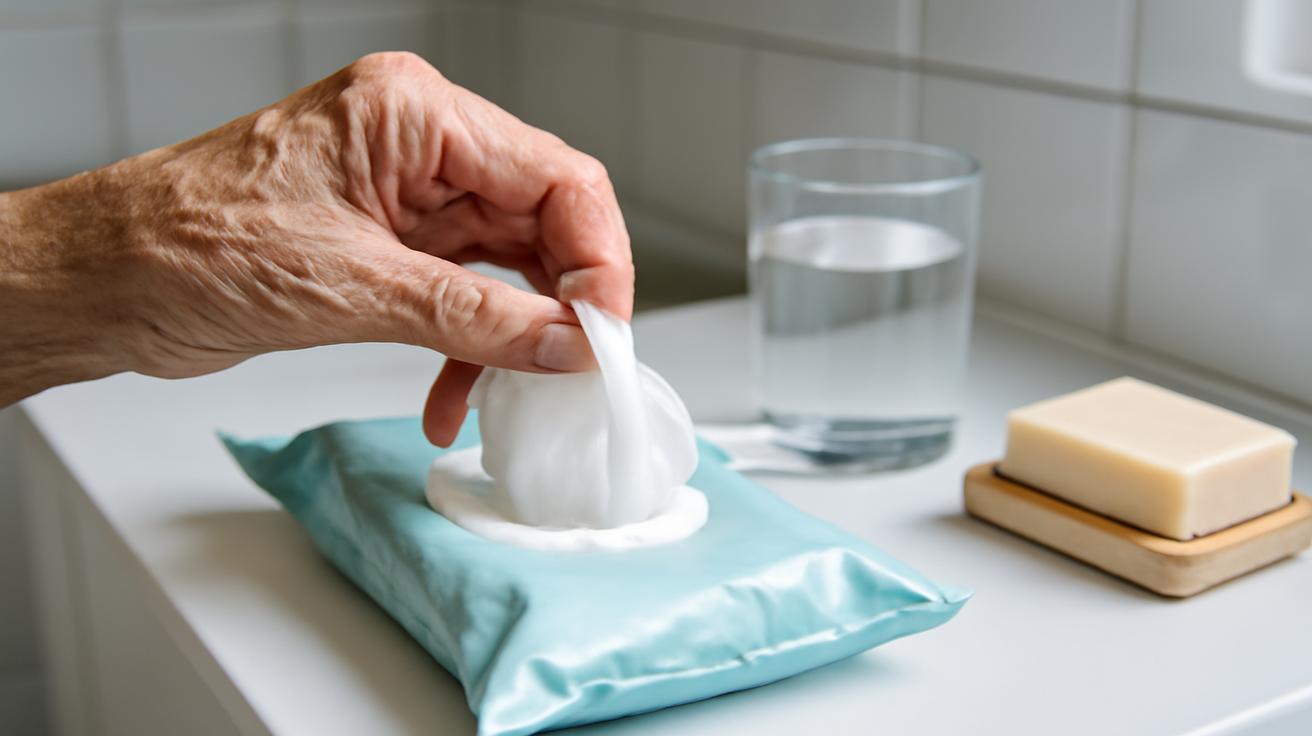
The packet makes a soft, plasticky crackle as Mrs. Lang pulls it open. A faint smell of aloe and artificial cucumber escapes into her small bathroom, mingling with the familiar scent of lavender soap and talcum powder. She has done this every morning for three years now—ever since her daughter, worried about “keeping clean down there,” turned up with a bulk box of “gentle intimate wet wipes for seniors.”
For a moment, she hesitates. Her skin has felt different lately—more fragile, a little raw. Yet the old habit is comforting: wipe, toss, done. No bending. No fuss. No water splashing onto the floor tiles she’s always a little afraid of slipping on. Cleanliness, neatly packaged, sealed in plastic.
But somewhere, in the quiet rustle of the wipes and the hum of the bathroom fan, a quieter question hangs in the air: at what point does “conveniently clean” start to mean “slowly harmed”?
How Daily Wipes Became a Ritual
Talk to people over 65, and you’ll hear the same story told in dozens of small variations. The knees ache. The shower feels a bit less safe. The sink is just a little too low, the soap bar too slippery. So somewhere along the way—through a TV ad promising “all-day freshness,” a well-meaning family member, or a nurse’s suggestion after a hospital stay—wet wipes slip quietly into the routine.
They arrive with smooth marketing and soft words: “gentle,” “dermatologically tested,” “pH balanced,” “for sensitive skin.” The packet sits by the toilet or on the bedside table, like a modern security blanket. The promise is simple and deeply appealing: you don’t have to struggle. You don’t even need water. Just wipe, and you’re done.
For older adults whose days are already stitched together with careful calculation—how much energy to spend standing, how many steps before the hip protests—this promise feels like a small blessing. Some start using wipes after every bathroom visit. Others use them several times a day on face, hands, intimate areas, sometimes in place of a proper wash. It feels like an act of care, of dignity, of staying “fresh.”
But behind the flowery scents and soft touch lies a less romantic reality: when experts look closely at what daily wipe use does to senior skin, they see a creeping pattern of dryness, irritation, infections—and a slow erosion of the most important protective barrier the body has.
The Skin After 65: A Thinner Shield
The skin of a 70-year-old is not the same as at 30 or 40—and it shouldn’t have to be. Time quietly rearranges its architecture. The outer layer becomes thinner. Natural oils decline. Collagen and elastin, the tissues that keep skin springy and resilient, steadily loosen their grip.
For older adults, especially those over 65, skin is more like fine tissue paper than rugged canvas. Bruises appear from light bumps. Scratches take longer to heal. A waistband that used to be just snug now leaves a red groove. The skin’s protective barrier—its invisible shield that keeps moisture in and irritants out—becomes fragile.
Now imagine dragging a chemically soaked cloth across that fragile surface several times a day. Imagine doing it on the thinnest, most sensitive regions of the body: the genital area, between the buttocks, under the breasts, in groin folds, around the anus. Places where sweat, warmth, and friction already test the limits of comfort.
Geriatric dermatologists have a name for what they see in their offices: irritant contact dermatitis, chronic dryness, secondary infections. The stories often begin innocently: “I switched to wipes to stay clean” or “I use wipes because it’s hard to shower.” And then: “My skin burns now,” “I’m always itchy,” “It hurts to sit.”
What’s Hiding in That Soft, Wet Square?
The wipes themselves tell another story—though you need good eyesight and patience to read it. Somewhere on the back of that pastel-colored package is a list of fine-print ingredients. They often include:
- Preservatives to keep the moist tissue from growing bacteria while it sits in a warm bathroom.
- Surfactants—cleansing agents that help lift off dirt and body fluids.
- Fragrances and masking scents to cover up the underlying chemical smell.
- Humectants and emollients to make the wipe feel “soothing” or “moisturizing.”
On younger, robust skin, an occasional wipe is usually no big deal. But on thinner, drier, more vulnerable skin, that mix becomes a different equation. Preservatives like certain parabens, formaldehyde-releasers, or other common agents may not cause an obvious reaction in everyone—but for some, especially older adults with a lifetime of exposures, they are the final straw.
Fragrances, even “natural” ones, are a leading cause of allergic reactions on the skin. Surfactants, by design, strip away oils. Applied daily—sometimes many times a day—they can slowly erode the thin film of lipids that protects senior skin from the outside world.
In the intimate area, the stakes are even higher. The skin and mucosa there are rich with nerve endings and blood flow, and in older adults, often already compromised by incontinence products, hormonal changes, or a history of infections. Add daily wipes laced with fragrance and preservatives, and the delicate ecosystem of beneficial bacteria and the skin barrier gets pushed off balance.
“But I Feel Cleaner With Wipes”
Cleanliness is not just physical; it’s emotional, almost spiritual. To feel fresh is to feel human, worthy, presentable. For many people over 65, especially those who depend on others for care, “feeling clean” becomes a stand-in for “feeling respected.”
That’s why the conversation around wet wipes isn’t simply: “They’re bad; stop using them.” It’s more nuanced. Experts question daily use not because they want to snatch away that sense of dignity, but because they see what happens when the cost of “feeling clean” is chronic irritation, pain, and even infections.
Wipes are good at giving one particular sensation: instant freshness. The cool, moist fabric glides over the skin; a mild chemical tingle is sometimes mistaken for “extra clean.” The scented residue gives the psychological impression that bad smells have been not just masked, but erased. It’s a little ritual of transformation—stale to fresh—in seconds.
But true cleanliness—especially in older adults—very often looks far less dramatic and far simpler: lukewarm water, a soft cloth, a plain, fragrance-free, pH-balanced cleanser used sparingly. It looks like rinsing instead of scouring. Patting instead of scrubbing. It is, at heart, the art of disturbing the skin as little as possible while still removing what needs to go.
When Wipes Become a Problem: Subtle Signs and Slow Damage
For those over 65, the harm from daily wet-wipe use rarely arrives as a single dramatic event. Instead, it creeps in quietly. One day it’s just a little redness. Then a light itch. Then a feeling of tightness or burning after using the toilet. A few weeks or months later, the skin is chafed, sore, or even cracked.
Caregivers, too, sometimes miss the early signals. A parent with dementia may not be able to say “this stings.” A partner may assume redness is just part of aging. But small reactions matter, especially when the irritant is used several times every day.
Here are some of the subtle patterns experts see again and again in seniors who rely on daily wipes:
- Persistent redness in the groin, under the breasts, or between the buttocks that doesn’t fully go away.
- Itching or burning that appears mostly after toileting or “freshening up.”
- Thin, shiny, or fragile skin in wiped areas, prone to tiny splits or fissures.
- Repeated fungal or bacterial infections in skin folds or intimate regions.
- Rashes that improve when wipes are stopped—even if nothing else is changed.
For an 80-year-old dealing with incontinence, arthritis, and limited mobility, a painful rash or raw skin is more than a minor annoyance. It can affect sleep, mood, appetite, and willingness to move. Pain can make toileting feel like torture, increasing the risk of withholding urine or stool, which in turn raises the risk of urinary tract infections and constipation. A small daily habit, in other words, can ripple through the entire fabric of health.
Gentle Alternatives: Clean Without the Damage
Experts who work with older adults rarely suggest a complete ban on wipes. Instead, they talk about strategy. The question shifts from “Should seniors use wet wipes?” to “When, how, and what else could we do?”
Many geriatric nurses and dermatologists recommend thinking in layers of gentleness. The more fragile the skin, the more minimal the intervention should be. That often means returning to the basics: water, cloth, and time.
Here is a simple, senior-focused comparison that caregivers and older adults can use as a guide:
| Option | Best Use | Pros for 65+ | Main Cautions |
|---|---|---|---|
| Plain lukewarm water + soft washcloth | Daily cleansing of intimate areas and skin folds | Gentle, avoids chemicals, respects skin barrier | Needs safe bathroom set-up to avoid falls |
| Fragrance-free, pH-balanced liquid cleanser | Short showers or partial washes a few times per week | Effective cleaning with less stripping of oils | Use sparingly; rinse off thoroughly |
| Water-based, fragrance-free wet wipes (occasional use) | Travel, limited mobility, quick clean-up | Convenient when water access is hard | Avoid multiple times daily on the same area |
| “Intimate” or scented wipes (daily use) | Ideally: very rare, last-resort option | Smell pleasant, feel fresh temporarily | Higher risk of irritation, allergy, and dryness |
For many households, the biggest shift is not a dramatic new product, but a quiet redesign of routine. That might mean:
- Keeping a small basin or handheld bidet near the toilet for rinsing after bowel movements.
- Using soft cotton washcloths, washed regularly, instead of disposable wipes for daily care.
- Reserving wet wipes for travel, hospital visits, or rare emergencies—not as default, everyday tools.
- Choosing wipes that are explicitly fragrance-free, alcohol-free, and designed for sensitive, older skin when they are truly needed.
Rethinking Clean: Dignity, Not Discipline
Beneath all the ingredient lists and clinical studies sits a more tender question: what does it mean to care for an aging body with respect?
Many of today’s older adults grew up in a culture obsessed with “being spotless”—ringed by phrases like “proper hygiene,” “fresh at all times,” “never smell.” Those messages collide with the realities of aging: slower steps, less flexible joints, occasional accidents, and a body that no longer matches the polished fantasies of advertisements.
In that space of discomfort and pressure, daily wet wipes offer a kind of modern spell: if you can’t shower, you can at least wipe. If the body feels unfamiliar, you can at least control its scent. Without realizing it, some people over 65 end up treating their skin as something to discipline rather than something to protect.
Experts now encourage a gentler mindset. Clean doesn’t have to mean scrubbed or fragranced or “sanitized.” It can mean reasonably washed, comfortable, calm. It can mean allowing the skin to have its own quiet, neutral smell—neither perfumed nor neglected. It can mean accepting that a body that has lived this long will not be as easily polished as one in a commercial.
For caregivers, that mindset often involves a shift from “How do I make them extra-clean?” to “How do I keep their skin healthy and comfortable?” That may mean saying no to heavily scented, “extra fresh” wipes—even when the label seems reassuring—and yes to humbler, slower practices: warm water, a soft towel, time, and conversation.
A Small Scene, A Different Ending
Back in her bathroom, Mrs. Lang still holds the open packet of wipes. The aloe scent hangs in the air. But now, there’s something new on the counter: a small jug of warm water, a folded cotton washcloth, and a non-foaming, fragrance-free cleanser her nurse recommended.
Her daughter, standing in the doorway, looks uncertain. “Mum, I just wanted you to feel fresh,” she says.
“I know,” Mrs. Lang replies. She touches the inside of her arm, where the skin reddened last week after a thorough wipe-down. “But maybe my skin is asking for something gentler now.”
She dips the cloth into the water, wrings it out, and feels the comfortable weight of it in her hand. The first pass of the warm, damp fabric over her skin is not tingly or perfumed or thrilling. It is quiet. It is enough. And that, in this new season of her body, may be the most radical form of cleanliness she can offer herself.
FAQs: Hygiene After 65 and the Use of Wet Wipes
Are wet wipes always bad for seniors?
No. Occasional use—especially of fragrance-free, gentle wipes—can be helpful, for example during travel, hospital stays, or when water isn’t easily available. The concern is with daily or multiple-times-daily use on sensitive areas, which can gradually damage older skin.
What kind of wipes are safest if I’m over 65?
Look for wipes that are fragrance-free, alcohol-free, and labeled for sensitive skin. Short ingredient lists, no “perfume” or “parfum,” and no harsh preservatives are best. Even with gentle wipes, try to limit how often you use them on the same area.
If I have trouble showering, what’s a better alternative to wipes?
Try partial washing at the sink or bedside with lukewarm water and a soft washcloth. Use a mild, fragrance-free, pH-balanced cleanser only where truly needed (groin, armpits, under breasts, feet) and just a few times a week. Consider a handheld shower or bidet spray and sturdy grab bars to make water-based care safer.
How often do I really need to wash intimate areas after 65?
For most people, once daily gentle cleansing of the genital and anal area with water, plus washing after bowel movements if possible, is enough. Over-washing or repeatedly using wipes can irritate and dry the skin. The goal is comfort and health, not constant “freshening.”
My skin burns after using wipes—what should I do?
Stop using the wipes for at least a week and switch to plain lukewarm water and a soft cloth. If the burning, redness, or itching continues, or if the skin cracks or weeps, see a healthcare professional. Bring the wipe package with you so they can check the ingredients and help you avoid similar products.
Can daily wipes cause infections?
They can contribute indirectly. By irritating and thinning the skin, daily wipes can make it easier for fungi and bacteria to enter, especially in warm, moist areas like the groin and skin folds. Damaged skin also heals more slowly in older adults, increasing the risk of ongoing problems.
What should caregivers keep in mind about wipes and older skin?
Use wipes sparingly and strategically, not as the default for every clean-up. Pay attention to early signs of trouble: redness, complaints of burning, or itchiness after cleaning. Whenever possible, favor water, soft cloths, and gentle cleansers over repeated wiping, and prioritize the elder’s comfort and skin health over a rigid idea of “extra clean.”