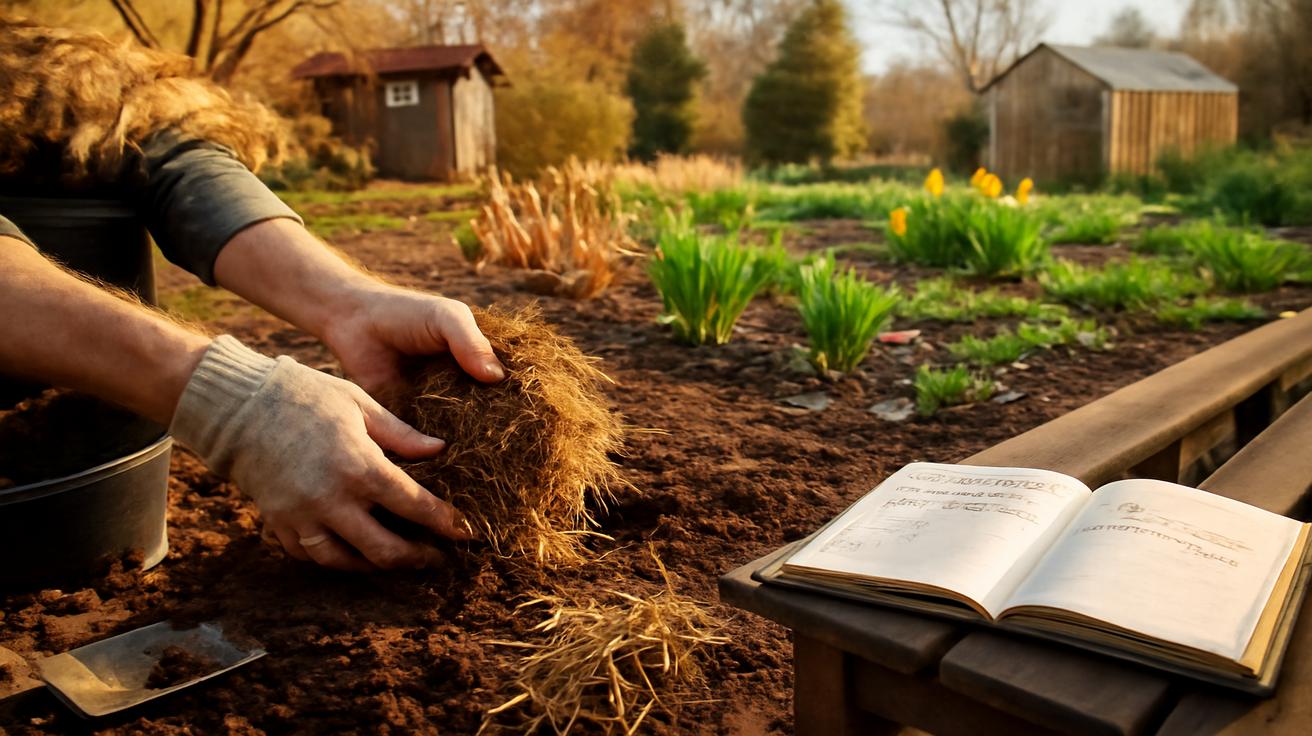
The first frost used to feel like a small betrayal. One night the tomatoes would still be hanging, green and stubborn, and by morning they’d be glassy and limp, as if someone had breathed winter across the whole garden while I slept. For years, that first hard frost marked the start of my annual ritual: a fast, slightly frantic teardown of everything I’d spent months growing. I ripped, yanked, bagged, and dragged it all to the curb, standing afterward in a muddy rectangle of bare soil that looked more like an abandoned lot than a garden. I told myself it was “putting the garden to bed,” but really, it felt more like I’d switched off a life support machine.
When Autumn Felt Like the End of the Story
Part of the problem was the story I’d inherited about what a “good gardener” does. Growing up, I watched neighbors roll wheelbarrows piled high with withered stalks and blackened annuals, their gardens stripped to the dirt by Halloween. Clean was the goal. Neat was the standard. Anything left standing past November was, at best, laziness and, at worst, a breeding ground for pests and disease. So I copied them, marching through the beds each fall like an overzealous editor, deleting every sentence of summer until nothing was left but punctuation marks of bare stakes and empty trellises.
It wasn’t fun. I’d moved into gardening because it felt like a conversation with the living world—soil and roots, rain and pollinators and that quiet miracle of a seed splitting open underground. But fall cleanup felt like a one-sided monologue: me issuing orders, the garden silently complying. My back would ache; my hands would sting from the cold. I’d bag up armloads of stems still humming faintly with life—seedheads, hollow stalks, curling leaves the color of rust and old honey—and feel an odd twist of guilt, as though I’d ended the party before everyone was ready to leave.
Then one autumn, the story started to crack a little. It was a slow shift—more like a leaf turning than a tree falling—but it changed everything about how I end the gardening season. And with that change, spring quietly transformed from a frantic scramble into something looser, kinder, and, somehow, easier.
The Year I Stayed Outside Longer
The turning point began not with a book or a gardening show, but with a bird. More precisely, a goldfinch the color of sunlit butter, balancing on the dried seedhead of a coneflower I’d forgotten to cut down. I was standing at the kitchen window, mug of tea cooling in my hands, mentally composing my “to-rip-out” list, when I saw that flash of yellow. The flower was long past what I’d have called beautiful—its petals shriveled to papery fringes, center dark and bristling. But the goldfinch treated it like a full pantry, picking seeds with careful, practiced movements.
As I watched, I noticed more life out there than I’d expected for late October. A small flock of juncos hopped beneath the stems, kicking through the leaf litter. A mourning dove shuffled under the spent zinnias. A squirrel, tail flicking like punctuation, darted along the fence and vanished under the tangle of dried bean vines I hadn’t gotten around to pulling.
That afternoon, I went out to “survey the damage,” as I always did after the first real cold snap. But instead of seeing only mess, I started seeing tiny scenes of activity. Spider silk stretched between stiff, hollow stems. Ladybugs tucked into the folds of curled leaves. The soil—normally exposed and bare by this time of year—was hidden beneath a patchwork quilt of fallen foliage. It looked chaotic, yes, but it also looked…inhabited.
The phrase “putting the garden to bed” floated back into my mind, suddenly feeling all wrong. Because what I was looking at didn’t seem sleepy. It seemed busy in a quieter, slower, winter kind of way. I realized that every fall, in the name of tidiness, I’d been evicting a whole neighborhood’s worth of creatures, ripping up their shelter and composting their pantry. Pretending the garden stopped just because the flowers did.
The Small Decision That Changed Everything
Maybe out of curiosity, maybe out of laziness, I tried something different that year. I decided not to clear-cut the entire garden. Instead, I gave myself permission to do only what felt absolutely necessary—and to leave the rest, even if it made me wince a little when I walked by.
I started by asking a new question: What, exactly, needs to go now, and what can wait until spring? Diseased plants? Absolutely, they had to leave. So the mildewed squash vines and blighted tomato stems went into a separate trash bag, away from the compost. Anything slimy, rotten, or truly collapsing into mush got the same treatment. But the upright, dried stalks? The seedheads that still held their shape? The tangles of stems that had simply browned and crisped, rather than melted? I left them. I trimmed a few that were leaning over the path, but most I simply let stand, like faded sculptures.
I didn’t rake every leaf. Instead, I pulled them away from paths and the crowns of perennials that I knew might rot if smothered, then casually kicked the rest around, like someone fluffing a messy blanket rather than folding it away. The soil looked oddly warm under that cover—protected, even. A few weeks later, when the first wet snow arrived and then melted, I checked and found that the earth under the leaf layer wasn’t frozen yet, while the bare patches I’d cleaned earlier in the season were hard as brick.
That first year, I called it an “experiment” to make myself feel better about the raggedy look of it. But as winter settled in, something unexpected happened. I stopped seeing the garden as something I’d abandoned and started seeing it as a place I was still sharing with other lives, even in its off-season. I’d step outside on cold mornings, breath streaming, and hear chickadees fussing in the thicket of dried switchgrass. I’d spot rabbit tracks threading through the stems. Once, brushing snow from the top of a seedhead, I found a ladybug nestled inside the hollow, red as a berry against the tan of the plant.
Discovering That “Messy” Was Doing the Work For Me
By spring, I expected to pay for my indulgence. I imagined mold coating everything, or armies of unwanted insects marching out of the stalks like an invading force. I pictured myself desperately yanking dried stems while the daffodils screamed for air. Instead, what greeted me was…softness.
The leaf layer I’d left had flattened, darkened, and started to break down into something rich and crumbly. In the beds where I normally spent half a day bent double, hacking at compacted soil to make space for planting, my trowel slid in with almost embarrassing ease. Worms, fat and glossy, curled away from the light. The soil smelled different too—less dusty, more like the forest floor on a warm day.
Perennials that had always emerged looking a bit anemic in April seemed somehow more confident. The coneflowers pushed through last year’s skeletons like climbers through a loose gate. The monarda sent up red-tinted shoots at the base of its own dried stems. Where I’d left ornamental grasses standing, I now found an easy, satisfying task: cutting the tan stalks into smaller pieces and laying them right back down as mulch, like feeding the garden its own history.
The biggest surprise was how little “cleanup” I actually needed to do. Instead of several grim weekends of dragging heaping bags to the curb, I spent a few scattered hours with pruning shears and a wheelbarrow, working in small circles of sunlight as the days warmed. The dried stalks snapped cleanly. The top growth of many plants almost fell away when nudged, already on its way to becoming soil. What had felt in autumn like postponed work revealed itself in spring as work half-finished by winter itself.
How My End-of-Season Routine Quietly Flipped
Over a few years, my routine shifted into something that felt less like “closing” and more like “turning down the covers.” I began to think of fall as the season where I did a trade: I traded neatness for function, instant order for long, slow help.
Now, when the nights get cold and the first frost warning pops up, I move through the garden with a different kind of attention. I still tidy, but with a lighter touch. I ask: Does this plant need to come out for health reasons, or am I just chasing a picture in my head of what a tidy garden should look like? More often than not, I realize I can leave more than I used to rip out.
The payoff in spring has been so consistent that I finally sat down and put the changes into a simple comparison, if only to remind myself not to slide back into my old habits when the itch to “clean” arrives.
| Fall Habit | What I Do Now | How Spring Feels |
|---|---|---|
| Pulled every dead-looking plant | Remove only diseased or truly mushy growth | Less debris to manage, more natural mulch in place |
| Raked all leaves off beds | Leave a thin layer as insulation and habitat | Soil stays softer, fewer weeds sprout early |
| Cut back perennials to the ground | Leave 8–12 inches of stems over winter | Easy spring cutting, built-in perches and insect homes |
| Bagged and removed most plant material | Chop and drop healthy stalks as mulch | Less need to buy mulch or compost |
| Tried to “finish” the garden in fall | Treat fall as the first step of next season | Spring feels like picking up a thread, not starting from scratch |
None of this is complicated. It’s less a system than a reorientation—trusting that the garden knows what to do with its own leftovers if I give it half a chance. The breakdown that looked like neglect from a distance turns out, close-up, to be a web of quiet tasks that winter takes on for me.
Sharing the Garden With More Than Just Plants
Some of the most persuasive arguments for changing my end-of-season habit came not from the plants, but from the animals that share the space. Once I started leaving more standing through winter, I realized how much the garden remained a living room for birds, insects, and small mammals long after I thought the party was over.
Seedheads I used to snip and discard became winter birdfeeders. Goldfinches, sparrows, juncos, and chickadees moved through the beds like shoppers in a market, pulling seeds from coneflowers, rudbeckia, sunflowers, and grasses. It felt irresponsible not to notice the simple trade I’d been making all those years: aesthetic neatness in exchange for turning a diverse pantry into a barren floor.
Then there were the insects. I’d read, in passing, that many native bees and beneficial insects overwinter in hollow stems and leaf litter, but reading is one thing; cutting open a stem in early spring and finding the delicate chambers inside is another. The first time I saw the tiny hollow spaces—some empty, some lined with a kind of papery wall—I understood that my urge to wipe the slate clean each fall hadn’t been neutral. I’d been erasing homes I didn’t even know existed.
Now, when I cut back stems in spring, I do it in stages and directions that feel almost ceremonial: some stems are left a little taller to support new growth, some are cut and laid gently on the soil so any resting insects can emerge when they’re ready. The work feels less like demolition and more like rearranging a room that belongs to more than just me.
From Control to Collaboration
This shift has changed how I feel in the garden at every season, but especially in those last bright weeks of fall. Where I used to rush, trying to beat the weather, now I move slower. I notice more. There’s a pleasure in seeing the colors fade to subtler tones: bronze and umber, smoke and straw. The garden doesn’t feel “overgrown” or “untidy” so much as mature, like a face showing its lines openly.
One October evening, I sat on the back step as the light thinned and watched a pair of chickadees hop through the dried sunflower forest at the back of the bed. They clung to bent stalks, pecking at the heads, stopping now and then to scold each other with those bright, buzzy calls. Behind them, the sky was the clear, sharp blue that only happens when the air has finally let go of summer’s humidity. The whole scene felt honest: nothing pretending to still be blooming, nothing stripped bare. Just a garden in between, doing the quiet work of becoming next year’s soil and next year’s shelter.
I realized then that what had bothered me most about my old fall routine wasn’t just the extra labor; it was the way it tried to freeze the garden into only two acceptable states: “on” in summer and “off” in winter. The new way, the leave-more-stand-longer way, allows the garden to keep talking through the whole year. Even at its quietest, it hums.
Spring, When I Haven’t Started From Zero
When warmer days finally slip in—the ones when you step outside and the air itself feels like an invitation—I notice the difference in my own body as much as in the soil. I’m no longer bracing for a giant, overwhelming cleanup. Instead, I take the garden in sections, almost like rooms. One afternoon I’ll tackle the bed by the fence, cutting back last year’s bee balm and laying its stems in a loose lattice on the ground. Another evening, I’ll move to the herb patch, trimming the fennel skeletons and discovering tender new growth already threading between them.
Because the soil is softer and protected, I’m not wrestling tools into the ground. Because I left seedheads and stems standing, I’ve had winter visitors who have, in some sense, already started the turnover process for me—birds scattering seeds, snow pelting and softening, wind knocking things down in manageable doses. The garden feels more like a partner that’s been quietly working alongside me, even in my absence.
And something else has shifted, too: my sense of urgency. In the old days, spring cleanup had a frantic edge to it, as though plants would fail if I didn’t clear every bed by some invisible deadline. Now I see that the garden isn’t waiting for me to grant it permission to grow. It’s already pushing up through whatever cover is there, adjusting around my schedule instead of relying entirely on it. My job is less about orchestrating and more about nudging, editing lightly, making space when and where it’s genuinely needed.
The Quiet Ease of Not Finishing Everything
There are still moments when I look out in late fall and my inner neat freak squirms a little. Some part of me will probably always love the sight of a sharply edged bed, the clean line where soil meets path. But the more years I spend living with this gentler, less final way of ending the gardening season, the more that old craving for control feels out of step with what the garden is actually doing.
Spring has become softer, not because I do more in the fall, but because I let fall do more of the work on its own. I let weather, time, fungus, and small creatures collaborate in the cleanup. I accept that a garden is not a room you can shut the door on and return to in perfect stillness. It’s a story that keeps telling itself, whether I’m outside in my boots or inside, watching through glass with a mug of tea in my hands.
Changing how I end the season didn’t require fancy tools or elaborate systems. It required something both harder and simpler: learning to tolerate an in-between state. To understand that “not finished” can be another word for “still alive.” And to trust, with a kind of quiet bravery, that if I loosen my grip on how tidy everything looks in October, the garden will reward me in April—not just with easier beds to work, but with a feeling that I’m no longer managing the land so much as living in step with it.
Frequently Asked Questions
Won’t leaving plants standing over winter create more pests?
Leaving some plant material can shelter both pests and beneficial insects, but in a healthy garden, predators and prey tend to balance each other out. I still remove and trash obviously diseased or heavily infested plants in fall; the rest I leave. Over time, I’ve actually seen fewer serious pest explosions in spring, likely because predators have had places to overwinter too.
How do I know which plants to cut back in fall and which to leave?
As a general rule, remove anything diseased, rotten, or that stays soggy and collapses (like some soft annuals). Sturdy perennials, ornamental grasses, and plants with attractive seedheads can usually stay standing. If you’re unsure, you can compromise: cut the stems to about 8–12 inches and leave that lower portion for winter habitat.
Is it okay to leave leaves on all my beds?
A moderate layer of leaves is usually helpful, protecting soil and feeding it as they break down. The exceptions are areas where leaves might smother low-growing plants or trap too much moisture around crowns that dislike it. In those spots, I gently move or thin the leaf layer rather than removing it entirely, and often use the extra leaves as mulch elsewhere.
Will this approach make my garden look too messy?
“Messy” is partly a matter of expectation. I’ve found that if I keep paths clear, edges defined, and a few key areas a bit tidier, the overall garden still reads as intentional, even with standing seedheads and leaf litter. Think of it as editing for structure rather than trying to erase every sign of decay.
When in spring should I finally do the main cleanup?
I wait until the weather has settled into consistently warmer days and nights—often when early bulbs are blooming and I see new growth at the base of perennials. That timing usually means many overwintering insects have begun to emerge. Then I cut and gently layer old stems and leaves on the soil as mulch, working bed by bed instead of all at once, letting the garden and the weather set the pace.