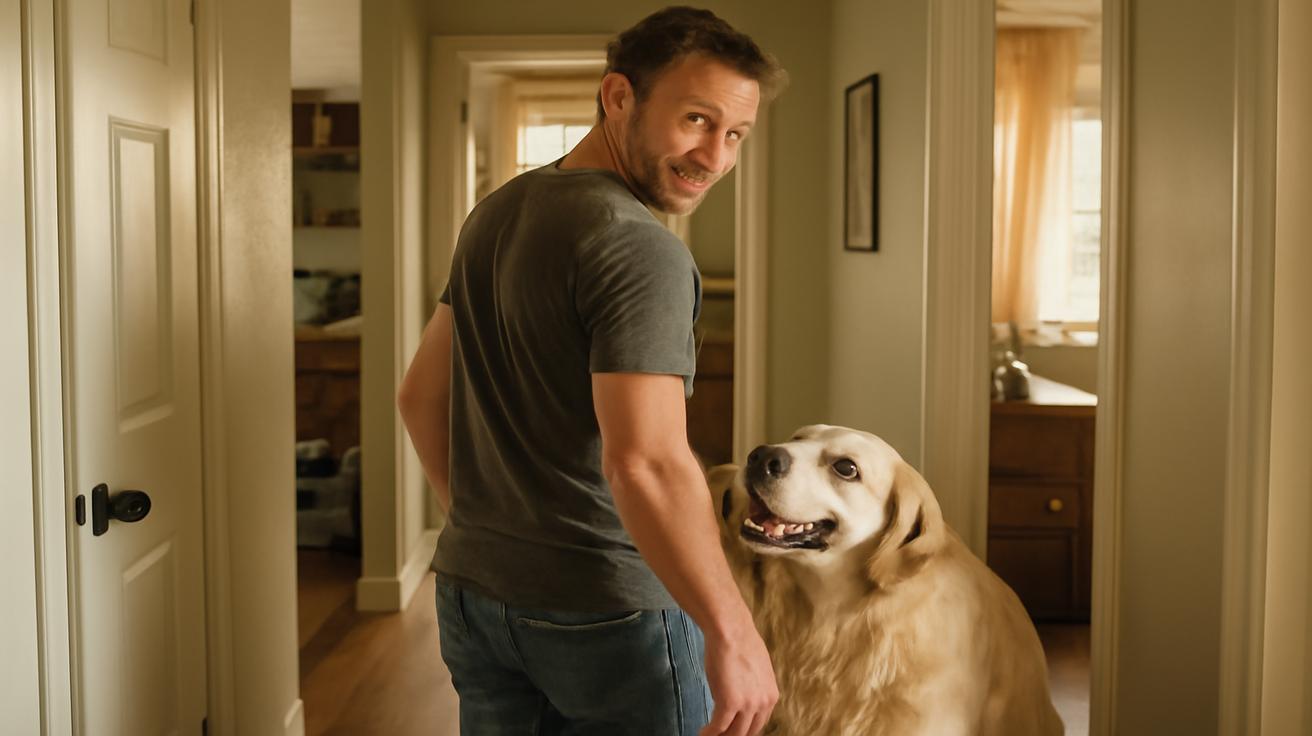
The sound comes first—the tiny click of nails on hardwood. Then the feeling of being watched. You look up from the kitchen counter, and there they are again: those eyes, warm and unwavering, your dog’s whole body angled in your direction as if you were the sun itself. You move to the sink; they move to the mat by your feet. You walk to the bedroom; they pad behind you, a soft shadow. You close the bathroom door, and a nose appears under the gap, snuffling and sighing, as if to say, “I know you’re in there. I’ll just wait.”
Why Your Dog Has Become Your Shadow
Living with a dog who follows you everywhere can feel a little like adopting a furry satellite. You orbit your day—shower, coffee, emails, laundry—and they quietly, faithfully, orbit you. It’s easy to joke about it. “Can I have five minutes alone?” you mutter as you step over them for the third time in ten minutes. But beneath the comedy of constantly tripping over a loyal companion, there is a story unfolding—a story about instinct, attachment, and what it means to be home for another creature.
To understand why your dog is glued to your side, it helps to slip into their world for a moment. Imagine you wake up each morning and the first thing you see is the person who feeds you, opens doors to interesting smells, understands your signals, and knows just how you like your chest scratched. This person is the center of every good thing: comfort, safety, routine, exploration. In a dog’s mind, following you is not just habit—it’s a deep, ancient impulse to stay close to the heart of their universe.
Unlike their wild ancestors, domesticated dogs are born into a life of proximity. We ask them to live in our homes, sleep in our rooms, and share our days. Over thousands of years, humans favored the dogs who looked to us for guidance, who bonded tightly, who wanted to be near. Your velcro dog is, in many ways, the product of that shared history. They are doing exactly what we bred them to do: tune into you, watch you, and care where you are.
Attachment: The Quiet Language Behind Those Watchful Eyes
There is a particular look dogs give the people they love. It sits somewhere between a question and a promise. Are we okay? Where are we going? I’m with you. Scientists sometimes talk about “attachment styles,” borrowing the language we usually reserve for human relationships. Dogs, like children, can form secure or anxious attachments to their caregivers—and the way they follow you can be one of the clearest clues about what’s going on inside.
In a secure attachment, your dog trusts that you will come back, that food and affection and routine will arrive as expected. They may follow you from room to room simply because your presence is their favorite thing, a steady background melody to the day. But when you leave, they can settle. They nap, they chew a toy, they watch the window for a while. They miss you, but they don’t unravel.
An anxious or insecure attachment feels different. In that case, following you is less about curiosity and affection and more about fear: fear of being left, fear of losing access to comfort or safety. When you stand up, a dog with anxious attachment might spring up instantly as if pulled by a wire. If a closed door stands between you, they may whine, scratch, or pace. When you leave the house, they might bark relentlessly, shred a pillow, or drool and shake. For them, your absence is not a pause in the day; it’s a storm.
Of course, it’s not always easy to read the truth behind those footsteps following you down the hallway. Sometimes, it’s love. Sometimes, it’s habit. Sometimes, it’s worry. But in every case, that soft shadow at your heel is speaking a kind of emotional language—one that says you matter more than anything else in the room.
The Many Reasons Your Dog Follows You Everywhere
If you could sit your dog down at the kitchen table and ask, “Why do you follow me everywhere?” their answer would probably be a tangle of instincts and feelings. But we can tease out the main threads. Most dogs who shadow their humans do it for a blend of these reasons—none of them wrong, all of them deeply dog-like.
You Are Safety, Full Stop
In the wild, being alone can be dangerous. Dogs carry that ancient fact in their bones, even as they snooze on orthopedic beds and snack on grain-free treats. You represent the pack, the safe center of the world. When the vacuum roars to life, when a storm rattles the windows, when unfamiliar footsteps echo in the hallway outside your apartment, many dogs instinctively move closer to their person. Your scent, your voice, your presence—these things are a shield.
If your dog tends to stick closest to you when the world feels loud or unpredictable, their following may be a simple, honest attempt to stay where safety lives. You are their bunker, their lighthouse, the known shape in a sea of unknowns.
You Are Also the Snack Dispenser
Let’s be honest: dogs are romantics, but they’re also realists. They know where the food comes from. If your dog has learned that you sometimes drop bits of cheese while making a sandwich, or that you tend to pull out treats “just because,” your presence takes on an extra glow. Following you becomes a gamble worth making: if I stay close, good things might fall from the sky.
Over time, these little moments of reinforcement can turn into a full-on habit. You open a cupboard; they appear. You reach into your pocket; their ears perk. You rustle a bag; their whole body leans in your direction. Even if you never mean to train them this way, your daily patterns quietly teach them that sticking to you is both comforting and occasionally delicious.
Curiosity, FOMO, and the Dog Who Hates Missing Out
Some dogs trail their humans not out of anxiety or bribery, but simple curiosity. What are you doing? Where are we going? Is that door you just opened a portal to something interesting, like the yard or the car or a mysterious cardboard box?
These dogs seem to live with a low-level case of FOMO—fear of missing out. If you disappear into another room, they worry they might miss a game, a walk, a visitor, a dropped sock that could be transformed into treasure. Following, for them, is a way of staying firmly in the center of the action, of not allowing life to happen without their supervision.
Bonding: Your Dog’s Silent “I Choose You”
Then there is love—the simple, profound, often wordless fact of it. Many dogs choose a favorite person, even in a home full of people. They sleep on your side of the bed, not anyone else’s. They listen for your car in the driveway. They know the rhythm of your footsteps and the way you clear your throat before you speak. To be loved like that, by a creature who does not understand your job title or your bank balance or your flaws, is no small thing.
When that dog follows you from room to room, part of what they’re doing is writing that love onto the day. They’re saying, with every step, “You’re my person. Wherever you are, that’s where life is happening.”
Is It Devotion or Dependence? Reading the Signs
It’s flattering to be adored, but there’s a quiet line between healthy attachment and overpowering dependence. Most dogs will choose to be near you if they can. That’s natural. But there are moments when following you everywhere can hint at something deeper—anxiety, pain, or confusion looking for a place to land.
Start with this question: How does your dog cope when you’re not actively accessible? If you step into another room and close the door, do they simply curl up nearby and wait? Or do they whine, pace, scratch, or bark? When you leave home, do they rest after a bit, or do neighbors report continuous howling? Are you stepping over a loving companion—or tripping over a nervous wreck who cannot settle unless they are practically touching you?
Physical health plays a role, too. A dog who suddenly begins to follow you more closely than before—shadowing you in ways they never did—may be trying to tell you something is off. Age-related changes, vision loss, hearing decline, or pain can make the world feel less stable. You, once again, become the anchor. In those cases, your shadow may be less a habit and more a plea: Stay where I can find you. Everything feels different now.
To help you notice patterns, here’s a simple comparison you can glance through:
| Behavior | Likely Meaning | What To Watch For |
|---|---|---|
| Follows you calmly, then naps nearby | Secure bond, enjoys your presence | Relaxed body, loose muscles, soft eyes |
| Clings, panics when left alone | Possible separation anxiety | Destruction, constant barking, drooling, pacing |
| Sudden increase in following behavior | Potential pain, illness, or sensory decline | Changes in appetite, stiffness, confusion, restlessness |
| Follows mainly in kitchen or near mealtimes | Food motivation, learned habit | Extra alert around food cues, counter-watching |
| Sticks close during storms or loud noises | Noise sensitivity, seeking comfort | Shaking, hiding, panting, tucked tail |
Paying attention to the “how” behind the following—body language, timing, changes—can help you tell whether your dog is simply devoted, or quietly distressed.
Helping Your Dog Feel Safe Without Being Your Shadow
Assuming your dog’s clinginess is rooted in anxiety or uncertainty, the goal is not to push them away, but to gently expand their sense of safety. You are home base—but home base can be bigger than your ankles.
Start by strengthening their comfort with short moments of separation. This does not mean shutting them in another room and letting them cry it out. Instead, think of it as teaching a new skill: the art of being okay without constant contact. Scatter a few treats on a mat or in a snuffle toy a few feet away, then step back, still in view. Let them discover that interesting, rewarding things can happen when they are not pressed up against your leg. Gradually, inch the distance a little farther.
Creating a true “safe place” can also help—a bed, crate, or corner that consistently means calm. Place it where life happens, not in an isolated room. Offer chews, soft blankets, and quiet praise when they choose to rest there on their own. Over time, you’re teaching them that their world has more than one center: you, yes—but also the cozy spot where they can exhale.
Routines matter more than we often realize. Predictable walks, meal times, play sessions, and rest cue a dog’s nervous system to relax. When life feels structured, your absences feel less like puzzle pieces missing from the day and more like expected pauses. They start to trust the rhythm: you go, you come back, and in between, the world does not fall apart.
When Following Becomes a Cry for Help
There are moments when a dog’s intense shadowing is less a quirk and more a flare in the dark. If your dog cannot eat or rest when you’re gone, if they destroy doors or injure themselves trying to reach you, or if their following behavior appears suddenly alongside other changes—confusion, accidents in the house, unexplained weight loss—it’s time to bring in support.
A veterinarian can help rule out physical causes and cognitive changes, especially in older dogs, that might drive them closer to you out of disorientation or discomfort. A qualified trainer or behavior professional can work with separation anxiety and fear-based clinging, offering a plan that goes at your dog’s pace rather than forcing them into loneliness they’re not ready to handle.
It’s not a failure—on your part or your dog’s—if professional help becomes part of the story. Sometimes love looks like saying, “This is bigger than us; let’s get someone else on our team.”
Living With a Soft-Footed Shadow
At the end of the day, sharing your life with a dog who follows you everywhere is an intimate kind of companionship. They see you in moments no one else does—bleary-eyed at dawn, frustrated over a broken appliance, laughing alone at something on your phone. They don’t know the details of your worries, but they feel the weather of your moods. And through all of it, they simply choose to be near.
There’s a strange tenderness in that constancy. You step from the shower, and there’s a dog sighing at the threshold, as if standing guard over your most vulnerable, slipperiest self. You stay up too late working at the table, and eyes blink heavily at your feet, fighting sleep because where you go, they go. Their devotion can be inconvenient, sure—tripping hazards, bathroom audiences, muddy paws always underfoot—but it is also a quiet, daily miracle: a heart that orients itself to yours, again and again, without conditions.
If your dog follows you everywhere, it means you have become their chosen orbit—the place their instincts, their history, and their affection all point toward. Sometimes it means they’re asking for reassurance, or for help, or for structure that will let them breathe easier when you step out the door. Sometimes it just means they like the way the world looks when you’re in it.
Either way, each soft step behind you is a sentence in a story you’re writing together—a story about trust, routine, and the ordinary, extraordinary act of being someone’s safe place on this spinning planet. You turn off the light. You head down the hallway. And yes, you hear it again: the whisper of paws, the gentle following. You don’t walk alone. Not really. Not anymore.
Frequently Asked Questions
Is it normal for my dog to follow me to the bathroom?
Yes. Many dogs follow their people into the bathroom simply because they’re curious and bonded to you. If they wait calmly and don’t panic when the door is closed, it’s usually just a sign of attachment and routine, not a problem.
How do I know if my dog’s clinginess is separation anxiety?
Separation anxiety usually shows up when you’re gone, not just when you move around the house. Signs include intense distress, destruction near doors or windows, nonstop barking or howling, drooling, pacing, or attempts to escape. A dog who merely follows you but can relax when you leave likely has a normal attachment.
Can I accidentally encourage my dog to follow me too much?
Yes, to a degree. Constantly giving treats, attention, or excitement every time your dog is right underfoot can reinforce the behavior. Balancing affection with moments where you calmly ignore them or encourage them to rest on their own spot can help prevent overdependence.
Should I stop my dog from following me everywhere?
You don’t need to stop it entirely if it doesn’t bother you and your dog can handle being alone when necessary. Focus instead on teaching them to be comfortable resting away from you at times and to stay relaxed when you leave the house. The goal is flexibility, not constant distance.
Why has my older dog suddenly started following me more?
Senior dogs often become more attached because of vision or hearing loss, cognitive changes, or physical discomfort that makes them feel unsure. They may lean on you as a source of orientation and security. If this behavior appears suddenly or comes with other changes, a veterinary checkup is important.