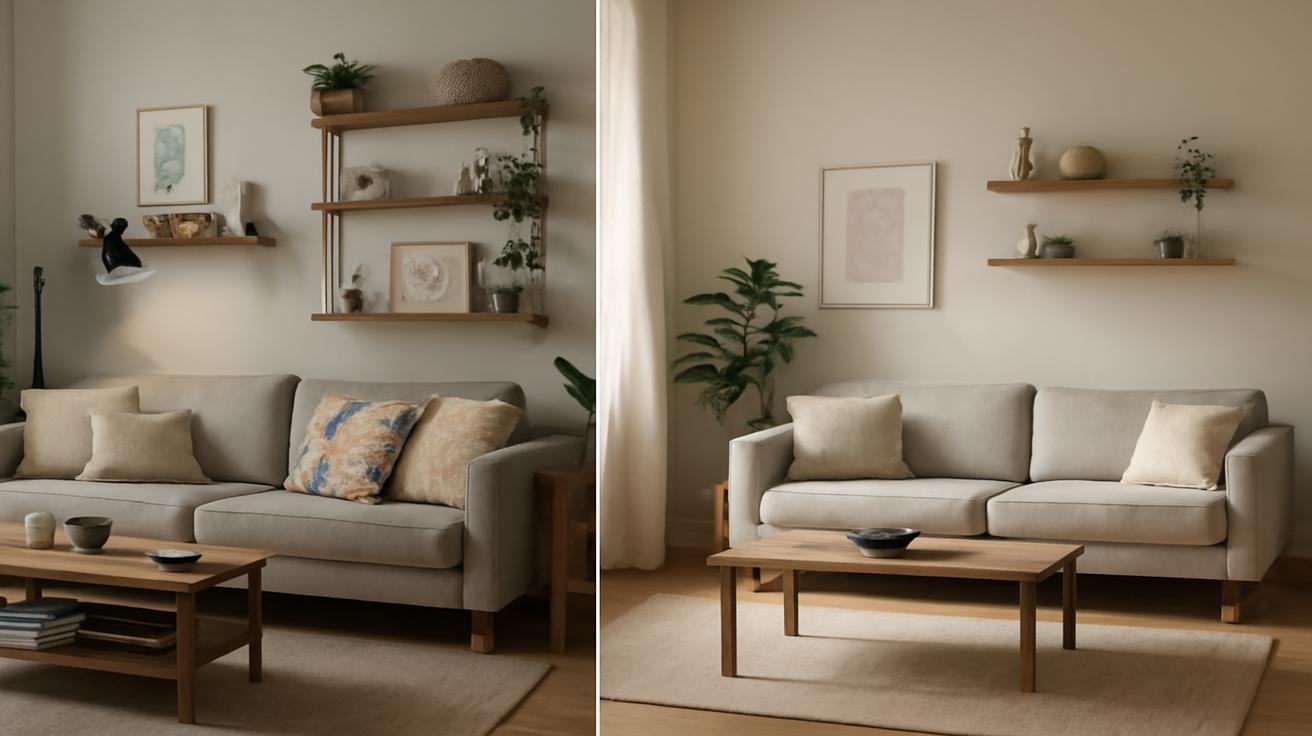
The mug was the last straw. It sat alone on the kitchen counter, a single blue dot on an otherwise empty white sea, and yet somehow it made the whole room feel… wrong. Not messy, exactly. Just noisy. A visual kind of noise that made your shoulders creep toward your ears and your brain hum with low-grade irritation. The dishwasher was empty. The sink was empty. The trash was taken out. By all rational standards, the kitchen was spotless. And yet, you stood there thinking, “Why does this still feel cluttered?”
The Secret Mess Your Brain Won’t Stop Seeing
You’re not imagining it. There’s a particular kind of “mess” that has nothing to do with dust bunnies or laundry piles. It’s quieter, more slippery. You feel it the moment you walk into a room that should, technically, be fine—but isn’t.
Maybe your entryway is tidy, shoes lined up, keys in a bowl, floor swept. Still, it feels busy. Your living room has only a sofa, a plant, a coffee table, and a lamp, yet it reads as chaotic. You look around and think, I’ve done everything right. Why does my house still feel like static?
This is the mess of visual contrast—too many tiny differences pulling your attention in a hundred directions at once. It’s the pattern of the rug against the grain of the coffee table, against the bright labels of the books on the shelf, against the busy fridge magnets, against the cables coiling under the TV. Nothing is actually “out of place,” but your brain never gets a place to rest.
The wild thing is that our brains are wired to scan for variation. Out in nature, this was a survival skill: the flick of a tail in the tall grass, the flash of a berry among leaves. Inside our homes, that same wiring can make us feel tired, overstimulated, and inexplicably annoyed just by standing in our own living room.
That’s where one small, nearly invisible visual trick can shift everything: creating what designers and stylists call a “soft horizon.”
The Visual Trick: Give Your Eyes a Place to Land
Imagine walking into a meadow. Directly at eye level, the line where the tall grasses meet the trees creates a gentle band across your field of vision. It’s not sharp or rigid, but it’s there, holding the whole scene together, giving your eyes a natural resting place before they travel up to the sky or down to the wildflowers.
A “soft horizon” in your home works the same way. It’s the quiet visual line that runs, more or less, through the middle of your space—often around chair-rail height, window height, or the top of a sofa. When that band is relatively calm, consistent, and simple, the whole room feels more grounded. Your brain can exhale.
When that middle band is chaotic—full of tiny objects, clashing colors, and jumbled shapes—your eyes keep tripping over it. Your house might be clean, but it still feels full.
The trick is not to empty your home. It’s to gather its visual energy into calmer zones and add gentle continuity along that horizon line. You’re not decluttering your belongings so much as decluttering your sightline.
Start Where Your Eyes Naturally Rest
Walk into your main living space and pause at the doorway as if you’re a guest. Let your gaze fall where it naturally wants to land. Usually, that’s somewhere around the middle of the room—maybe the back of the sofa, the TV console, the dining table, or the window frame.
Now, notice what’s happening in that band. Not the floor, not the ceiling—just that middle slice of the room. Is it calm, with a few steady shapes and mostly similar tones? Or is it a riot of edge and color—picture frames, cords, toy bins, plant stands, baskets, and chair legs all colliding?
This is where your hidden clutter lives. And it’s where a small shift in what you see—and what you don’t see—can make a huge difference.
The Power of Smoothing the Middle
Picture three neighboring houses. In the first, the living room has a dark sofa, pale walls, a low coffee table, and a gallery wall of mismatched frames dancing across the center of the space. In the second, the frames are moved higher, grouped more tightly, with just a few larger pieces. In the third, the room is nearly identical, but a simple, solid console table runs behind the sofa like an underline on a sentence.
Nothing major has changed. But the third room feels calmer. Why? Because your eyes can follow an uninterrupted line beneath the art—sofa back, console top, maybe a long runner or low lamp—like a path through a forest. The center of your view is no longer broken up into fifty tiny interruptions.
That’s the heart of this visual trick: make the middle of your view flow.
How to Create a Soft Horizon at Home
You don’t need a designer. You don’t need to buy a new sofa. You certainly don’t need to embrace minimalism if that’s not your style. You just need to make a few small, intentional adjustments to what occupies that mid-height zone.
Here are gentle, practical ways to do it in everyday rooms:
- Raise or lower wall art: If you have lots of small frames right at eye level, try grouping them higher so there’s a calmer band of wall beneath. Or replace them with one or two larger pieces that read as a single shape.
- Choose calmer surfaces at mid-height: Console tables, TV stands, dressers—keep what sits on top of them visually simple. A few larger items (a lamp, a bowl, a stack of books) feel quieter than many tiny trinkets.
- Hide or route cords: Messy cables drag the eye and chop up that soft horizon. Tuck them behind furniture, run them along baseboards, or bundle them discretely.
- Streamline open shelving: If shelves and bookcases live at mid-height, group items by color or type, leaving intentional breathing room around them.
- Match shapes where you can: Repeating a few shapes—cylindrical lamps, rectangular frames, rounded baskets—creates a gentle rhythm instead of visual static.
Think of it less as decorating and more as landscape design for your eyes. You’re smoothing the hillside, not paving it.
Why This Feels So Different in Your Body
On some level, this is a story about stress—how it can hide in your walls even when every drawer is neatly organized. We talk a lot about digital overload and information fatigue, but visual fatigue inside our homes can be just as exhausting.
When there’s no calm horizon line in a space, your gaze flits and stutters. Your brain keeps working: categorizing, comparing, scanning. Tiny decisions stack up: That’s a book, that’s a plant, that’s a cord, what’s that, what’s that? You’re not consciously thinking these thoughts, but your nervous system feels them.
Contrast that with a walk through a forest. There’s still an incredible amount of detail—bark texture, leaf edges, pebbles on the trail—but the main band of your vision is surprisingly gentle: the tree trunks rising, the path curving, a wash of undergrowth. There’s a rhythm, not a scramble.
This is, in a way, what you’re trying to borrow for your home. A sense of visual rhythm. A place for your eye—and therefore your mind—to settle for a moment before wandering.
Listening to Your House Like a Landscape
Try this small exercise one evening, when the light is soft and you’re not rushing anywhere. Turn off overhead lights and leave on just a lamp or two. Then walk slowly from room to room as if you are walking a trail.
Notice where your gaze keeps snagging. A busy row of magnets along the fridge door. A jumble of shampoo bottles across the middle of the shower wall. A crowded line of spices marching along the backsplash.
None of these things are wrong. They’re normal. But like brambles growing into the path, they can make an otherwise charming route feel a bit choked.
Ask yourself: What would this view feel like if there were just one or two resting places for the eye instead of ten? Not empty—just calmer. Could half the magnets move to the side of the fridge? Could spices tuck into a drawer or corral into one tray? Could shampoo bottles live in a single, simple caddy at one side, leaving the mid-height of the wall quieter?
These are minor rearrangements. Yet they change how your nervous system experiences your own home.
Small Edits, Big Shifts: Practical Examples
To make this easier to visualize and adapt to your own rooms, here’s a compact guide showing subtle before-and-after style shifts that specifically target that visually noisy middle band of your space.
| Area | Common Visual Noise | Soft Horizon Adjustment |
|---|---|---|
| Sofa wall | Many small frames at eye level | One large piece or tight grouping hung slightly higher, calm space between sofa top and art |
| TV area | Visible cables, multiple gadgets spread out | Cords concealed, devices corralled in one tray or inside a cabinet, fewer items on top |
| Kitchen counters | Appliances, bottles, utensils lined across the whole backsplash | Designate one “busy” zone, keep the rest mostly clear or repeated in matching containers |
| Entryway | Hooks at eye level with many small items hanging | Limit hooks, add a simple shelf or narrow console to create a single steady line |
| Bookshelves | Mixed orientations, bright colors, small decor on every shelf | Group books by height or color, leave some open space, cluster decor to just a few shelves |
Notice how none of these changes require a whole new life. They’re mostly about grouping, shifting, and smoothing that crucial mid-height band. You’re not erasing personality; you’re letting it read more clearly.
Letting Your Style Breathe, Not Shrink
A common fear kicks in here: If I make everything calmer, will my house feel boring? Will it still feel like me?
But creating a soft horizon doesn’t mean draining all the color out of your home. Think of it more like arranging a bouquet. The quieter greens and stems exist so the wild flowers can shine. A calm middle band lets your favorite things—the striped blanket, the vintage mirror, the bright pillow—stand out instead of shouting over each other.
If you love color, keep it. Just gather it with intention. Maybe the middle of the room is calmer, while color explodes in the pillows and art above, or in a patterned rug below. If you love objects, keep them—display them in small, meaningful clusters instead of scattering them through that center slice of your vision.
You’re not making your home less you. You’re turning down the static so your real voice can come through.
Walking Through Your Home With New Eyes
Once you notice this visual trick, it’s almost impossible to un-see. You’ll spot soft horizons everywhere: in the way a café arranges tables and artwork, in the line of windows along an old library, in the way sunlight gathers along a fence at dusk. And you’ll start to feel how those calm bands change your body—your breath, your shoulders, the way you stand in a room.
Try this simple walkthrough the next time you have 20 quiet minutes to yourself:
- Choose one room. The one that feels “off” even when it’s clean.
- Stand at the entrance. Soften your gaze and notice where your eyes naturally rest.
- Trace an invisible line. Follow the mid-height of the room from left to right. Note anything that feels choppy, cluttered, or hyper-detailed.
- Edit lightly. Remove or relocate just three things along that middle band—maybe a stack of mail, a small plant, a cluster of containers.
- Re-group with intention. Add one longer, simpler element: a runner on a console, a single bowl, a lamp, a plant with clean lines.
- Step away and return. Leave the room, then come back as if you’re arriving home after a long day.
Listen to the first feeling that lands in your chest. Not the thought (“It still needs X”), but the feeling. If it’s even 10 percent more spacious, you’re on the right track. These changes compound. Tomorrow, you can do three more tiny edits. Next week, another room.
Over time, your house begins to feel less like a storage container for your life and more like a living landscape you move through—a place with calm horizons, soft edges, and space for your mind to stretch out.
The things you love are still there. But now, you can actually see them.
FAQ
Does this mean I have to get rid of a lot of my stuff?
No. This approach is more about where things live than how many you have. By moving and grouping items—especially around that mid-height band—you can keep most of what you love while making the room feel calmer.
What if I live in a very small space with limited storage?
In small spaces, visual calm matters even more. Focus on:
- Choosing furniture that doubles as storage (closed units help reduce visual noise).
- Keeping the middle of your view as simple as possible, even if things are stored higher or lower.
- Designating just one or two “busy zones” instead of letting small items spread everywhere.
Can I still have a gallery wall or open shelving?
Yes. Just be strategic. Hang gallery walls slightly higher so there’s a quieter band below. On open shelves, group items by color or shape and leave some negative space. A few deliberate clusters will feel more soothing than edge-to-edge objects.
How is this different from just decluttering?
Decluttering focuses on quantity—owning fewer things. This visual trick focuses on placement and continuity. You might declutter as part of the process, but the main goal is smoothing the visual “horizon” that your eyes land on when you enter a room.
Where should I start if my whole home feels visually noisy?
Begin with the room you see first when you walk in the door, or the space where you spend the most time. Make one small pass: adjust art height, clear one surface at mid-height, hide cords. Then stop. Notice how it feels for a few days before moving on. Incremental changes are easier to sustain—and easier for your nervous system to appreciate.