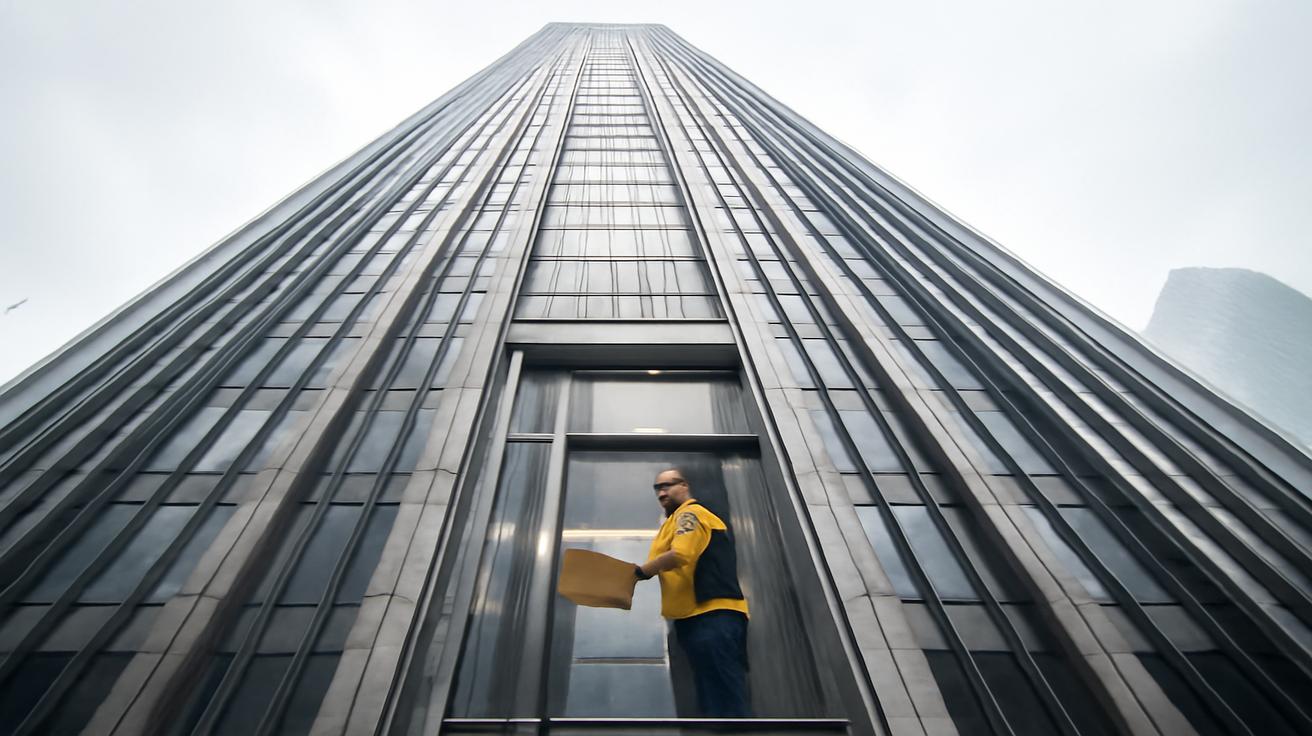
The first thing you notice isn’t the height, it’s the echo. A scooter pulls up at the base of a glass-and-steel cliff, its engine cutting off with a tired cough. For a moment, there’s quiet. Then: the soft clatter of stacked lunchboxes, the rustle of plastic bags, the high-pitched ding of a notification. Above, the building simply keeps going, layer after glittering layer, into the misted Beijing sky. Somewhere near the top, a programmer in a hoodie glances at the time, taps impatiently on a desk, and checks their food delivery app again. Their lunch is technically “at the building.” But in China’s new vertical cities, that’s just the beginning of the journey.
The Vertical City and Its Invisible Climbers
China’s skylines don’t just grow; they erupt. In the space of a decade or two, entire districts have gone from low-rise neighborhoods to forests of towers that seem to lean over each other, competing not just for square footage, but for altitude itself. From Shenzhen’s glimmering tech corridors to Chongqing’s cliffside high-rises, the country’s most ambitious cities now stretch upward like avalanches frozen in glass.
Stand on a winter morning at the base of one of these skyscrapers and you’ll feel it: the building’s own kind of weather. A wind tunnel forms in the shadow of its height, whipping delivery flyers and fallen leaves into restless spirals. The ground-level air smells like roasted chestnuts from a street cart, exhaust from passing buses, and the faint, omnipresent aroma of fried noodles from a nearby food court. Above, people’s lives stack like books on a shelf: offices, co-working hubs, serviced apartments, fitness centers, cafés that never see the street.
For the millions who work and live on the upper floors of these vertical cities, everything comes through an app—from office chairs to fresh strawberries to the afternoon bubble tea ordered “with less ice, less sugar, extra pearls.” But when skyscrapers rise past fifty, sixty, seventy floors, the logistics of a simple meal become something new and strangely complex. Elevators are overworked. Security gates slow everything down. Access cards don’t always work. And in that gap between the ground and the clouds, a new kind of urban worker has emerged: the floor-specialist meal courier.
They’re not the scooter riders you see weaving through traffic in yellow, blue, or red jackets. They’re the people who pick up where the scooters stop. Their territory isn’t the open road but the invisible hinterland of elevator shafts, security desks, and labyrinthine office corridors. Their job is simple to describe, but exhausting to do: get the meals from the building’s entrance into the hands of the person waiting at the top—no matter how high, no matter how tangled the route.
The Handoff at the Threshold
Most food delivery journeys in urban China now have a quiet, almost theatrical moment of transformation. It happens at the building threshold. A scooter hums to a stop. A rider, wrapped in the bright uniform of a big app platform, hops off, pulls off their helmet, and makes a beeline for the entrance. Just inside, near the security turnstiles or tucked into the corner of the lobby, stands someone in a different shade of uniform, holding a handheld scanner and a half-emptied cart.
There’s a practiced efficiency to the exchange. Bags are scanned, order numbers confirmed, a few quick words traded about which elevators are working, which security guards are in a bad mood today, and whether the 52nd floor is still blocking access to delivery riders. In less than a minute, the scooter courier is back outside, zipping away to the next address. The building courier—sometimes called a “floor runner” by colleagues—turns toward the battery of elevators like someone preparing to climb a mountain they know by heart.
On the screen of their phone, a digital tower lights up with little icons, each representing a hungry person high above. Orders bloom at the 17th floor, the 38th, the 61st. Some buildings mix hotel rooms with start-up offices with private clinics, so the floor runner’s mental map has to be fine-tuned. They know which lifts are express, which ones stop at every floor, where the security bottlenecks are, and at exactly which time the 39th-floor accounting department tends to order milk tea for the whole team.
The Everyday Alpine Climb
As the elevator doors slide shut, the air shifts—cooler, recycled, faintly perfumed from someone’s leftover cologne. Inside, the floor runner checks and rechecks their bags. Cold dishes grouped together, hot soups stabilized so they won’t slosh onto someone’s special request chili oil. Phones vibrate like nervous birds. A colleague is asking if they can swap floors later because of a knee injury. The app is sending a reminder: “Customer on 68th floor has been waiting 12 minutes.” A building notice flashes: “Elevator maintenance scheduled—expect delays.”
Each stop is a small performance. Step out, find the right glass door with its frosted company logo, squeeze past cardboard boxes, beg the receptionist to sign off or allow direct access, dodge a colleague’s electric suitcase, and try to match a name on an app with a face that may or may not appear from behind a conference room door. Sometimes, the floor runner is greeted like a savior; eyes light up, chairs scrape back, someone exclaims, “Finally!” Other times, they’re invisible, leaving an insulated bag on a designated shelf marked with taped-on labels: “Takeaway Pickup Zone.”
On certain days—rainy ones especially—the smell of the orders clings to them as they ride from floor to floor: cumin lamb, stir-fried eggplant with garlic, spicy hotpot broth seeping through cardboard. It mixes with the scent of printer ink, coffee from office machines, the occasional whiff of cleaning chemicals. Their territory is a collage of smells, sounds, and textures that never quite belongs to them, but that they know more intimately than anyone who actually works in the building.
Skyscraper Lives Measured in Floors and Minutes
In this niche world, success is measured not in miles but in minutes shaved off a vertical route. A skilled floor runner knows how to ride the timing of the lunch rush like a surfer reads waves. They know that if they catch the express elevator to floor 30 at 11:52 a.m., they can ride the same car back down with office workers who’ve finished early meetings, then slip into the service elevator that quietly opens only for people with the right access card.
Their job is intensely physical, but it doesn’t look like exercise in the traditional sense. It’s more like an endless rehearsal of micro-movements: pressing buttons, weaving around people, balancing bags, slipping through half-open doors. Some buildings still force runners to climb flights of emergency stairs when elevator systems get jammed. A malfunction on the 40th floor can cascade upward and downward, forcing them into the narrow, echoing stairwells that smell of concrete dust and forgotten mop buckets. By mid-afternoon, ankles throb. By evening, the weight of the day’s accumulated elevation gain starts to register in their calves and lower back.
Yet there’s a strange intimacy in this work, too. Floor runners move through the private vertical rhythms of the city in a way few others do. They see the morning scramble—bleary-eyed office workers rushing in with still-wet hair. They witness the post-lunch lull, when desks are cluttered with empty containers and the hum of conversation dips. They catch quick dramas in the elevator mirrors: someone wiping away tears before the doors open, colleagues falling silent when a manager steps in, couples riding in awkward silence after an argument carried out over chat.
A New Job for a New Skyline
This role didn’t appear in any grand policy plan or urban blueprint. It grew from friction—those few extra minutes where app riders were forced to wait downstairs, arguing with security or hunting for a QR code scanner. For big platforms racing to promise “delivery in 30 minutes or it’s free,” those minutes were a crack in the system. So the platforms and property management companies quietly patched it with people.
Today, some skyscrapers employ their own in-house delivery staff who handle all incoming food at set times. Others see private contractors bidding for the right to manage “upward logistics.” In the busiest districts, these floor runners can handle hundreds of orders a day. On major shopping holidays or winter storm days, their phones turn frenetic: a new alert every few seconds, staircase icons lighting up red on their app-based dashboards.
There is pride in being able to say, “I know this building better than anyone,” even if you don’t own a single square meter inside it. Floor runners learn the names of regular customers, the preferred sauces of each department, which law firm never tips and which design studio always does. They learn which elevators are haunted by phantom button presses, which ones make a worrying rattle around the 50th floor, and at what hour the entire building smells irresistibly like fried scallion pancakes because one stall in the basement food court drops a fresh batch.
Moments Between Floors
Between the rush and the routine, small, human moments slide in like bookmarks. On a muggy summer afternoon, a glass elevator pauses halfway up. Fog from the outside humidity blooms on the windows, turning the city into a watercolor smear. A floor runner and a young architect stand side by side, both clutching their phones, pretending not to be annoyed by the delay.
“That my lunch?” the architect nods toward a bag fragrant with sesame oil and chili.
“Could be,” the runner replies. “Which floor?”
“Fifty-two.”
The runner taps their screen, checks the list, and smiles. “Sorry, you’re the salad. This is hotpot for sixty-one.”
They both laugh. It’s a small moment of shared recognition in a city that often feels too busy for even that. When the elevator finally shudders back to motion, their lives peel away from each other again, one heading to a desk by a glass wall, the other to the next floor, the next door, the next impatient app notification.
There are days when the job feels like being a quiet accomplice to everyone’s coping mechanisms. Late-night orders are heavy with instant noodles, sugary drinks, and strong coffee. During major deadlines, entire floors smell like fried chicken. After company celebrations, it’s all congee and herbal tea and “something light, please.” A floor runner sees the city’s stress and joy translated into paper bags and plastic containers, riding up and down the spine of a building.
Numbers Behind the Vertical Rush
In some of China’s densest office districts, one skyscraper can house more people than a small town. Tens of thousands of workers might clock in daily. Even if a fraction of them place an order, the arithmetic becomes staggering. A single lunch hour might generate several hundred tickets for that one tower alone.
Here is a simplified snapshot of what a busy day can look like for a building courier in a large, mixed-use tower:
| Time of Day | Estimated Orders | Typical Destinations | Delivery Rhythm |
|---|---|---|---|
| 9:00–11:00 | 30–60 | Cafés, small offices, co-working floors | Slow and steady, mostly coffee and snacks |
| 11:30–13:30 | 200–400 | Corporate offices, open-plan tech floors | Peak rush, multiple elevators, stacked trips |
| 14:00–17:00 | 40–80 | Meeting rooms, late-working teams | Intermittent, more drinks and desserts |
| 18:00–21:00 | 80–150 | Overtime crews, serviced apartments | Second rush, heavier meals, slower elevators |
Behind each of those numbers is a small choreography of movement that never touches the street again once it passes the lobby. The floor runner becomes the final link in a chain that began at some street-level kitchen and zigzagged through traffic before landing in their hands.
Between Gig and Profession
Like many jobs born of app economies and rapid urban growth, this role sits in an ambiguous space. It’s physical labor wrapped in digital structure. Schedules are often semi-flexible but tied tightly to app metrics: delivery times, ratings, complaint counts. Some buildings pay a retainer plus per-delivery bonuses; others rely entirely on piecework. There are workers who treat it as a long-term occupation, and students or recent migrants who see it as a temporary foothold in the city.
Some appreciate the predictability of working inside a single building instead of darting through traffic all day. The weather still matters—rain and heat waves boost orders—but there is shelter, air conditioning, a familiar circuit. Others find the repetition claustrophobic. The same hallways, the same elevator music looped in an endless cycle, floor numbers blinking like a metronome for a life lived between up and down.
Yet if you listen long enough, you’ll hear something else: a subtle sense of ownership. “This is my building,” one runner might say, not in the legal sense, but as someone who knows how the afternoon sun hits the western glass and turns the lobby into an oven, or how the 23rd floor always orders jasmine tea when their big client visits. They might know where the security cameras have blind spots, which corner has the best signal when all the devices in the building compete for bandwidth, and exactly how long it takes to go from the basement delivery intake to the topmost penthouse if every elevator arrives on time. (In reality, they never all do.)
The Future of the Upward Journey
As China explores delivery robots and smart locker systems, you might imagine this vertical job fading into automation. There are already prototype robots that glide along office corridors, their boxy bodies stacked with meals, chirping mechanical voices announcing order numbers. Some towers are experimenting with integrated food lockers on each floor, where couriers can drop off meals that customers then collect with QR codes, cutting down the need for door-to-door knocks.
And yet, the human element is stubborn. Elevators malfunction. Access permissions get confused. Someone needs help navigating a language barrier or a last-minute change: “I’m in a meeting, can you leave it with the lady at the front?” A tired developer might ask for an extra pair of chopsticks because a colleague decided to stay late too. A nurse working in a high-rise clinic might need a delivery left quietly at a side desk so as not to upset anxious patients. These are not tasks that algorithms and steel boxes handle gracefully—at least not yet.
So for now, and likely for some time to come, the upward journey of a bowl of noodles in a Chinese skyscraper still depends on a person who spends their day riding the spine of the city, up and down, again and again.
The City From the Inside Out
Near the end of a long shift, a floor runner rides the lift down from one of the building’s highest floors. The sky outside glows orange, smeared with the last light of the day. Windows along the shaft flicker with scenes: a fitness studio where people run nowhere on treadmills, a conference room glowing blue from a projector, a half-finished interior where construction workers sit on overturned buckets taking a break.
By the time they step out into the lobby, the air has cooled. The scent of evening rain drifts in from revolving doors. Outside, the scooter riders are still coming, still going, their bikes lined up like tired animals at a trough. A new batch of bags waits on the cart. The app lets out another bright, insistent ping.
Up there, near the top, someone is watching a ticking clock and wondering where their dinner is. Down here, on the marble floors that mirror the building’s lights, a person in a worn uniform lifts the cart handle, checks the elevator display, and steps back into the vertical river.
Modern China is often described in sweeping, horizontal terms: roads and rail lines, supply chains stretching across provinces. But in cities where skyscrapers scrape the clouds, another geography has emerged—one measured not in kilometers but in floors. And in that space, there are workers whose world is a column of air and steel, whose map of the city is a single building seen from the inside out, lived one delivery at a time.
Frequently Asked Questions
Why do skyscrapers in China need dedicated meal couriers for upper floors?
Very tall buildings create logistical bottlenecks—busy elevators, strict security, and restricted access. Standard scooter couriers often can’t spare the extra time to navigate these vertical obstacles while meeting strict delivery deadlines. Dedicated in-building couriers specialize in moving quickly and efficiently inside a single tower, bridging the “last 100 meters” between the lobby and the top floors.
Are these building couriers employed by delivery platforms or by the buildings themselves?
It varies. In some towers, property management hires or contracts a team to handle all incoming food deliveries. In others, major delivery platforms or third-party logistics companies place their own staff on-site. Many arrangements are hybrid, with couriers paid a mix of base compensation and per-delivery bonuses.
How do customers receive their food on very high floors?
Depending on building rules, customers may receive food at their office door, at a reception desk, from a designated “takeaway shelf,” or occasionally at a smart locker on their floor. In all cases, a building courier typically brings the order from the lobby up through security and elevators to the agreed handoff point.
Is this work considered safer than street-level food delivery?
In some ways, yes: building couriers are largely protected from traffic accidents and extreme weather, spending most of their time indoors. However, the job has its own risks, such as physical strain from constant walking and standing, elevator breakdowns forcing stair use, and stress from time pressure and high order volumes.
Will meal delivery inside skyscrapers eventually be automated?
Elements of it likely will be. Some buildings are testing delivery robots, smart lockers, and integrated elevator systems that communicate with logistics apps. But human couriers still handle many unpredictable situations—access issues, last-minute changes, special requests, and interpersonal nuances. For now, and probably for years, people and machines will share the work of feeding the higher floors of China’s vertical cities.