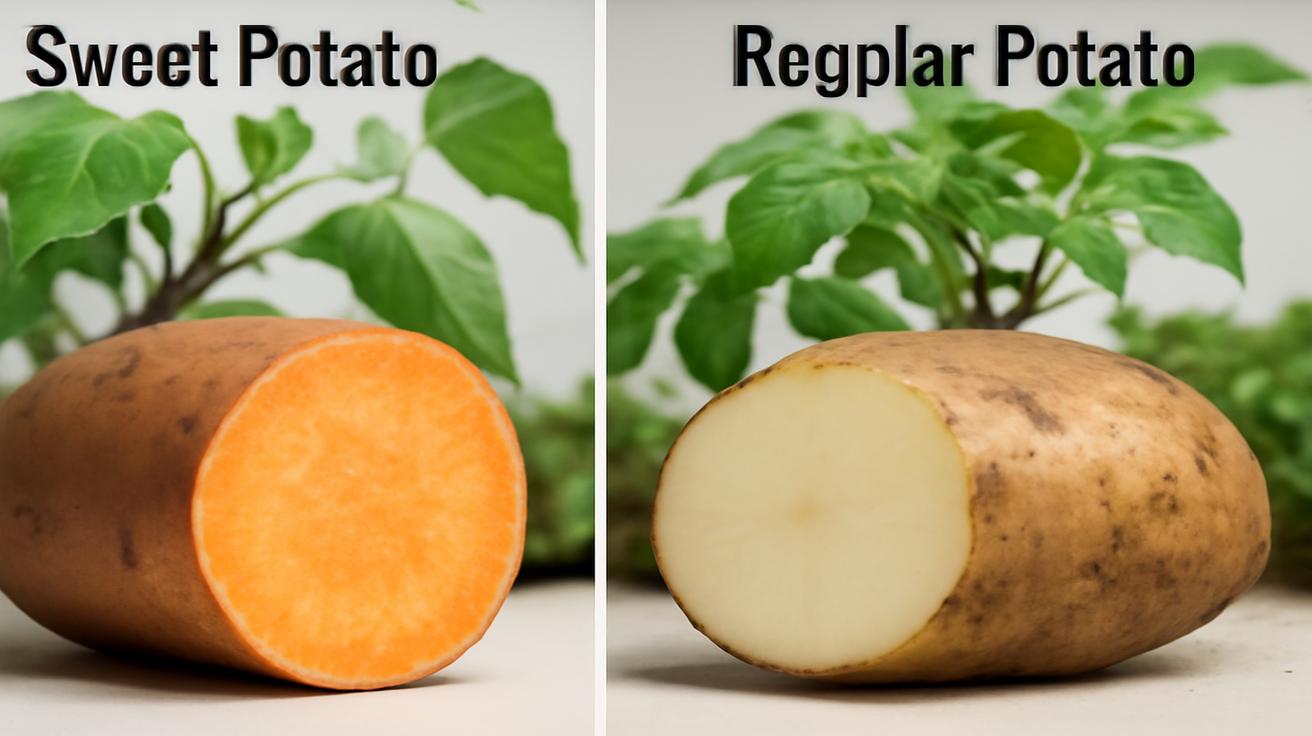
The farmer’s market on Saturday morning was the kind of place where decisions happen with your nose first. The air smelled of soil and citrus, roasting coffee, and something sweet and earthy that drew you down the aisle. You stopped in front of a stall overflowing with tubers: knobbly brown Russets, smooth red potatoes, delicate fingerlings, and, piled like a sunset, sweet potatoes in shades of copper, cream, and deep violet. Someone next to you picked up a sweet potato, weighed it in their hand, and said to the vendor, “So, these are just the healthier kind of potato, right?” The vendor smiled politely, but didn’t answer. Somewhere between the dirt under your fingernails and the recipes in your head, an unnoticed truth sat quietly in the crate: these two “potatoes” are more strangers than siblings.
The Family Secret Hiding in the Produce Aisle
If your brain has always grouped sweet potatoes and regular potatoes together like cousins at a family reunion, you’re not alone. They share a name, a vaguely similar shape, and the same humble role: the root that patiently waits underground while the world rushes on above. They show up together on holiday tables, in glossy food photos, and on menus where “fries” is a shared last name.
But in the quiet language of botany, family is not determined by taste or tradition. It’s written in flowers, in chromosomes, in invisible histories carved through millions of years of evolution. Under that system, sweet potatoes and regular potatoes barely speak to each other.
The ordinary potato—the one you mash, bake, or turn into fries—belongs to the nightshade family, Solanaceae. Its closest relatives are tomatoes, eggplants, and peppers. Sweet potatoes, on the other hand, come from an entirely different lineage: the morning glory family, Convolvulaceae. Their botanical kin are the delicate trumpet-shaped flowers that climb fences and twist themselves toward the light.
To most of us, that feels almost absurd. How could the dense, starchy comfort that anchors a shepherd’s pie be related to the glossy red tomato, while the sweet, orange, “healthier” potato is more closely tied to a dainty garden flower? Science, as it often does, shrugs and answers: because that’s how evolution wrote it.
Two Plants, Two Stories Underground
Before the Latin names and evolutionary timelines, you can sense the differences just by looking more closely at the plants themselves. Pretend you’re walking through two fields: one planted with regular potatoes, the other with sweet potatoes. They don’t behave the same way at all.
In the potato field, you’ll see compact green plants about knee-high, with rugged, matte leaves and small, star-shaped flowers—white, pink, or purple—with a yellow center that might remind you vaguely of tomato blossoms. Below the soil are swollen stems called tubers, each one swelling from a network of underground stems known as stolons. Those tubers are what we call “potatoes.”
Now cross the fence into the sweet potato field. The first thing you’ll notice is the sprawl. Sweet potato plants creep and trail, sending vines like green rivers along the ground. Their leaves often look like hearts or lobes, broad and glossy. When they flower, the blooms are soft trumpets, pale lavender or white with a deeper purple throat—pure morning glory in miniature. Underground, what you dig up are not stem tubers, but storage roots: swollen, modified roots the plant uses to hoard energy.
The difference sounds like a small technicality—tuber versus root—but in plant anatomy, it’s a bright line. Regular potatoes are thickened stems. Sweet potatoes are thickened roots. That single distinction is like discovering that two people who share a last name don’t actually share a family tree.
The Science of Distant Cousins
When botanists talk about relatedness, they’re not guessing by shape or flavor. They’re tracing evolutionary branches, looking at structures, reproduction, chromosomes, and, more recently, DNA. If potatoes and sweet potatoes were truly close cousins, their family histories would braid together somewhere not too far back. Instead, their branches diverged eons ago.
Both plants are flowering species, yes. Both are dicots, which means they sprout with two seed leaves rather than one, and that gives them a place together in a broad part of the plant kingdom. But step down a level and they split into different orders. Regular potatoes belong to the order Solanales; sweet potatoes fall into the order also called Solanales but in a wholly different family. Even when they share that order, their lineages within it are separated by deep evolutionary time.
Look at their flowers with a botanist’s eye. Potato flowers are more star-like, their petals fused only at the very base, with prominent yellow anthers clustered in the center. Sweet potato and morning glory flowers form more of a trumpet or funnel shape, the petals fused into a continuous tube. Their ovaries, stamens, and pollen structures all carry signatures that whisper to botanists: different families, different ancestries.
Modern genetic studies deepen the divide. The regular potato, Solanum tuberosum, aligns strongly with tomatoes and eggplants at the DNA level. The sweet potato, Ipomoea batatas, clusters with ornamental morning glories. Their genomes don’t line up in the way close relatives’ do; instead, they look like distant branches that happen to have evolved a similar trick—hiding energy underground in a swollen mass. It’s a classic case of convergent evolution: different lineages arriving at similar solutions to life’s problems.
Convergent Evolution: When Nature Repeats a Good Idea
Imagine you’re designing a plant to survive unpredictable weather, grazing animals, and seasonal changes. You might decide to stash energy somewhere safe, out of reach of most herbivores, protected from fire and frost. Underground, in other words. Many unrelated plants have independently evolved this strategy: carrots, cassava, beets, taro, parsnips, potatoes, sweet potatoes. Different families, similar idea.
In the same way that birds, bats, and butterflies all developed wings separately to solve the problem of flight, sweet potatoes and regular potatoes separately discovered the value of an underground pantry. They didn’t inherit the idea from a common recent ancestor; they invented it in parallel. What you see in the produce aisle is less a set of siblings and more a set of common solutions: “Oh, that worked for you too?”
The Table Tells a Different Story
Supermarkets and recipes, of course, have their own way of arranging reality. They care less about chromosomes and more about how a food behaves in a pan, or how it fits into a cultural story. This is where the two “potatoes” get tangled together again.
We boil, roast, and fry them in similar ways. We cube them into stews, slice them into chips, and bake them whole in their jackets. They both show up in comfort food and peasant cuisines, in expensive restaurants and weeknight dinners. To the cook, potatoes and sweet potatoes share a job description: hearty, filling, and versatile.
But even in the kitchen, under the sizzle of oil, their separate identities keep peeking through. Regular potatoes carry more starch and less sugar. Their flesh can be fluffy or waxy, depending on the variety, and that starch transforms into a creamy mash or a crisp fry. Sweet potatoes, despite the name, are not always intensely sweet, but they do carry more natural sugars and beta-carotene, especially in the orange-fleshed types. Roast them, and those sugars caramelize at the edges, turning the cubes almost candied.
We often talk about sweet potatoes as the “healthier” potato, but that’s more food folklore than simple truth. They’re just different. To give you a quick, simple snapshot, imagine both baked without any toppings:
| Nutrient (per 100 g, baked) | Regular Potato | Sweet Potato |
|---|---|---|
| Calories | ~93 kcal | ~90 kcal |
| Carbohydrates | ~21 g | ~21 g |
| Fiber | ~2.2 g | ~3.3 g |
| Vitamin A | Minimal | Very high (as beta-carotene in orange types) |
| Vitamin C | Moderate | Moderate |
In other words, neither one is the hero or the villain. They’re just two different plants offering two different nutritional personalities, shaped by their separate lineages. One isn’t a “better” version of the other any more than a tomato is a better version of a plum.
Why They Share a Name at All
If they’re so unrelated, how did we end up calling them both potatoes? The answer lies in history and human habit. The word “potato” itself has deep roots in the Caribbean: it’s thought to come from “batata,” used in Taíno languages for what we now call the sweet potato, and “papa,” from the Quechua language in the Andes, where the regular potato was first domesticated. Over time, European languages tangled batata and papa together, and “potato” emerged as a broad, generous term for starchy underground foods that came from the “New World.”
When Europeans encountered sweet potatoes and regular potatoes, they filed them under the same mental drawer: edible, tuber-like things from across the ocean. Names stuck harder than botanical accuracy. Even now, confusion persists. In some regions, people call sweet potatoes “yams,” despite those being a completely different family again (yams are in the Dioscoreaceae family). Science keeps drawing fine lines; language, meanwhile, happily smudges them.
What Flowers Reveal That Roots Can’t
If you really want to test the relationship between plants, watch them bloom. Gardeners sometimes get a front-row seat to this realization.
Grow a potato plant in your backyard, and later in the season you might catch it briefly wearing dainty star flowers, often followed by small green fruits that resemble cherry tomatoes (and are toxic, by the way). The resemblance to other nightshade family members—from tomatoes to petunias—is impossible to miss once you notice it.
Grow sweet potatoes nearby, and an entirely different show appears. Their vines meander across the soil or up a trellis, and when they decide to flower, they produce trumpets like mini-morning glories. In the cool of early morning, those blossoms funnel the light, opening to pollinators. If you’ve ever seen wild morning glories weaving through a fence, you’ve essentially seen a sweet potato cousin.
To botanists, these flowers speak more clearly about ancestry than the underground parts we eat. Roots and tubers can evolve similar shapes due to the pressures of survival. But flowers are all about reproduction, and their structures are tightly linked to the plant’s evolutionary lineage. The sweet potato’s floral architecture says, unmistakably: “I belong with the climbers and the morning glories.” The regular potato’s flowers say: “My kin are tomatoes and peppers.”
The Genetic Breadcrumbs
In modern labs, scientists don’t stop at flowers. They unravel the spiral ladders of DNA itself. When they compare genes across species, close relatives share long stretches of near-identical code, like long paragraphs copied from the same book. Distant relatives share only short phrases, echoes from very long ago.
These genetic comparisons confirm what the flowers hint at. Potatoes cluster genetically with other Solanum species; sweet potatoes cluster with Ipomoea, a genus packed with morning glories. Their closest relatives are nowhere near each other’s family reunions. Whatever resemblance we see above our cutting boards is a matter of surface convergence, not shared bloodlines.
Why This Difference Matters More Than Trivia
You might be wondering why any of this matters beyond being a fun fact to drop at dinner. But these quiet distinctions influence how we farm, how we breed crops, and how we navigate a changing climate.
Because potatoes and sweet potatoes belong to different families, they carry different diseases and pests, and they respond differently to environmental stress. A blight that devastates potato crops may not touch sweet potatoes. A pest that loves sweet potatoes might ignore potatoes entirely. Plant breeders, who work to improve yields and resilience, can often cross plants within the same species or family, but they can’t just cross a potato with a sweet potato. Their genetic languages are too different.
Next time you read about efforts to develop drought-tolerant crops, to store more carbon in soils, or to rescue food systems from disease, the deep family trees behind our foods matter. Knowing that these two “potatoes” are not interchangeable plants helps scientists decide where to look for solutions. It shapes which wild relatives they study for helpful traits, and how they protect genetic diversity in seed banks.
On a simpler, everyday level, understanding that sweet potatoes are not just “orange potatoes” nudges us to treat them with a bit more curiosity. Rather than swapping them one-for-one in recipes, we might ask: What does this plant want to do in the pan? How does its ancestry express itself in flavor and texture?
A New Way to Look at a Familiar Pile of Roots
Back at that farmer’s market stall, you pick up a regular potato in one hand and a sweet potato in the other. They feel like members of the same team—rugged, dependable, unfussy. But now you can almost see the invisible threads running out behind each one.
In the potato, a line stretches back through high Andean fields, to Indigenous farmers who patiently selected plants for centuries, gradually turning wild, bitter tubers into a staple that would eventually cross oceans and feed empires. Its family branches out into tomatoes glistening in summer gardens, peppers in bright reds and greens, eggplants with glossy purple skins.
In the sweet potato, the line runs through tropical and subtropical landscapes, along the Pacific, dancing across Polynesian islands and African markets, weaving itself into cuisines from Japan to the Caribbean. Its relatives climb fences and hedges, opening purple throats to morning sun.
Holding them, you’re not just planning dinner. You’re cradling two different stories evolution wrote about survival, energy, and place—stories that just happen to end, coincidentally, in something we like to roast with olive oil and salt.
FAQ
Are sweet potatoes and regular potatoes from the same plant family?
No. Regular potatoes belong to the nightshade family (Solanaceae), which also includes tomatoes, eggplants, and peppers. Sweet potatoes belong to the morning glory family (Convolvulaceae), which includes ornamental morning glories.
Do sweet potatoes and regular potatoes grow the same way underground?
They grow differently. Regular potatoes form tubers, which are swollen underground stems. Sweet potatoes form storage roots, which are thickened roots. This is a key anatomical difference between them.
Is one healthier than the other: sweet potatoes or regular potatoes?
Neither is universally “healthier”; they’re just different. Sweet potatoes, especially orange ones, are rich in beta-carotene (a form of vitamin A) and have slightly more fiber. Regular potatoes can be good sources of vitamin C and potassium. Overall nutrition depends on preparation and portion size.
Are sweet potatoes the same as yams?
No. Yams are a different group altogether, belonging to the Dioscoreaceae family. In some regions, especially in North America, sweet potatoes are sometimes called “yams” in stores, but botanically they’re not the same.
Can potatoes and sweet potatoes crossbreed?
No. They are too distantly related. Their genetic and reproductive systems are incompatible, so you cannot cross a potato with a sweet potato to create a hybrid plant.
Why do they both have “potato” in the name if they’re not related?
The shared name comes from historical language mixing and the fact that both are starchy underground foods. Early European encounters with these crops blurred indigenous words like “batata” (sweet potato) and “papa” (potato), leading to the common term “potato” for both.
Do their flowers really look that different?
Yes. Potato flowers are star-shaped, often white or purple with yellow centers, resembling tomato flowers. Sweet potato flowers look like small morning glories—trumpet-shaped, often white or lilac with a darker throat. These flower differences are major clues to their separate plant families.