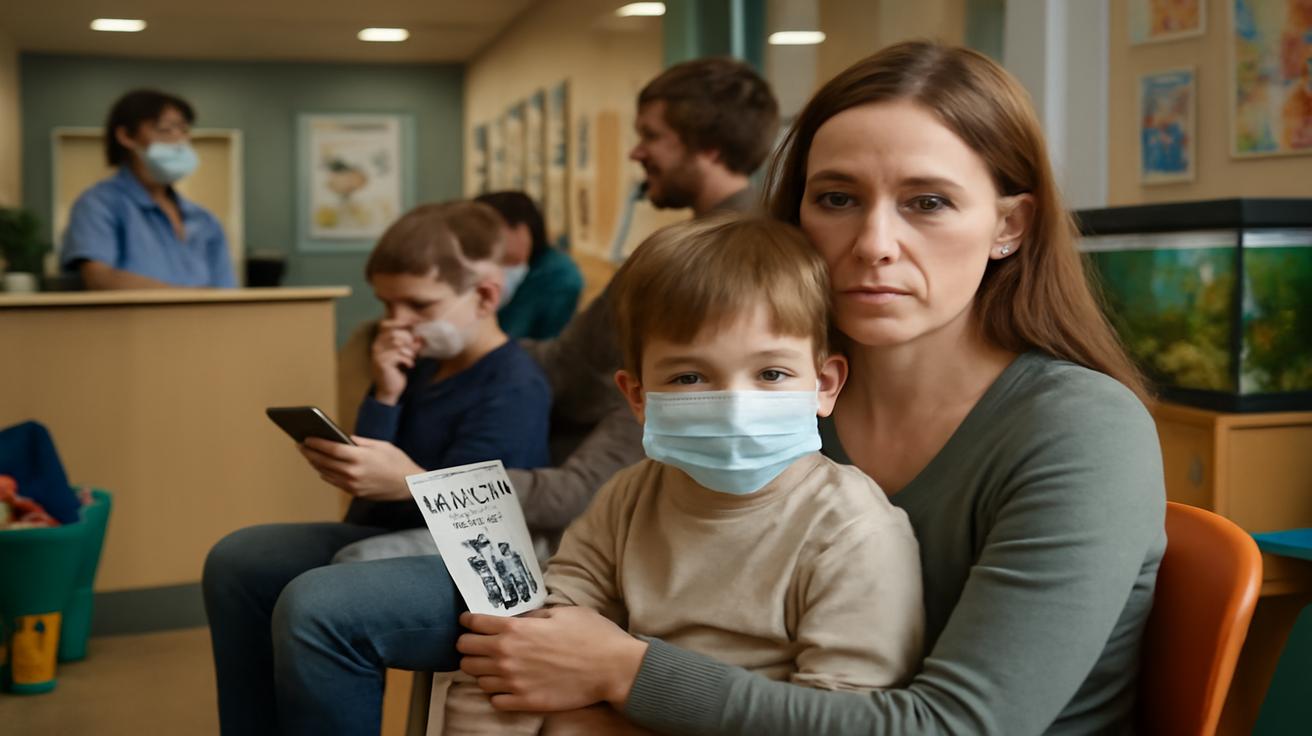
The waiting room smells faintly of antiseptic and crayons. A fish tank gurgles in the corner, its neon tetras slipping through blue light like tiny living sparks. A toddler in a dinosaur T-shirt coughs, a wet, rattling sound that makes a few parents look up, then quickly look away. On the far chair, a woman in yoga pants scrolls her phone, her child climbing over her knees like a small, restless mountain goat. Somewhere behind the closed door, a nurse calls a name, and the tension in the room tightens almost imperceptibly. It’s vaccine day at the pediatrician’s office, and whether anyone says it out loud or not, freedom is in the air—though not in the way many people think.
When “My Child, My Choice” Becomes Everyone’s Problem
If you listen closely lately—in playgrounds, in Facebook groups, in those low-simmering conversations at family gatherings—you can hear a familiar phrase tossed around like a shield: “It’s my right. It’s my freedom.” It sounds so simple, almost noble. Who wouldn’t want the freedom to decide what happens to their child’s body?
But there’s an invisible piece missing from that sentence, a quiet ending we rarely say out loud: “…no matter what it does to anyone else.”
Vaccines are one of the rare places where our private choices don’t stay private. They follow us, drifting like breath in winter air, carried on droplets from a sneeze in the grocery aisle or a cough in line at the movies. Immunity is not a locked door around one child. It’s a shared roof we all stand under, whether we like it or not.
Parents who refuse childhood vaccines often see themselves as rebels against a fearful, over-medicalized world. They talk about “natural immunity,” about “letting kids’ bodies do what they’re made to do.” It’s an appealing story—nature as benevolent, disease as a sort of tough-love teacher. But nature, if you’ve ever watched a predator take down a fawn or a parasite hollow out a caterpillar, is not gentle. It is not sentimental. It is indifferent.
The diseases we vaccinate children against are not abstract monsters from some bygone era. They are still here, waiting at the edges of our loosened defenses. Measles, pertussis, polio—names that sound almost quaint, like sepia-toned photos or dusty family stories—are, in reality, predators. Vaccines are not chains that bind our freedom; they are fences that keep the predators from the playground.
The Quiet Mechanics of Herd Immunity
Step outside your front door in the early morning, when the neighborhood is still sleepy and the sun is just catching the rims of mailboxes and car roofs. Behind the quiet, there’s an invisible network at work: electricity humming through cables, water rushing through pipes, data flashing through fiber lines. Herd immunity is like that—unseen, mostly unnoticed, yet holding everything together.
When enough people are vaccinated, a disease fizzles out instead of catching fire. It jumps from one person, finds no easy landing in the next, and dies there, stranded. This is herd immunity: not a single person’s force field, but a woven fabric of protection.
Some people can’t be vaccinated—newborns, kids on chemotherapy, children with certain immune disorders. Their safety is not a private matter; it is literally made from the choices of the people around them. In school cafeterias, in daycare nap rooms, in church nurseries, there are always a few children whose lives hang on the immunity of others.
When parents say, “I’m not vaccinating my child; it’s my personal decision,” what they’re actually saying—whether they realize it or not—is: “I’m comfortable putting vulnerable kids at higher risk so I can feel better about my own choices.”
That may sound harsh. But ethics is often uncomfortable when it bumps up against our self-image. Freedom, in any real and meaningful sense, isn’t just about what we’re allowed to do; it’s about what we owe each other when our actions spill beyond our own front doors.
The Numbers That Tell a Very Human Story
Statistics, by themselves, can feel cold and distant. But behind each digit is a face: a child with a favorite stuffed animal, a parent pacing a hospital hallway, a nurse watching oxygen saturation numbers on a small, glowing monitor.
| Disease | What It Can Do to a Child | Estimated Deaths Before Widespread Vaccines (per year, globally) |
|---|---|---|
| Measles | Pneumonia, brain swelling, permanent hearing loss, death | Over 2 million |
| Pertussis (whooping cough) | Severe coughing fits, broken ribs, brain damage, death in infants | Hundreds of thousands |
| Polio | Permanent paralysis, breathing failure, lifelong disability | Hundreds of thousands |
| Tetanus | Painful muscle spasms, locked jaw, breathing problems, death | Tens of thousands |
Vaccines pulled those numbers down, year after year, like a tide going out. Entire hospital wards once filled with iron lungs and measles cases emptied. Doctors who had trained on polio stopped seeing it in practice. For a brief moment in history, humanity wrestled a group of ancient killers to the ground and held them there.
But all it takes is a little slippage—a few more parents deciding to “wait,” a handful more insisting that “these diseases aren’t really a problem anymore”—and those old predators start sniffing around again. Small outbreaks flicker on the map: a cluster of measles cases in a school where many kids are unvaccinated, a resurgence of whooping cough in a community that’s proud of its “natural parenting” ethos.
Each of those outbreaks is not just a number; it’s proof that personal choices are rippling outward, cutting holes in that shared roof we all stand under.
The Seductive Myth of “Natural” Freedom
There’s a comforting fantasy at the heart of vaccine refusal: the idea that nature, un-interfered with, is a wise, self-correcting system. In this story, childhood infections are almost like rites of passage, the body’s way of “learning” and “strengthening itself.” The language is soft and reassuring. It’s also deeply misleading.
Nature, left to its own devices, did not give us antibiotics, clean water systems, or NICUs. It did not lower infant mortality or increase life expectancy. Humans did that: by pushing back against “what naturally happens” with sanitation, science, and yes, vaccines.
Polio is natural. Smallpox was natural. Rabies is natural. So is a venomous snakebite, or a hurricane. “Natural” is not the same as “good,” and certainly not the same as “safe.”
The word “freedom” gets bound up with these myths. Freedom to let kids “build immunity the way nature intended.” Freedom from “toxins” and “pharmaceutical interference.” Freedom to be the kind of parent who trusts intuition over expert consensus. In a culture that often feels cold, rushed, and disconnected, that narrative can feel like warm shelter.
But imagine a coastal village where some families decide they don’t believe in sea walls. “We don’t want to interfere with the ocean,” they say. “We feel safer without this concrete barrier; it’s our property, our decision.” The wall, though, doesn’t just protect their house—it dampens the entire storm surge for everyone inland. Tearing down one section doesn’t only expose their home; it alters the way the waves hit the entire shoreline.
Refusing vaccines is a bit like punching a hole in the sea wall and calling it “freedom.” The people on the inland streets—newborns, kids with cancer, elders with compromised immunity—don’t get a vote in that decision. They simply get wetter, and sometimes, they drown.
Fear, Misinformation, and the Stories We Tell Ourselves
Sit in the kitchen with a parent who’s decided against vaccines, and you won’t usually find a cartoon villain twirling a mustache. You’ll find worry. You’ll find someone up late at night on their phone, scrolling through forums and videos and personal testimonies that feel more real than any journal article ever could.
Human brains are built for stories, not spreadsheets. If you hear about one child who had a seizure after a vaccine, that single story can tower over millions of children who were protected without incident. The rare becomes enormous; the common becomes invisible.
Anti-vaccine communities are exquisitely tailored to this wiring. They offer dramatic narratives—brave parents versus corrupt systems, intuitive mothers versus cold experts, fragile children versus invisible harm. The algorithms on social media feed these stories back to those who linger over them, like a digital echo chamber designed for anxiety.
Underneath, there’s a deep, almost primal fear: What if I harm my child by trusting the wrong people? What if I miss a hidden danger? When that fear meets a culture that often feels dismissive, rushed, and technical, it’s no wonder some parents turn away from doctors and toward those who speak in emotional, certain tones.
But certainty isn’t the same as truth. Science, at its best, is humble, constantly revising itself based on better evidence. That humility can sound like doubt: “Very rare,” “extremely low risk,” “we continue to monitor.” Fear-based communities offer a different tone: “They’re lying to you. We know the real story.” In an anxious mind, one of those voices lands a lot more neatly.
Still, the responsibility doesn’t disappear just because fear is understandable. When that fear leads to decisions that put other people’s children at risk, we cross a line. Compassion for the worrier cannot mean silence about the consequences of their choices.
Freedom, But for Whom?
People often frame this debate as the individual versus the state: “The government can’t tell me what to do with my child.” It’s a vivid conflict, but it’s incomplete. There’s a third player missing from that picture: everyone else.
Freedom, in a shared world, is always overlapping. Your freedom to drive however you like ends where my right not to be hit begins. Your freedom to smoke indoors ends where the lungs of the people around you begin. We place limits on individual actions all the time when they carry a high risk of harming others.
Vaccination is no different. Refusing a vaccine is not like declining dessert. It’s more like deciding not to maintain your brakes because you personally believe you won’t need to stop quickly—then taking that car onto public roads.
We rarely describe seatbelt laws or drunk driving limits as “tyranny.” We recognize them as guardrails that protect the many from the dangerous choices of a few. Vaccine requirements for school, daycare, and public gathering spaces inhabit that same moral terrain: not perfect, not always gracefully implemented, but rooted in the idea that no person’s freedom includes the right to recklessly endanger strangers.
Remembering What We Almost Forgot
Talk to an older pediatrician or grandparent, and you may see their face change when they hear people dismiss measles as “just a rash” or polio as “overblown.” They remember.
They remember children gasping for air, their chests heaving against ribs that couldn’t expand enough. They remember wards full of small bodies in metal cylinders, the slow, mechanical breath of iron lungs. They remember funerals—tiny coffins, tiny shoes polished and set aside.
Those memories are fading. There is an entire generation of parents who have never seen these diseases up close. In a way, that’s the greatest success of vaccines: they’ve made their own necessity harder to see.
Contrast that with the sharp vividness of a viral post: a child crying after a shot, a parent describing months of health problems they attribute—sometimes incorrectly, sometimes without evidence—to a vaccine. The human mind, once again, leans toward what it can picture, not what it has been spared from seeing.
But absence is not proof of irrelevance. The very quietness around vaccine-preventable diseases in some parts of the world is the result of decades of collective action. Opting out of that history while still benefiting from it is, bluntly, a kind of free-riding. You are letting others do the work of risk, compliance, and social cooperation while enjoying the lowered disease transmission they create.
Truly valuing freedom should mean valuing the conditions that make it possible: bodies not wracked by preventable illness, hospital beds not filled with children struggling to breathe, parents not bankrupted by medical crises that never had to happen. Vaccines are part of that invisible infrastructure of freedom, as essential as clean water and safe roads.
Reclaiming a Different Kind of Freedom
Imagine, for a moment, a different story of freedom around vaccines—one that doesn’t pit the individual against the collective, but weaves them together.
In this story, rolling up a tiny sleeve in a clinic isn’t an act of submission; it’s an act of solidarity. A parent doesn’t just protect their own child from measles; they shield the baby down the street who is still too young for the shot, the classmate on steroids for a chronic illness, the elderly neighbor whose immune system is growing frail.
In this version, freedom is not a solitary figure standing on a hill, but a crowded playground where no one’s child dies from a disease we know how to prevent. It’s parents able to plan futures instead of funerals. It’s kids running, sticky with ice cream and summer sweat, not tethered to respirators in pediatric intensive care units.
We could speak of vaccine appointments not as grim obligations but as small, shared rituals of care—quiet declarations that we’re willing to do a brief, uncomfortable thing now to ward off far greater suffering later. A pinprick in the arm, a Band-Aid, a sticker, a lollipop, and beneath it all, a vast, humming network of protection.
That is a kind of freedom worth defending: not just the freedom to choose, but the freedom, collectively, from needless loss. The freedom to grow up, to grow old, to gather, to breathe each other’s air without gambling children’s lives on myths and misinformation.
Frequently Asked Questions
Are vaccines 100% safe?
Nothing we do in medicine—or in life—is 100% risk-free, including driving to the doctor’s office. Vaccines can have side effects, most of them mild and short-lived (soreness, low fever, fussiness). Serious side effects are extremely rare, far rarer than the complications of the diseases they prevent. Decades of research and monitoring systems are in place to track and investigate any possible safety issues.
What about parents who say their child was harmed by a vaccine?
Their pain is real, and it deserves empathy. But personal stories, while powerful, don’t always show cause and effect. Children sometimes develop health issues in the same years they receive many vaccines, and our minds naturally connect the two. Large-scale studies comparing vaccinated and unvaccinated children overwhelmingly show that vaccines are not responsible for the conditions most often blamed on them, like autism.
Isn’t it enough if most other kids are vaccinated?
Relying on others to vaccinate while opting out yourself is both ethically shaky and practically risky. Herd immunity only works when a very high percentage of people are immune—often over 90–95% for highly contagious diseases like measles. As more people refuse vaccines, that threshold slips, and outbreaks become more likely, affecting everyone, including your own family.
What about “natural immunity” from getting the disease?
Yes, many infections do create immunity—but often at a terrible price. Measles can cause pneumonia and brain inflammation. Pertussis can kill infants. Polio can paralyze. Vaccines teach the immune system to recognize these pathogens without making a child endure the full, dangerous illness. It’s like learning to swim in the shallow end under supervision instead of being thrown into a stormy sea.
How can I talk to a vaccine-hesitant friend or family member?
Start with listening, not lecturing. Ask what they’re worried about and where they heard it. Acknowledge that wanting to protect your child is a good impulse. Then, gently offer clear, evidence-based information from pediatricians and public health experts. Share that vaccines are not just about their child, but also about protecting babies, medically fragile kids, and elders in their community. Conversations rooted in respect often go further than arguments based on shame.