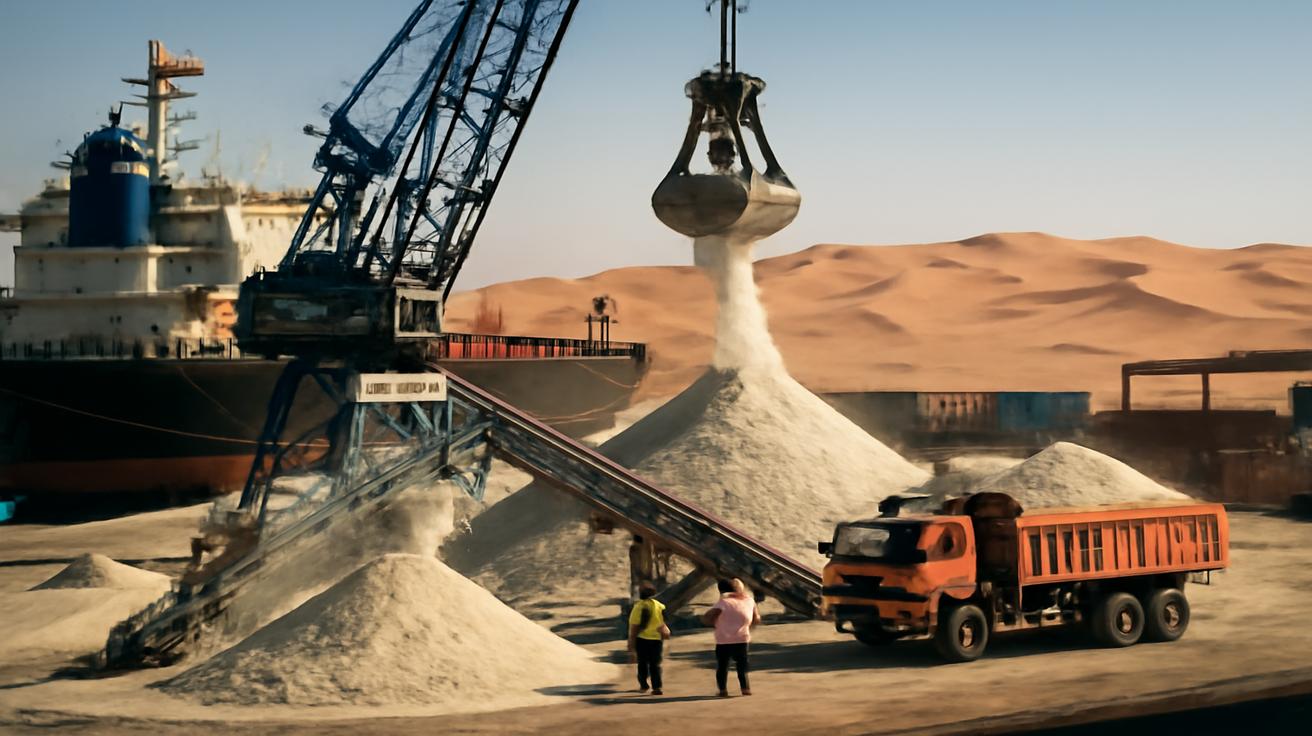
The man at the port looks tired. Behind him, the Arabian sun glows like molten copper on the horizon, turning the water into a sheet of hammered gold. Towering above him are mountains of sand–pale, grainy, utterly unremarkable to the casual eye. A crane groans. A conveyor belt hums. And from the belly of a ship registered on the other side of the world, thousands of tons of imported sand spill into a country that is, by any sensible definition, made of sand.
Why Desert Kingdoms Are Buying Sand
It sounds like the premise of a bad joke: Saudi Arabia and the United Arab Emirates, home to some of the largest deserts on earth, are paying to import millions of tons of sand every year. Not just a few specialty shipments for labs or art projects, but an industrial torrent arriving in steady waves on cargo ships alongside oil tankers and container vessels.
Walk through Dubai’s harbor at dawn and you can see the evidence stacked along the waterfront: carefully graded piles of beige and gray, tagged and tracked, waiting for their turn to become the invisible skeleton of skyscrapers, artificial islands, highways, glass towers, and ports. The air smells like salt, diesel, and dust. A warm breeze pushes across the Gulf, carrying a faint rasp of grit that settles on skin and teeth.
It feels absurd. How can a desert nation possibly lack sand? But the contradiction is the kind that reveals a deeper story. The sand that stretches in waves across the Empty Quarter or billows in the dunes beyond Riyadh is not the sand that makes cities. In the brutal, unimaginative world of industrial construction, not all sand is equal.
The Wrong Kind of Sand in a Sea of Sand
The fine, wind-blown desert sand that defines Saudi Arabia and the UAE is beautiful but almost useless for building. Over thousands of years, those grains have been polished into smooth, rounded marbles by relentless winds. They slip and slide over one another like tiny ball bearings. Try to lock them into concrete and the mixture won’t hold the way it should. The grains don’t interlock; they don’t bite.
What engineers and developers crave is angular sand–the kind produced by the grinding violence of rivers and glacial erosion, where stones scrape and fracture into jagged, irregular grains. This “sharp” sand grips. It bonds with cement. It forms the solid concrete backbone of towers, bridges, ports, and man-made islands. It’s also crucial for making glass and silicon chips. You can’t just scoop it out of the nearest dune.
So the Gulf monarchies, despite sitting atop an ocean of sand, find themselves in the surreal position of importing the one material most people assume they have in infinite supply. The desert isn’t wrong; it’s just the wrong kind.
The Hidden Engine of Modern Cities
Sand is the quiet hero of the modern world. Concrete is mostly sand. Asphalt is sand and gravel. Glass is sand transformed under fire. Every skyscraper piercing Dubai’s horizon, every freeway in Abu Dhabi, every glassy mall, airport terminal, or waterfront promenade is, at its core, built from sand. In a concrete-heavy city, up to three-quarters of the built environment, by volume, is basically stone and sand bound together.
Once you notice this, the entire Gulf region starts to look different. Those glittering skylines become massive piles of compacted, arranged sand. The airport runways that glimmer at night, the artificial islands shaped like palm trees or entire maps of the world, the highways slicing through the desert; all of them are sand made obedient.
This demand is staggering. To build land out of sea, as both Saudi Arabia and the UAE have done in their race to reshape coastlines, takes unimaginable quantities of aggregate. The creation of Dubai’s Palm Jumeirah alone used more than 90 million cubic meters of sand and rock. That’s enough to bury Manhattan under a layer several meters thick. And the Palm is just one project in one city of one country dedicated to building bigger, faster, bolder.
Now imagine that multiplied across decades of construction booms, mega-projects, and ambitious visions to turn desert coastlines into economic engines. The Gulf’s hunger for high-quality sand is not just large; it’s almost insatiable.
The Global Hunt for the Right Grain
Because their own desert sand is often unsuitable, Saudi Arabia and the UAE turn outward. They import sand from riverbeds, quarries, and coasts in countries that have what they need: coarser, more angular grains. Barges and bulk carriers move this material in quiet flotillas, often without the kind of global attention lavished on oil or gas.
The trade rarely makes front-page headlines, but the numbers are enormous. Across the world, sand is now the most extracted solid material after water. The Gulf’s glittering towers and reclaimed islands are part of a much bigger story, one in which rivers are dredged, beaches scraped, and wetlands chewed away to feed cities’ endless appetites.
In many exporting countries, this extraction comes at a high cost. Riverbanks collapse. Fish populations crash. Coastal communities watch as their shorelines retreat grain by grain. In some regions, “sand mafias” have emerged–criminal networks that strip away river sand at night, using bribery and violence to silence opposition. All this to sustain the dreams of somewhere else; all this to pour foundations in cities far away.
More Than Construction: A Suspiciously Strategic Resource
To many observers, this sand trade doesn’t just look environmentally destructive; it looks suspiciously strategic. Because behind the cranes and concrete mixers lies a darker realization: as the world urbanizes, high-quality sand is running out.
This sounds impossible until you trace what’s happening. Dams trap sediments that would naturally replenish river deltas. Coasts retreat under the combined pressure of climate change and over-extraction. Some countries, having seen their rivers hollowed out to feed foreign appetites, have imposed bans or strict controls on sand exports. Others are quietly watching the market tighten, sensing leverage in what was once considered worthless dirt.
Saudi Arabia and the UAE, with their ambitious plans for new industrial zones, futuristic cities, tourism hubs, and artificial coastlines, cannot afford to be caught short. In this light, their import of millions of tons of sand is less absurd and more like an arcane, quietly fierce competition for one of the last cheap raw materials holding global development together.
When a Cheap Material Becomes Geo-Strategic
Both Gulf states have learned, from oil and water, how quickly a basic resource can become a political weapon or vulnerability. Sand may not have the romance of crude oil or the visceral urgency of fresh water, but it underpins trillions of dollars in infrastructure. Without it, construction slows, housing becomes more expensive, and growth plans stumble.
Look closely, and you see the outlines of a new geopolitical puzzle taking shape around sand:
- Countries rich in usable sand – in river systems, lakebeds, and coastal shelves – sit on a silent bargaining chip.
- Rapidly urbanizing regions in Asia and the Middle East depend heavily on imports to keep building.
- Environmental fallout from sand mining is starting to provoke political backlash, regulation, and sometimes conflict.
In this context, importing sand is not just about pouring concrete today; it’s about buying time, influence, and insurance in a world where the easy grains have already been taken from many of the world’s rivers. The absurdity melts away, revealing something much sharper: a quiet scramble for the mineral skeleton of the future.
The Gulf’s Grand Projects and the Weight of Sand
To understand why Saudi Arabia and the UAE are willing to chase sand across oceans, you have to enter the mind of their mega-project planners. Both countries are racing to transform their economies–Saudi Arabia with sprawling visions of new linear cities and tourism corridors; the UAE with its relentless expansion of ports, financial hubs, islands, and luxury districts.
These are not modest initiatives. They are grand, cinematic plans carved into policy documents and marketing reels: cities in the desert promising car-free living; entertainment hubs on reclaimed coasts; logistics megazones stitched together with highways and rail. Every one of these ideas is built from the same granular reality: if you want to materialize visions in steel and glass, you need cement, and if you need cement, you need mountains of sand.
It is easy, watching the stunning time-lapse videos and digital renders, to forget the raw physics: all that mass must come from somewhere. Somewhere on earth, hills are being crushed, riverbeds dredged, shallow marine shelves scraped clean to form the bulk of those glossy masterplans.
A Trade That Leaves No Label
Walk through a luxury mall in Abu Dhabi or step onto a plush hotel balcony in Jeddah, and there is no sign pointing to the origin of the sand beneath your feet. There’s no label telling you whether the grains in that concrete came from a river in South Asia, a pit in Africa, or a coastal shelf in another part of the Middle East.
And yet those origins matter. Each shipment represents a chain of consequences: farmers downstream dealing with altered river flows; communities watching as the water turns cloudy; fishermen finding fewer fish in once-rich waters. The Gulf’s imports are, in many ways, a mirror of its earlier energy story–an extraction-fueled transformation, except this time the resource is not buried beneath their own soil but stripped from someone else’s.
The pattern is painfully familiar: wealthy countries turn to global markets to solve local constraints. They secure what they need to keep building, often insulated from the slow-motion damage dispersing across poorer landscapes. The geopolitical game around sand is not only about control over material flows. It is also about who pays the environmental bill.
Sand, Power, and the Illusion of Endless Growth
Once you zoom out, the sand trade between desert countries and the rest of the world becomes a lens onto something larger: the idea of endless growth built on finite, physical resources. Sand, of all things, exposes the limits of that fantasy.
In theory, we love to believe that technology will find a way around shortages. In practice, we still depend on raw, low-tech materials in staggering volumes. You cannot digitize concrete. You cannot stream a highway. You cannot “cloud compute” a port. A future in which cities keep rising, coastlines keep expanding, and new industrial zones keep appearing on the map is a future that demands ever more sand.
Saudi Arabia and the UAE, with their visions of tomorrow’s cities glittering in the desert, are at the very edge of that paradox. Their leaders speak fluent futurism–AI, green hydrogen, smart cities–but beneath all that lies a 19th-century material reality: you still have to move rocks.
Last Cheap Resource, Rising Hidden Costs
For now, sand remains relatively cheap per ton. But cheap is not the same as abundant. The real cost is hidden in disappearing wetlands, collapsing riverbanks, increased flooding, lost fisheries, and social tension in exporting regions. These are externalized onto communities that rarely share in the wealth their sand helps create.
As regulations tighten, as rivers are protected, and as climate pressures mount, that cheapness will erode. Countries that locked in supply chains early, nurtured relationships with exporters, or invested in their own aggregate industries may find themselves with a quiet advantage. Others may discover that the very foundation of their growth model–the literal foundation–is suddenly fragile.
It is here that accusations of a “brutal geopolitical game” start to make sense. You don’t need gunboats or dramatic sanctions to wage this kind of contest. You only need contracts, influence, and time. You need to ensure that when everyone else begins to hit sand scarcity in earnest, your projects can still pour concrete, your ports can still expand, and your ambitions are not choked off by a humble grain.
Can We Build Without Devouring the Earth?
There is another, quieter conversation emerging from this desert-sand paradox: how do we build without devouring the landscapes that sustain us? The answer is not simple, but the urgency is starting to register even in the places most addicted to concrete.
Engineers and planners are experimenting with alternatives: recycled construction waste crushed into usable aggregate; industrial byproducts like slag and fly ash; new kinds of concrete that use less sand or rely on different chemistries. Coastal protection projects explore softer, nature-based solutions that might reduce the need for continuous armor of rock and sand-filled structures.
In Saudi Arabia and the UAE, there is growing talk–though still often more rhetorical than real–about sustainable building, circular economies, and reducing material footprints. Ambitious, futuristic projects market themselves as environmentally forward-thinking, promising lower-impact construction and smarter land use. The reality on the ground remains intensely resource-heavy, but the language is changing, and language is often the first tremor before policy and practice begin to shift.
A Different Story Hidden in the Grains
If sand has become a symbol of geopolitical struggle, it can also become a measure of responsibility. Imagine if the story of where the sand came from was as visible as an architect’s rendering–if the origin of each shipment, the ecological cost of each barge, were publicly counted and considered.
Such transparency is unlikely to materialize overnight, especially in a world where the sand trade often thrives in the shadows. Yet as pressure builds from environmental advocates, local communities, and even investors wary of climate and biodiversity risks, the quiet trade may become harder to ignore.
For Gulf states, this presents a choice. They can remain central players in a game that grinds distant riverbeds into dust, or they can push harder toward technologies, regulations, and designs that reduce the need to import nature in bulk. In doing so, they would not be acting out of charity; they would be hedging against a future where sand, like oil once did, becomes a contested resource with volatile prices and rising political costs.
A Grain of Truth in an “Absurd” Trade
Stand again at the port, as the sun tilts lower and the sky over the Gulf turns mauve and bruise-purple. The cranes are still moving. Ships ease in and out of the harbor, lights blinking as they align with channels and berths. On the surface, this is a scene of perfectly ordinary commerce: cargo in, cargo out, paperwork stamped, engines idling.
But just beneath that surface lies a story that stretches from remote river valleys to boardrooms in Riyadh, from eroding deltas to engineering offices in Dubai. The “absurd” fact that desert countries import sand is not a punchline; it is a quiet alarm bell tolling for the way we build our world.
Sand, once overlooked, has become a mirror: it reflects our appetite for growth, our willingness to outsource ecological damage, and our tendency to underestimate the limits of seemingly ordinary materials. It also reveals how power operates in the shadows of global trade–not always with drama, sometimes just with contracts and cranes, one shipload of grains at a time.
As Saudi Arabia and the UAE continue to craft new cities and coasts from foreign sediment, the question is not whether this trade is absurd. The question is what happens when the last cheap grains are spoken for, when the world realizes that even sand–the humblest of materials underfoot–is something we can no longer take for granted.
| Aspect | Saudi Arabia & UAE | Global Context |
|---|---|---|
| Local Sand Type | Mostly fine, wind-blown desert sand; grains are smooth and rounded | Rivers and glacial regions provide angular, coarse construction sand |
| Main Use of Imported Sand | Concrete, glass, reclamation projects, artificial islands, ports, highways | Urban construction, infrastructure, land reclamation, industry |
| Key Drivers of Demand | Mega-projects, rapid urban growth, coastal expansion, economic diversification | Global urbanization, infrastructure booms, population growth |
| Core Risk | Dependence on external sand sources; exposure to price and supply shocks | Environmental damage, social conflict, rising costs, regulatory limits |
| Future Pressure Point | Maintaining mega-project momentum as sustainable sand becomes harder to secure | Balancing development with ecosystems and community rights |
FAQ
Why can’t Saudi Arabia and the UAE just use their own desert sand?
Their desert sand grains are typically very fine, smooth, and rounded due to constant wind erosion. Construction-grade sand needs to be coarse and angular so it can interlock and bond well with cement. Desert sand tends to make weak concrete, so engineers often reject it for large-scale structural use.
Where does the imported sand usually come from?
It often comes from riverbeds, quarries, and coastal areas in other regions, especially places with rich deposits of coarse, angular sand. Exact sources can vary and are not always made public, but many exporting countries are in Asia, Africa, and parts of the Middle East with suitable geology.
Is sand really running out?
High-quality, easily accessible construction sand is becoming scarcer in many regions. Over-extraction from rivers and coasts has already led to erosion, habitat loss, and local shortages. While there is sand everywhere, usable sand that can be mined without severe environmental damage is increasingly limited.
How does sand extraction harm the environment?
Mining sand from rivers and coasts can destabilize banks, increase flooding, destroy fish and aquatic habitats, erode shorelines, and damage wetlands. It also affects the communities that rely on those ecosystems for drinking water, farming, and fishing.
Are there alternatives to using so much natural sand?
Yes. Alternatives include crushed rock aggregates, recycled construction and demolition waste, certain industrial byproducts, and new types of concrete mixes that use less sand or different ingredients. However, scaling these options to replace conventional sand globally remains a significant challenge.
Why do some people see sand as part of a geopolitical game?
Because as demand rises and supplies tighten, countries rich in construction-grade sand gain leverage, while import-dependent nations become vulnerable. Control over sand flows can quietly influence development, pricing, and infrastructure timelines, turning an ordinary material into a strategic asset.
What can be done to make the sand trade more sustainable?
Stronger regulations on sand mining, better enforcement to curb illegal extraction, transparent tracking of sand sources, investment in alternative materials, and more efficient building designs can all help. Importing nations, including Saudi Arabia and the UAE, can also factor environmental costs into their procurement and planning choices.