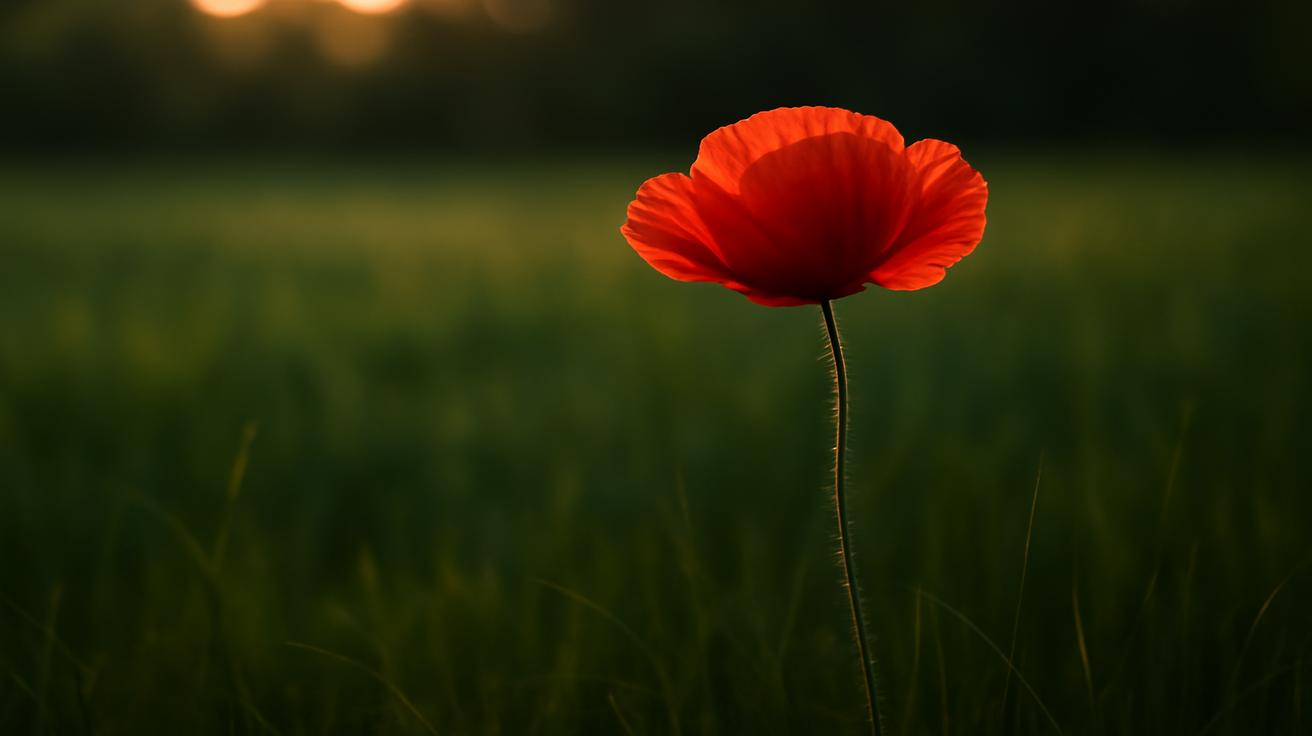
The meadow looks perfect at first glance. Early light rinses the grass in silver; a spider web catches the sun like a shattered prism. There’s the damp breath of soil and crushed clover, and the air feels clean enough to bottle. The nearest road is miles away. There are no fields of shimmering pesticide-treated corn, no humming power lines, no factories coughing smoke into the sky. It feels like a refuge—one of those rare pockets of Earth that might still be intact.
And yet, when you stand very still and listen, something is wrong. The silence here is not peaceful. It is missing a layer, the invisible thread that, not long ago, stitched the living world together: the small, ceaseless rasp and buzz and whir of insects. You realize it almost by accident, by the absence of something you didn’t know you were relying on. The air is quiet. Too quiet.
The Vanishing Buzz
The first time I really heard the silence was on a summer night that should have belonged to crickets. I’d driven out to a remote cabin, the kind that doesn’t appear on booking apps, where the sky still remembers what stars are. I stepped outside at dusk expecting a wall of sound—the shrill, layered orchestra of katydids, tree crickets, and the low drone of beetles bumbling through the dark.
Instead, the night felt hollow. A few lone chirps flickered at the edges of the field, but there was space between them—wide, unnatural spaces. I could hear my own breath too clearly. Even the distant owls sounded like they were calling into an empty hall.
It’s easy to blame the familiar villains: pesticides, industrial farming, choking highways. And it’s true—they are major culprits. But that cabin sat at the end of a rough dirt road, hemmed in by forest and old pasture, far from the glow of cities and the chemistry of industrial agriculture. No sprayed orchards, no vast monocultures. Just a thin gravel track, a stand of aging pines, and a creek that still smelled like cold stone and tannins.
Yet the crickets were fading here, too. Fireflies winked half-heartedly. Moths, drawn to the porch light, were a pathetic sample—a handful where there should have been dozens. I realized, with a chill that felt strangely personal, that distance from “pollution” was no longer a guarantee of safety for the smallest things.
The Myth of Safe Distance
We like to think in lines on maps: polluted and pristine, urban and wild, sprayed and unsprayed. If we can just get far enough away from the bad stuff, we tell ourselves, there will be a place where nature goes on as it always has, busy and indifferent to us.
But insects live in a different geography altogether, one defined by air, water, temperature, and the invisible chemistries that wander freely across our crisp categories. Pesticides drift. Nitrogen from far-off farms falls as quiet rain on mountain meadows. Microplastics ride the wind and lodge in alpine snow. The reach of our influence is not confined by property lines.
Even where chemicals don’t directly arrive, the backdrop has shifted. Summers last longer. Winters are patchy, their once-reliable freezes broken up by strange thaws. Flowers bloom earlier or all at once, like a party that starts before the guests arrive. Streams run low at the wrong time of year. Forests, stressed by heat and drought, shed their leaves differently, reshaping the undergrowth that many insects depend on.
Insects are exquisitely tuned to patterns in time—when to hatch, when to migrate, when to enter diapause, that suspended animation that carries them through cold or drought. They evolved to match the old rhythms: the thawing of a given soil layer, the average date of spring rain, the temperature of a specific creek pool. Nudge these patterns enough, and the old agreements no longer hold.
Even “remote” is no longer truly remote. A few new houses along a country road mean porch lights glowing all night, pulling moths to an artificial moon until they exhaust themselves. A weekend cabin means grass regularly mowed into a tight green pelt where once there was shaggy meadow. A picture-perfect vacation farmstead means ornamental plants from distant regions that offer no nectar or pollen insects can use. Each small, seemingly harmless change strips another thread from the web.
Listening for What’s Missing
Once you start listening carefully, you discover that silence has textures. In one forest, the missing sound is the whine of mosquitoes, oddly absent on a warm, still evening. In another, it’s the hum of bees over blackberry brambles that hang heavy with blossom but light on visitors. A lakeside dock at dusk used to be a gauntlet of swarming midges. Now you can sit comfortably, unbothered, and realize that comfort comes at a cost.
I walked through a high mountain valley recently, the kind of place that should be an insect paradise. The air was sharp and thin, carrying the metallic scent of granite and the green, sweet breath of wet sedges along the river. Wildflowers poured down the slopes in every color—larkspur, paintbrush, asters, the soft yellow lanterns of columbine. It was a scene from a field guide, composed flawlessly.
But the flowers were quiet. Kneeling to look closer, I saw bees, but not as many as there should have been. Single bumblebees stitched from bloom to bloom, doing the work of what felt like a missing army. Hoverflies, those nimble mimics of wasps, zigzagged through the air, but in smaller squads. I cupped my hands and brushed them lightly through the blossoms, expecting to flush out tiny beetles, thrips, pacing ants. There were some, but again and again the sensation was of scarcity—a faint, uneasy thinness.
In a way, you don’t notice an insect world that’s healthy; it’s just there, an unnoticed density of life. It’s when it thins out that something in you leans forward, uneasily, trying to find the missing weight in the air.
Why Even Truly Wild Places Are Not Spared
“They’ll be fine out there,” people say, waving vaguely toward mountains, deep forests, or the far north. “There’s plenty of untouched nature left.” But that untouched nature lives under the same sky and in the same warming climate as our cities and fields.
Warming at high altitudes and latitudes is often faster than in the lowlands. Alpine and Arctic insects, adapted to narrow temperature bands, are suddenly dealing with heat they never evolved to tolerate. Some try to climb higher, chasing cooler conditions, only to run out of mountain. Others can’t shift at all, trapped in valleys that now swing wildly between drought and flood.
Rainfall patterns twist and buckle. Where there used to be a slow melt of snow feeding streams steadily into summer, sudden spring heat now melts everything in a rush, leaving creeks shrunken and warm just when aquatic insects—mayflies, stoneflies, caddisflies—should be emerging. Their life cycles, timed to the old flow of water, crash into the new erratic schedule and fall out of sync.
Even the absence of obvious threats can be deceptive. A clearing that looks like an idyllic meadow may be the aftermath of a disease-weakened forest compounded by drought and bark beetle outbreaks. The fallen trees change light and humidity; grasses and shrubs take over where shade-loving plants once grew. The insect community, honed over centuries to that particular pattern of trees and understory, must reassemble on the fly, and sometimes it simply can’t keep up.
Then there’s the slow, steady pressure of nitrogen, drifting from fertilized fields and burning fossil fuels. It falls as a fine, invisible dust even in protected reserves, subtly overfeeding the soil. Plants that thrive on low nutrients are pushed aside by those that can gulp down the extra nitrogen and grow fast—often tall grasses and a few common herbs. Diversity of plants shrinks, and with it, diversity of insects. A rich buffet turns into an all-you-can-eat of just a few dishes.
The Hidden Economics of Small Lives
It’s tempting to see this as a purely aesthetic loss—less summer music, fewer bright wings in the air. But insect lives are woven through almost everything else that moves, breathes, and eats. Even far away from big cities and industrial zones, their quiet vanishing rearranges the rules for everything larger than them, including us.
Consider a mountain songbird feeding its nestlings on caterpillars fattened on alpine willows. If those caterpillars emerge too early during a freak warm spell, or in fewer numbers because host plants have shifted, the chicks go hungry at a critical phase. A few bad years in a row, and the bird population starts to tip.
Bats, those expert night hunters, rely heavily on moths. Fewer moths means longer, harder hunts and less energy for reproduction. Trout and salmon, icons of wild rivers, depend on the annual pulse of aquatic insects hatching from streams and lakes—tiny bodies translated into sleek muscle and silver skin. Thin that pulse, and you thin the fish.
Even the soil feels the absence. Many insects are the quiet engineers of decomposition and nutrient cycling, turning dead leaves and wood into building blocks for new growth. Their tunneling and chewing and digesting create the very texture of fertile ground. When their numbers wobble, the whole underground economy stutters.
We can’t easily see these connections, which is one reason the crisis has been allowed to deepen in the background. We notice, maybe, that there are fewer smashed insects on our windshields than in childhood, but it feels like a small, almost welcome change, not a canary staggering in the coal mine.
A Glimpse at the Decline
Researchers trying to quantify the loss have returned with numbers that feel like science fiction. Long-term monitoring in some regions has found insect biomass dropping by more than half in just a few decades, even inside nature reserves. It’s not a precise, universal figure—different places, different methods—but the pattern is consistent enough to be deeply alarming: fewer individuals, fewer species, narrower distributions.
To grasp what “less than half” really means, imagine a lush meadow 30 years ago with a hundred bees, moths, beetles, and flies in the air and under the leaves. Now imagine that same space with only forty of them left. Empty flowers. Unvisited foliage. Predators waiting longer for food that comes less often.
Some species are hit much harder than others; specialists tend to suffer first. The bumblebee that depends on a certain mountain flower. The butterfly whose caterpillars can only eat one shrub. The beetle that lives only in rotting logs of a specific tree. As these specialists disappear, ecosystems flatten into communities dominated by a handful of survivors that can live almost anywhere and eat almost anything. It’s life, technically—but more generic, more fragile, less capable of absorbing surprise.
| Change Observed | What It Looks Like Outdoors | Possible Drivers |
|---|---|---|
| Fewer nighttime insect sounds | Quieter summer evenings, fewer crickets and katydids | Climate shifts, habitat loss, light pollution |
| Decline in pollinators | Flower-rich areas with few bees or hoverflies visiting | Warming, mismatched flowering times, pesticides drift |
| Reduced aquatic insects | Fewer mayflies and stoneflies around streams and lakes | Altered stream flow, warming water, pollution deposition |
| Loss of specialists | Rare butterflies or beetles disappearing from known sites | Habitat simplification, plant community shifts |
| General “thinning” of insect life | Fewer bugs on windshields, porch lights, or in nets | Combined climate stress, land-use change, global pollution |
The Quiet Role of Light, Lawn, and Leisure
Not all the drivers of this silent massacre are dramatic. Many are woven into the comforts of what we think of as gentle living, even when we escape, theoretically, “into nature.”
Consider light. A single bright bulb on a cabin porch pulls in moths and other night-flying insects from a wide radius, disrupting their mating, feeding, and navigation. Multiply that by every remote rental cabin, every newly built house along a scenic ridge, every decorative garden strung with fairy lights, and the darkness that nocturnal insects evolved within becomes a maze of false suns.
Or lawns. The default yard, even in rural areas, is often a close-cropped, single-species grass carpet. From an insect’s point of view, it is a desert—no flowers, no seed heads, no long stems to climb or hide beneath. Even where the surrounding landscape is rich, these lawns become dead zones stitched between fragments of good habitat, breaking up continuity and safe passage.
We also flatten variety in our quest for order and ease. Fallen logs get cleared for tidiness. Dead stems are cut down in autumn instead of left to stand as winter shelter. Wet corners of fields are drained to make them more “usable.” Edges—those messy, species-rich in-between zones where forest meets meadow or water meets land—are sharpened and straightened.
Each act feels small, but taken together, they pare away at the complexity insects rely on. A world that once offered a wild patchwork of micro-habitats becomes smoother, neater, and less habitable. And the effects reach even into landscapes that still read as “wild” to our eyes, because they are surrounded and influenced by this rising tide of uniformity.
What It Feels Like to Notice
Once, I camped beside a high plateau lake that, years earlier, had been so thick with midges at dusk that you walked through them like weather. Not dangerous, just an annoyance that you accepted as the price of being in a place that still belonged mostly to itself.
This time, as light faded, I braced myself for the familiar assault and pulled up my hood. It never came. A few stray insects skated across the surface of the water. Spiders sat in their webs along the grasses but their nets were almost empty. My headlamp cut a clean cone through the dark with only the occasional drifting speck.
Inside the tent, listening to the sheer clarity of the night—no buzzing, no tapping against the fabric—I realized I missed the chaos, the sense that I was camping in the middle of gigantic, unseen traffic. I missed being slightly overwhelmed.
There’s a strange grief in that realization, mixed with guilt and helplessness. It feels like arriving late to a party that’s already half over, where most of the guests have quietly slipped outside and left without saying goodbye.
Choosing to Be Loud in the Silence
So what do we do, standing here in this thinning world, watching even the “untouched” places grow quieter?
Part of the answer lies in attention. Paying honest, sustained attention is not nothing; it is the first step in making loss visible, in refusing to accept a steadily shrinking baseline as normal. When we remember how alive the nights and meadows once were, we’re less easily soothed by the modest buzz that remains.
But attention has to lean into action, even if that action feels small against a global problem. Some of the most powerful changes we can make are near at hand:
- Let patches of your yard, cabin lot, or rural property stay messy—leave leaves, dead stems, and fallen wood as habitat.
- Plant a diversity of native flowering plants that bloom from early spring through late fall, especially in places that feel “far” from agriculture but are still subtly changing.
- Keep outdoor lights off when not needed, use warmer, dimmer bulbs, and shield them to minimize skyglow.
- Protect and restore edges—those rich, ragged boundaries between woods and fields, wetlands and uplands.
- Support policies and projects that reduce emissions, safeguard water, and create connected reserves rather than isolated islands.
And then there is the work of speaking: telling these stories, sharing the unease instead of brushing it away. The more people hear that the silence is spreading even in the places we assume are safe, the harder it becomes to treat insect decline as an abstract story about someone else’s farmland.
Stand again in that seemingly untouched meadow. Feel the cool rise of air from the forest, the damp scent of earth, the brush of grasses against your legs. Listen for what is there—the rustle of a beetle in the duff, the thin whine of a solitary mosquito, the patient clicking of a single, stubborn cricket. Then listen harder for what is not.
This is not the silence of peace. It is the quiet of a room after too many have left. It is an alarm with the volume turned low, easy to ignore until it is almost too late.
We are not separate from this thinning chorus. Our breath, our food, our water, our sense of belonging are all entangled with these small lives. The massacre may be silent to our distracted ears, but it is happening in the same air we breathe. And in that shared air, there is still time—shrinking, precious time—to choose a different story.
Frequently Asked Questions
Are insect populations really declining even in clean, protected areas?
Yes. Long-term studies in nature reserves and remote landscapes have found significant drops in insect biomass and diversity, even where direct pesticide use is minimal. Climate change, pollution drifting from other regions, habitat simplification, and light pollution all contribute, reaching far beyond obvious industrial zones.
How can climate change affect insects in seemingly “pristine” places?
Insects are finely tuned to temperature and seasonal patterns. Warming changes when plants leaf out and bloom, alters snowmelt and stream flow, and increases heat stress, especially at high elevations and latitudes. These shifts can push insects out of sync with their food sources, breeding seasons, and safe temperature limits—even in remote mountains and forests.
Is light pollution really that harmful to insects?
Artificial light at night disrupts navigation, feeding, and mating for many insects, especially moths and other nocturnal species. They can become trapped circling lights, exhausted, or more vulnerable to predators. As more rural and wild areas are developed with outdoor lighting, these effects extend deep into what used to be dark refuges.
What can individuals do to help insect populations recover?
Individuals can make meaningful changes: reduce or eliminate pesticide use, plant diverse native flowers, leave parts of gardens or properties messy as habitat, limit outdoor lighting, and support conservation projects and climate action. Even small patches of insect-friendly habitat become stepping stones that help populations persist and move across the landscape.
How can I tell if insect life is declining where I live?
Pay attention to sounds and sights over time: nighttime insect choruses, bugs around lights, pollinators on flowers, and insects on car windshields after long drives. Joining or starting local monitoring projects, like butterfly counts or community science programs, can turn observations into data that track changes and guide conservation efforts.