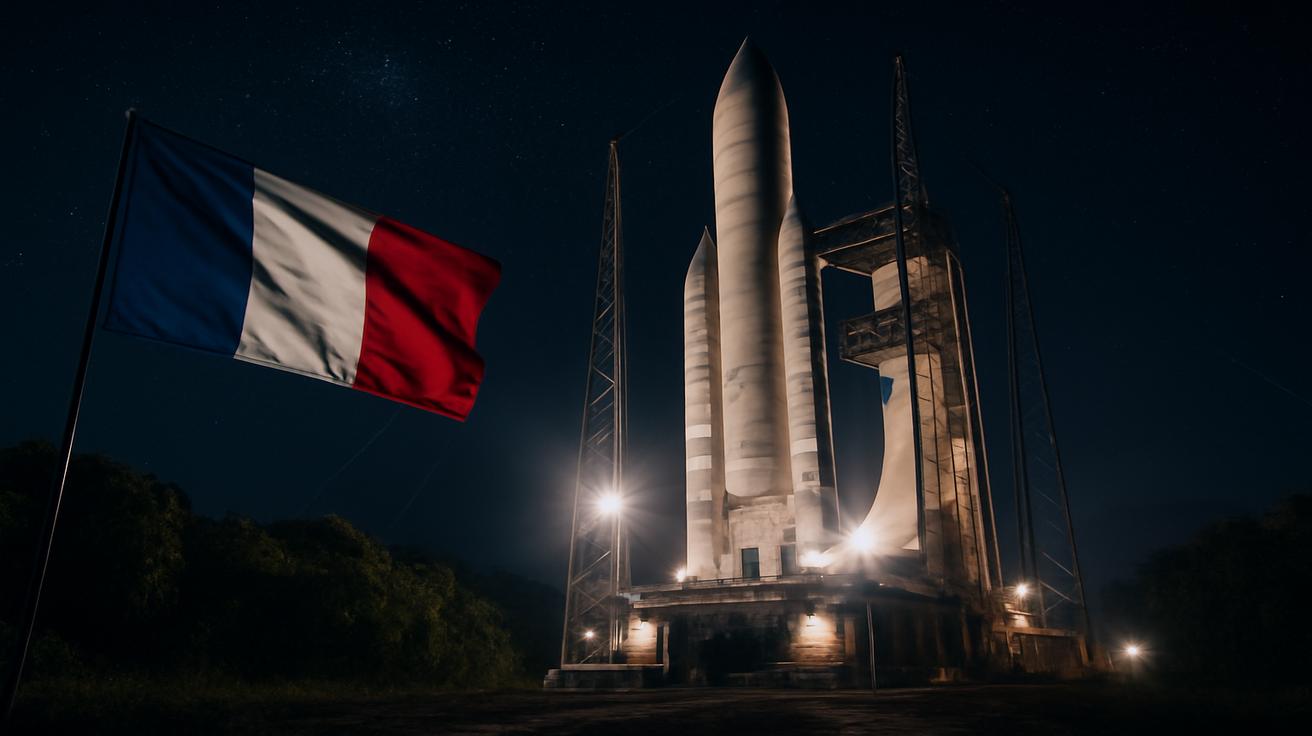
The sea was silent, at least to human ears. Only the whine of the crane and the slap of waves against steel broke the night off Kourou, French Guiana, as a barge carried the long, white body of a rocket toward the launchpad. Sodium lights painted the clouds a dull orange. From the jungle, frogs called in a pulsing chorus. And high above—unseen but very present—streaks of light crossed the sky: SpaceX Starlink satellites, sliding overhead like a silent, moving constellation.
France, Space, and a New Kind of Frontier
For more than half a century, France has seen the sky not as a limit, but as territory. Not territory in the old colonial sense of maps and borders, but in the modern sense of presence, autonomy, and power. From the first Diamant rocket in the 1960s to Ariane 5’s long rule as a workhorse of global launches, France quietly became the backbone of Europe’s access to space.
Today, though, the scene has shifted. When a rocket arcs through the clouds above Kourou, the sky it pierces is more crowded, more contested, and more commercial than at any other time in history. Space is no longer just a realm of prestige and science. It is becoming what some French officials now call a “new theater of operations.” A domain to secure. A domain where sovereignty is on the line.
On one side of this unfolding drama stands SpaceX—a private American company that has, in less than two decades, turned reusable rockets from science fiction into a business model. On the other stands China, with a state-driven, long-term space strategy that marries civil and military ambitions. Between them, Europe—and especially France—must decide whether it is content to be a customer, or determined to remain a power.
Can France still keep up? Or has the race moved so far, so fast, that even a country with nuclear weapons, world-class engineers, and a legendary space heritage risks becoming a secondary player beneath someone else’s orbital shadow?
What “Space Sovereignty” Really Means
“Sovereignty” in space sounds abstract, like something debated in marble halls in Paris or Brussels. On the ground, though, it plays out in recognizably human terms: who gets to decide, who has to ask permission, who pays, who waits their turn.
For France, space sovereignty rests on a few very concrete pillars:
- Independent access to orbit: the ability to launch satellites without relying on another country’s rockets or political goodwill.
- Secure communications: military and government satellites that no one else can switch off, spy on, or deny.
- Earth observation and intelligence: the power to see, track, and understand what’s happening on Earth and in orbit—without having to ask for data.
- Industrial and technological autonomy: keeping the skills, factories, and supply chains inside Europe so that access to space doesn’t depend on external suppliers.
In these areas, France is not a minor player. It is the engine of European space, home to ArianeGroup, to CNES (the French space agency), and to many of ESA’s key programs. It runs military observation satellites like the CSO series, communications platforms like Syracuse, and contributes to Europe-wide constellations like Galileo (navigation) and Copernicus (Earth observation).
Yet sovereignty is not a steady state; it’s a moving target. As launch costs fall, satellite constellations multiply, and new forms of space warfare emerge—from jamming signals to blinding satellites with lasers—the bar keeps rising. Having “a few satellites” is no longer enough. Power now lies in scale, speed, flexibility.
That is where SpaceX and China come into uncomfortable focus.
SpaceX, China, and the New Gravity of Power
Imagine standing in a dark field in rural France on a clear night. You look up, and after a few minutes your eyes adjust. Within seconds, you can see them: a tight train of bright dots sliding silently across the sky in a straight line. Starlink.
Those lights are not just an engineering feat; they are a statement of power. SpaceX has launched thousands of satellites, often on its own rockets, in a tightly integrated ecosystem it controls from factory to orbit. It serves civilian customers, but its infrastructure has also become woven into geopolitics, from providing internet over war zones to supporting allies.
China’s approach is more opaque, but just as consequential. It has its own space station, a rapidly expanding fleet of satellites, and an increasingly capable family of Long March rockets. The line between civil and military is intentionally blurred. Space is not a playground, in this view; it is an extension of state power.
Between these two poles, European and French policymakers face an uneasily simple question: do you want to rent power, or own it?
Ariane 6: A Heavy Legacy in a Lighter World
In the sweltering humidity of Kourou, towers and gantries surround a new silhouette: Ariane 6. It is designed to be the successor to Ariane 5, the grand old champion of Europe’s launch capability. But the world Ariane 6 enters is not the world Ariane 5 dominated.
Ariane 5 was a symbol of reliability and prestige, carrying everything from telecommunications satellites to the James Webb Space Telescope. It was powerful, dependable—and disposable. Each launch meant a brand-new rocket, millions of euros of hardware burned up in the atmosphere after a single use.
SpaceX changed that equation. With Falcon 9 and Falcon Heavy, the company made landings look routine: boosters dropping back from the sky on columns of fire, touching down on drone ships with almost theatrical precision. The effect wasn’t just visual. It was economic. Reusability, even partial, slashed costs and multiplied cadence.
Ariane 6, by contrast, is still expendable. It’s more flexible than Ariane 5, and it aims to be cheaper, but it doesn’t fully embrace the new logic of reusability. French engineers and ESA partners are working on reusable demonstrators—like the Prometheus engine and the Themis stage—but these are still stepping stones rather than the main stage.
In the meantime, European institutional missions are effectively “captive” to Ariane 6 and its smaller counterpart, Vega-C. Commercial satellite operators, though, are far less sentimental. They go where the price and availability are best. Increasingly, that means booking rides on foreign rockets, many of them stamped with a SpaceX logo.
The Numbers Behind the Struggle
It’s one thing to talk about sovereignty and prestige; it’s another to stare down the raw economics that drive launch decisions. To understand the pressures France is facing, it helps to look at some basic comparisons.
| Launcher / Program | Approx. First Flight | Reusability | Typical Use Case |
|---|---|---|---|
| Ariane 6 (Europe/France-led) | Mid‑2020s | Expendable | Institutional & commercial GEO, deep‑space missions |
| Falcon 9 (SpaceX, USA) | 2010 | First stage reusable | Mega‑constellations, cargo & crew, rideshare |
| Long March family (China) | 1970s–present | Mostly expendable; reusable tests ongoing | National missions, space station, lunar & planetary |
| Upcoming European Reusable Tech (Themis, etc.) | Late‑2020s+ (demos) | Planned partially reusable stages | Technology pathfinders, future launchers |
These aren’t hard-and-fast market shares or launch counts, but they tell a story: France and Europe are trying to modernize in a game where others have been iterating, flying, and failing fast for years. Sovereignty here isn’t just about announcing a new rocket; it’s about sustaining a launch ecosystem that can evolve as quickly as private competitors.
France’s Invisible Space: Military Eyes and Ears
Walk through a forest in the Massif Central, or along the windswept coast of Brittany, and you might feel very far from the politics of orbit. Yet above you, always above you, French and European satellites trace their silent, invisible arcs.
Some of these satellites see the world in astounding detail: the CSO reconnaissance series can resolve features on the ground with a clarity that would have seemed magical only decades ago. Others whisper constantly, carrying encrypted messages for ships at sea, aircraft in flight, and deployed forces far from home, via systems like Syracuse.
These assets are not optional. In modern conflict, they are as vital as fuel and ammunition. They enable navigation, secure communication, and precise targeting; they provide early warning and situational awareness. Without them, France’s armed forces—and by extension Europe’s—would be fighting blind in many scenarios.
Here the stakes of space sovereignty sharpen. If launch capacity is constrained or dependent on external partners, replacing or upgrading this orbital infrastructure becomes slower, riskier, more political. If constellations for communication or observation belong to someone else—especially a foreign tech giant or a geopolitical rival—the risks multiply.
French officials have been explicit about this new reality. In 2019, France even created its own space command, later upgraded to the Space Force Command, signaling that space is now treated not just as a scientific arena, but as an operational one. The doctrine includes protection of French and European satellites, monitoring space debris, and preparing for a world in which jamming, hacking, or even physically damaging space assets is no longer unthinkable.
The Constellation Question
So far, much of France’s presence in orbit has been built on a model of a few large, highly capable satellites. SpaceX and, increasingly, China are pushing a different paradigm: many smaller satellites in constellations, constantly refreshed and replaced.
France and the EU are starting to answer. The IRIS² program, for example, aims to build a European-moderated constellation for secure connectivity. It’s meant to be not just another commercial broadband network, but a backbone for government and defense communications, less vulnerable to the whims of foreign providers.
Yet there is a deeper tension here. The more constellations proliferate, the more crowded orbit becomes. Space traffic management, debris, collision risks—these grow with every launch. Space sovereignty, in this sense, is not just about having your own assets. It’s also about having a say in the rules of the orbital road, from low-Earth orbit up to geostationary altitudes.
France, with its strong diplomatic tradition and leadership inside the EU, could help shape those rules. But to be heard in that conversation, it needs credible hardware in orbit and reliable rockets on the pad.
Innovation vs. Inertia: Can France Change Fast Enough?
In a sleek clean room in Toulouse or near Paris, a young engineer adjusts a cluster of small satellite modules on a test stand. She isn’t working for one of the giant legacy contractors, but for a start‑up, backed in part by a French or European innovation fund. On her laptop are simulations of a satellite bus designed to be built quickly, launched cheaply, and replaced often.
This is one of the quiet bets France is making: that a vibrant ecosystem of small, agile companies can coexist with the heavy institutional giants and inject them with new energy. NewSpace à la française. Micro‑launchers, smallsat manufacturers, advanced materials labs, in‑orbit servicing concepts—they are all trying to rewrite the story of European space from within.
The challenge is cultural as much as technical. France and Europe are good at big, deliberate, multi-decade programs: Ariane, Galileo, Copernicus, the ISS. They are less comfortable with the Silicon Valley style of rapid iteration, “move fast and break things,” and aggressive commercial risk‑taking.
SpaceX’s success, for all its particularities and deep NASA support, stems from an ability to fail visibly—and learn quickly. Multiple test flights blow up; the next one flies better. China, in its own way, can tolerate costly failures inside a state-driven framework, buffered from market pressures.
For France, public money must justify itself relentlessly. Taxpayers ask: why support another rocket, another satellite? Why pour billions into orbit when hospitals need funding, schools need repairs, climate adaptation needs investment on the ground? Answering that means telling a convincing story about how space is not a luxury, but an infrastructure—as essential as roads or electricity in a digital, data-driven century.
Climate, Data, and the Everyday Benefits
One way to see that story is through the lens of climate. Satellites are our thermometers, our eyes and ears on a warming planet. They track melting ice, rising seas, changing forests, shifting currents. Many of the most detailed climate observations today come from European programs, in which France plays a central role.
If Europe and France lose the ability to control the platforms that gather this data—if they must buy it, filtered or incomplete, from others—their ability to plan, adapt, and verify international climate commitments weakens. In that sense, space sovereignty is also environmental sovereignty.
And it filters all the way down into ordinary life. Navigation apps, precision farming, disaster response, monitoring of illegal fishing or deforestation—all thread back to orbiting instruments. Space infrastructure is woven into the fabric of everyday existence, mostly invisible, but now indispensable.
So, Can France Keep Up?
Standing in the glow of a launchpad in Kourou, or in a control room in Toulouse, the question of whether France can “keep up” with SpaceX and China is not a single yes or no. It splits into several, more nuanced questions:
- Can France and Europe maintain an independent, reliable path to space?
Yes—if Ariane 6 stabilizes, if Vega‑C returns robustly, and if reusable technologies move from demo to deployment in the next decade. - Can they match the sheer launch cadence and low costs of SpaceX?
Probably not one‑for‑one in the near term. But they can carve out niches—science missions, institutional work, dual‑use security constellations—and lower costs enough to stay strategically relevant. - Can they counterbalance China’s long-term, state-driven strategy?
Not alone. But as the heart of Europe’s space efforts, France can help ensure that the EU remains a third pole in space, neither subordinate to Washington nor Beijing. - Can they nurture a vibrant NewSpace ecosystem that complements, rather than collides with, the institutional giants?
That is the real test. Laws, funding mechanisms, and procurement culture will decide it.
In the end, “keeping up” may be the wrong metaphor. France is not trying to become SpaceX, nor can it mimic China’s political system. It is trying to remain itself—a democratic, scientifically ambitious, strategically minded country in a European framework—while adapting to a sky that is now full of competitors, partners, and private actors.
As more and more satellites reflect the sun back at us in dawn and dusk, as astrophotographers lament the streaks across their long exposures, as children learn to recognize Starlink trains as easily as Orion, a quieter work is going on in labs and ministries across France. It is the work of deciding what kind of space power the country wants to be in 2035, 2050, and beyond.
Will France’s rockets still rise from the equatorial air of Kourou, carrying European missions and French military satellites, built with French engines and European avionics? Will its constellations provide secure links for its allies, its climate instruments guide adaptation on a changing planet, its telescopes and probes explore beyond Mars?
Those futures are not guaranteed. But they are still within reach—if France chooses, collectively, to treat orbit not as a distant spectacle, but as part of its own terrain. Not as a race already lost to California or Beijing, but as a long expedition it helped start, and still has every reason to continue.
Frequently Asked Questions
Why is space sovereignty so important for France?
Space sovereignty matters because it underpins national security, economic resilience, and technological independence. Without its own launchers and satellites, France would be dependent on foreign providers for navigation, secure communications, intelligence, and climate data—critical levers of power and stability in the 21st century.
Is Ariane 6 enough to keep Europe competitive with SpaceX?
Ariane 6 is a vital bridge, but not a complete answer. It can secure Europe’s immediate access to space and serve institutional missions, but its expendable design and cost structure make it hard to rival SpaceX on commercial markets. Long‑term competitiveness will depend on new, partially reusable European launch systems and innovative business models.
How does China’s space program affect French and European strategy?
China’s rapid advances reinforce the need for Europe, led in part by France, to remain an independent space actor. As China builds its own stations, lunar ambitions, and military space capabilities, Europe must maintain its own robust systems to avoid being squeezed between two superpowers or forced into technological dependencies.
What role do French NewSpace start‑ups play?
French start‑ups are experimenting with micro‑launchers, small satellite platforms, and in‑orbit services. They bring agility and innovation that can complement the large institutional programs. If supported by smart regulation and funding, they can help reduce costs, accelerate development cycles, and keep French industry at the technological frontier.
Will space activities really benefit ordinary people in France?
They already do. Satellite navigation, weather forecasting, climate monitoring, emergency response, agriculture optimization, and global communications all rely on space infrastructure. Maintaining sovereignty in space is less about prestige and more about ensuring that these services remain reliable, secure, and aligned with French and European interests.