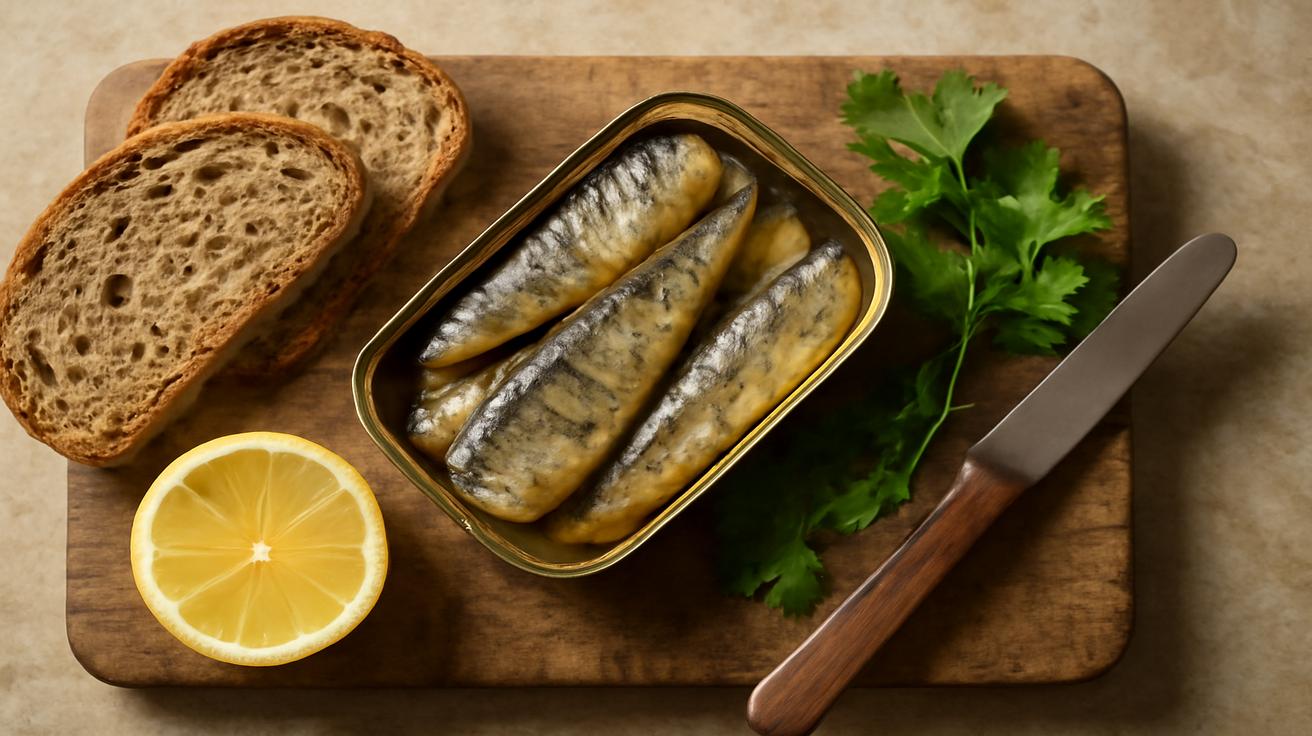
The sardines always stare back first.
The lid peels open with that soft metallic sigh, and there they are: silver bodies pressed shoulder to shoulder, eyes glazed, glinting faintly under kitchen light. The smell rushes out—briny, a little wild—cutting through the polite indoor air of your home and dropping a fragment of open sea right onto your countertop. You might hesitate for a second, feeling that old childhood suspicion toward anything fishy from a tin. And yet, something about this small, humble can has been quietly winning over nutrition scientists, neurologists, and chefs alike.
Tinned sardines, it turns out, are a kind of secret portal. Not to a Mediterranean island or a weather-beaten fishing village—though it might smell that way—but to your own brain. Inside that unassuming can lies a mix of compounds that your neurons practically recognize on sight: fats they can use as building blocks, minerals they depend on to fire cleanly, vitamins that keep the lights on in your mental control room. It’s like someone packed a care package for your nervous system and shelved it between the pasta sauce and the tinned tomatoes.
And the strangest part? You can buy this brain-care ritual for the loose coins in your pocket, on an ordinary Tuesday, at a supermarket under fluorescent lights.
The aisle where the ocean hums
Walk into almost any grocery store and you’ll find them waiting, half-forgotten, somewhere around the middle of the canned goods aisle. Not the glamorous stretch of artisanal crackers and plant-based milks, not the boldly branded snack display. Just a row of small, slightly old-fashioned tins stacked like miniature treasure chests. You could pass them a hundred times and never notice.
Pick one up. The metal feels cool and dense, a little heavier than it looks. There’s something oddly reassuring about the heft of it, like it’s promising substance, not fluff. The label might show a painted sardine sailing across blue water or a minimalist design in industrial gray. Behind the artwork is the same quiet purpose: a fish caught young, rich in oils, packed quickly, and sent around the world to wait on a supermarket shelf for someone to remember that food can be both simple and profound.
Inside that can is a combination that modern life keeps robbing from us. Our diets tilt toward the dry, the crunchy, the sweet. Highly processed snacks dissolve on the tongue, leaving an echo of flavor and not much else for the brain to work with. And then there’s this: oily, dense, unapologetically real. A small, silvery interruption to all the beige food that forgets we’re still part animal, that our brains evolved beside coasts, rivers, and oceans.
When you open that tin and fork one of those soft fillets onto toast, your senses flare awake: the crisp crack of bread, the rich salt, the faint metallic hint of the can, the deeply savory, almost buttery texture of fish oil catching the light. Your mouth knows this is something different. So does your nervous system.
Brain food hiding in plain sight
Behind the sensory jolt of sardines is a quietly intricate biochemistry story. Each small fish is like a densely packed toolkit of things your brain uses constantly and can’t make on its own fast enough. The first characters in this story are the omega‑3 fatty acids—especially DHA (docosahexaenoic acid) and EPA (eicosapentaenoic acid).
If you could zoom in on your brain’s neurons, you’d find that DHA is woven into their membranes like flexible glass. These membranes need to be fluid yet stable—able to host receptors, let ions flow, and adapt as you learn and remember. DHA helps keep those outer layers soft enough to stay responsive but strong enough not to leak or warp. EPA, meanwhile, takes on more of a diplomatic role, influencing signaling molecules that control inflammation and mood.
Now, your body is capable of turning plant-based omega‑3s (like those from flax or chia) into DHA and EPA, but it does it reluctantly and slowly, as if under protest. Sardines skip the negotiation entirely. Their flesh is already packed with ready‑made DHA and EPA, harvested from the smaller lifeforms they eat in the food chain. When you eat sardines, your body essentially gets a direct shipment of neuron-ready building blocks.
But the brain-support story of sardines doesn’t stop at fat. Tinned sardines also carry vitamin D, which acts like a subtle hormonal conductor in the nervous system; vitamin B12, crucial for maintaining the insulating sheaths around your nerves; and iodine, which helps your thyroid guide energy use in the brain. In many tinned versions, the soft, edible bones contribute calcium and phosphorus, key ingredients for nerve signaling and structural stability in skull and spine.
All of that, hidden in a can you can slip into a backpack.
The calm after the fish
If you’ve ever noticed that your thinking feels a bit cleaner after a stretch of eating more seafood, it’s not your imagination drifting romantically toward the coast. Omega‑3s, especially those from fatty fish like sardines, appear to influence how you feel, how sharply you think, and even how well you cope with the mundane stress of another overflowing inbox.
Picture your brain as a dense, living forest of electrical trees. Every thought, every memory, every flash of insight is a spark racing along branches, leaping tiny gaps between cells. That forest lives in constant tension: too much inflammation and the branches become irritated, less responsive; too little structural support and they sag or break. Omega‑3s help manage that tension. They reduce chronic, low-level inflammation that can dull mental clarity, while supporting the flexible scaffolding that keeps neurons talking smoothly.
People often report that when they consistently add oily fish to their diets—sardines included—they feel a particular kind of mental shift: not jittery like caffeine, not sedated like a heavy meal, but more grounded. Less fog, fewer sharp mood drops in the late afternoon. Researchers exploring diet and depression have repeatedly circled back to marine omega‑3s as important players in emotional steadiness, like invisible ballast in the hull of a ship.
There’s also the quieter, more intimate effect: what happens when blood sugar swings are softened by meals that include solid protein and healthy fat. A tin of sardines with some bread, rice, or vegetables doesn’t behave like a sugar rush. Glucose enters the bloodstream at a slower, steadier pace, and the brain—greedy for constant fuel—breathes out in relief. Instead of peaks and crashes, there’s a more even hum. That hum feels like focus.
A small ritual of resilience
Part of the power of supermarket sardines isn’t just nutritional; it’s ritualistic. On a hectic day, when you’re squinting at a screen and your thoughts feel like they’re sliding around, the act of stepping away and opening a tin can become a tiny ceremony of reclamation.
You might toast a piece of bread until the edges darken and the kitchen fills with that warm, nutty smell. Maybe you rub a clove of garlic over the hot surface, or drizzle a line of olive oil that soaks in with a muted shine. Then you lay the sardines down, one by one, their soft bodies giving way under the fork, the oil pooling slightly around them. A squeeze of lemon, a dusting of black pepper, perhaps a few slivers of red onion if you’re feeling sharp. Suddenly, your lunch is not just fuel but a small, deliberate act of self-respect.
This ritual matters because the brain is deeply responsive to pattern and context. When you repeatedly pair nourishing food with a mindful break, your nervous system begins to anticipate ease. The relief isn’t only chemical; it’s experiential. You are teaching your brain: “At least once today, I will step away and give you something you can truly use.”
In an age where convenience usually means compromise, tinned sardines offer a rare overlap: convenience without surrender. No stove is strictly necessary, no expensive specialty shop, no elaborate preparation. Just a can, an opener, maybe a plate, and a few minutes of slowing down while the world keeps spinning outside.
From tin to synapse: what’s actually inside?
For all the sensory romance, it can be grounding to see the numbers—the quiet proof that this little can is more than nostalgia or culinary rebellion. Here is a simplified snapshot of what you might typically find in a standard 100-gram serving of supermarket tinned sardines in oil, compared to a familiar protein like chicken breast:
| Nutrient (per 100g) | Tinned Sardines (in oil) | Chicken Breast (cooked) |
|---|---|---|
| Calories | ~200–220 kcal | ~165 kcal |
| Protein | ~24 g | ~31 g |
| Total Fat | ~12 g (rich in omega‑3) | ~3.5 g |
| Omega‑3 (EPA + DHA) | ~1.0–1.8 g | Negligible |
| Vitamin B12 | Over 100% of daily value | Modest amount |
| Vitamin D | Significant (varies by brand) | Very low |
| Calcium (with bones) | Up to 30–35% of daily value | Very low |
Numbers can’t capture the scent of the opened tin or the way the oil glistens, but they do tell you this: sardines are dense. Not dense like a heavy dessert that knocks you out for the afternoon, but dense in the way a pocket-sized tool kit is dense—every square centimeter doing a job.
For the brain, that means multiple reinforcement lines converging at once. Omega‑3s fortify membranes and help modulate inflammatory signals. B12 and other B vitamins keep homocysteine—a compound associated with cognitive decline—within calmer limits. Vitamin D and minerals play background roles in neurotransmitter production and nerve firing. You’re not feeding your brain one thing; you’re feeding it a small chorus.
The overlooked sustainability of the small fish
There’s another layer, too, one that doesn’t show up on nutrition labels but still matters to a thinking, feeling brain: how your food intersects with the world that produced it. Sardines are small, fast-growing fish that feed low on the food chain, often considered more sustainable than the large, long-lived predators that tend to dominate seafood cravings.
When you choose a tin of sardines over, say, tuna or swordfish, you are aligning your fork with a part of the ocean that can often better withstand our appetite. You’re also sidestepping some of the mercury and heavy metal concerns that come with larger fish, because little fish have had less time and fewer opportunities to accumulate those contaminants.
This matters more than we might admit. A brain that knows its meal was drawn from a more resilient corner of the ecosystem often rests a little easier. There’s a quiet psychological nourishment in feeling that your personal rituals aren’t entirely at odds with the ocean’s limits. Each can becomes not just brain food, but a small act of alignment with the wider, watery world that helped build the neurons you’re using to think about it.
Learning to love the tin
Of course, none of this helps if you can’t get past the first whiff. For many people, sardines carry a faint aura of school-lunch dread, of strong smells and social risk. But like black coffee or dark chocolate, they’re a taste that can evolve—especially if you learn to introduce them gently.
Try opening a can in olive oil and flaking a few fillets into a bowl of hot pasta, with lemon zest, garlic, and a handful of chopped parsley. The fish dissolves slightly into the sauce, leaving behind a deep, savory backbone rather than a screaming headline of “FISH!” Or mash sardines with a little mustard, yogurt, and finely chopped pickles, then pile the mixture onto crackers. The tang and crunch meet the richness halfway.
On quieter mornings, a single sardine laid across warm toast, with sliced tomato and a drizzle of oil from the tin, can feel surprisingly luxurious. The salt hits first, then the fat, then the delicate, almost smoky thread that lingers at the back of the throat. Not aggressive, just insistent, like a seabreeze that finds you even three blocks inland.
Your brain doesn’t particularly care how elegant the preparation is. It simply notices: The raw materials I need arrived. But your senses care, and they’re the gatekeepers. Nurturing a way of eating sardines that feels pleasurable rather than dutiful is part of what allows this little fish to become a long-term ally instead of a short-lived experiment.
A tiny rebellion in oil
In the end, the surprising effect of supermarket tinned sardines on the brain is not just biochemical; it’s cultural and psychological. Reaching for a can of sardines is, in a way, a small rebellion against two powerful stories: the story that “brain boosters” must come as expensive powders and pills, and the story that convenience food must always be nutritionally hollow.
Here is a food that has been sustaining coastal communities for generations, that fits in the palm of your hand, that costs less than many fancy coffees—and yet stands shoulder to shoulder with the most hyped “superfoods” in terms of what it can do for your mind. It is old-fashioned in the best sense, stubbornly physical in a digital age, faintly wild in a world that sterilizes and sweetens so much of what we eat.
That wildness is not an accident. Your brain came of age in landscapes where food was still unpredictable, where the scent of fish on the air meant something had happened—a catch, a tide, an opportunity. Maybe that’s why, when you crack open a tin of sardines at your kitchen counter or office desk, part of you feels a faint, ancient alertness. This is real. This is dense. This will keep you thinking.
So the next time you pass that quiet shelf in the supermarket, with its small metal tins lined up like forgotten relics, you might pause. You might pick one up and feel its cool weight, imagine the glitter of a school of fish just beneath the surface of a sunlit sea. Inside the can is more than lunch. It is a tiny, silver invitation to care for your brain in a way that is tactile, affordable, and profoundly alive.
FAQ
How often should I eat tinned sardines for brain benefits?
For most people, including sardines or other oily fish 1–3 times per week is a practical and beneficial target. This can help you maintain a steady intake of omega‑3 fats and key nutrients without overdoing it.
Are tinned sardines as healthy as fresh sardines?
Yes, in many ways they are comparable. The canning process preserves most nutrients, including omega‑3 fats, protein, and minerals. Some delicate vitamins may decline slightly, but tinned sardines remain highly nutritious and very brain-friendly.
Should I choose sardines in water, brine, or oil?
Sardines in olive oil offer extra flavor and healthy fat, while those in water or brine are lighter and lower in calories. For brain health, any version is useful; just be mindful of added salt and the quality of the oil used.
Do I need to eat the bones in tinned sardines?
You don’t have to, but the soft, edible bones are an excellent source of calcium and phosphorus. They usually dissolve easily in the mouth and are barely noticeable when mashed into spreads or sauces.
Are sardines safe to eat regularly regarding mercury and contaminants?
Yes. Because sardines are small, fast-growing fish low on the food chain, they tend to accumulate far fewer heavy metals like mercury than larger species such as tuna or swordfish. For most people, they are considered a safe regular choice.
Can tinned sardines really affect mood and focus?
They can contribute meaningfully. The omega‑3 fats, B vitamins, and other nutrients in sardines support brain structure and neurotransmitter function. Over time, this can help with clarity, steadier mood, and resilience to everyday stress, especially as part of an overall healthy diet.
What if I don’t like the strong taste—any tips?
Start by mixing small amounts into flavorful dishes: pasta with garlic and lemon, tomato-based sauces, or tangy spreads with mustard and herbs. As your palate adjusts, you may find you enjoy them more simply, on toast or with vegetables.