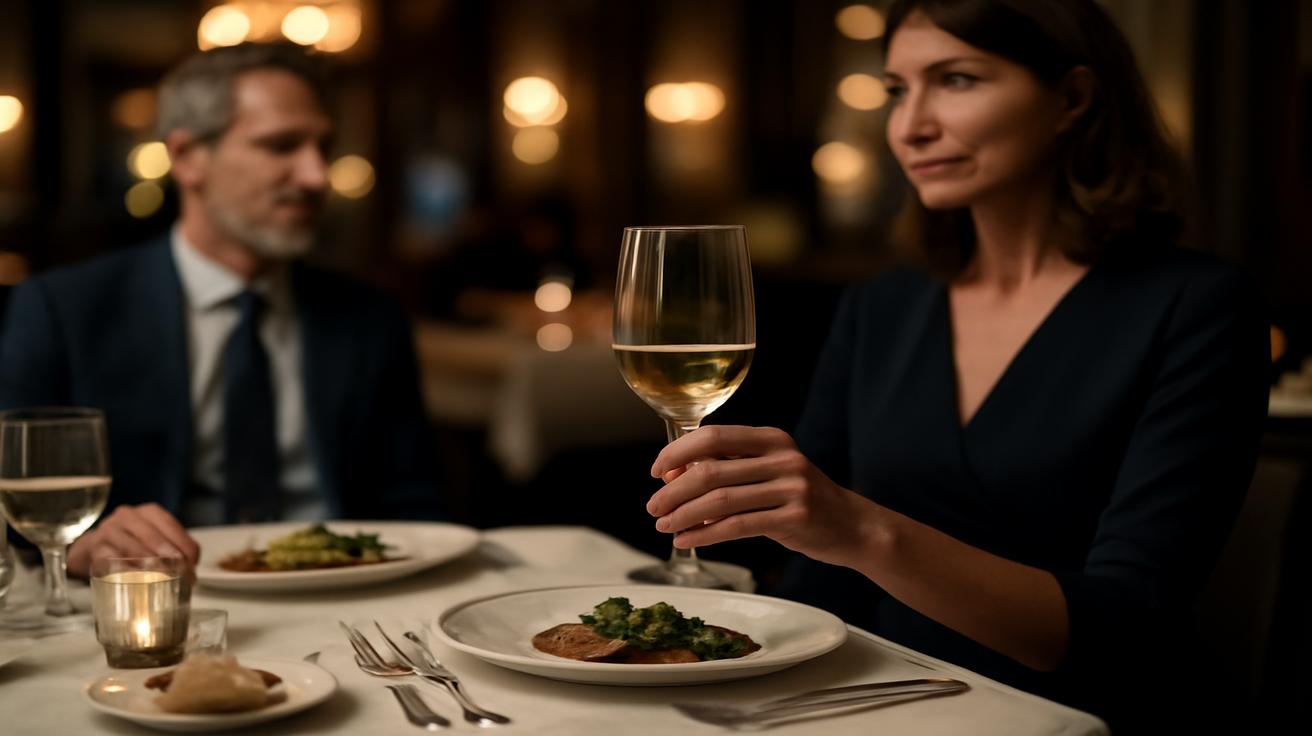
The first thing you notice is the sound. Not the clink of crystal or the murmur of conversation, but the hush that falls over a room when people, almost without thinking, agree to behave well together. Chairs slide in quietly instead of scraping. Cutlery touches plates with a soft, measured music. Someone laughs, but not too loudly. Someone pours water, and the glass fills in a small, clear arc. Before a single bite is taken, the table has already become a small, temporary world with its own gentle gravity, its own laws.
The Silent Invitation of the Chair
Most of us arrive at a table thinking about the food. But long before the first forkful, the story begins with something smaller, subtler: how we sit. There is an art to it, though nobody teaches it in school. You enter a dining room—maybe it’s a friend’s tiny apartment, a noisy family home, a quiet restaurant where the air smells faintly of butter and citrus—and the chair is there, waiting. This is the moment where manners start, silently.
You don’t throw yourself into the chair as if it’s a couch at the end of the day. You approach, turn slightly, and ease it back just enough to slip in. You use your hands lightly, not yanking the chair across the floor like furniture in a moving van. Then you draw yourself in, close enough so your body belongs to the table but not trapped under it. Your feet find the floor. Your back rises, not rigid like a soldier, but alert, like a tree that has grown toward light.
Good posture at the table isn’t about stiff tradition; it’s about presence. When you sit upright, shoulders relaxed and open, you communicate with your whole body: I am here, I am part of this, I’m listening. You give your lungs room to breathe and your stomach room to do its job. You give the people across from you your face, your eyes. Slouching, sinking, sprawled elbows and a half-turned torso all whisper a different message: I’m not fully here, I’m sliding away somewhere else.
Sitting well is a kind of respect—for your own body, for the food that was prepared, and for the people who’ve joined you. Even the distance between you and the table matters. Too far, and you hunch forward to spear a green bean; too close, and your chest presses the edge. The sweet spot is that arm’s-length ease where your forearms can rest lightly near the plate, not on it, not clinging, just available.
The Table as a Small, Shared Landscape
Once you’ve taken your seat, the table becomes more than a flat surface. It’s a small landscape of quiet boundaries and invisible paths. Each object—glass, plate, napkin, piece of cutlery—has its own territory. Learning table manners is less about memorizing rules and more about reading that landscape, like a map that keeps everyone from bumping into each other.
Your napkin is the first signpost. It’s not just a square of fabric; it’s the first gesture of settling in. You wait until your host picks theirs up, then you follow, unfolding it onto your lap, not like a flag at a ceremony but like a leaf drifting down where it belongs. On your lap, it becomes a quiet promise: I’ll try not to make a mess of this shared space, and if I do, I’ll tend to it myself.
Then there’s the subtle choreography of plates and glasses. The big plate in front of you is home base. To your right, like a little bright moon, is your drinking glass; to your left, usually, a small bread plate. Confusion at the table often shows up in those small, fumbling moments: someone reaches the wrong way, another person hesitates, a bread plate becomes disputed territory. But once you recognize this simple left-right pattern—bread and small dishes to the left, drinks to the right—the table suddenly feels more navigable.
The tools of the meal tell their own story. Forks generally rest on the left, knives and spoons on the right, marching outward from the plate in the order you’ll use them. It’s not arbitrary; it’s designed so your hands can move naturally, without crossing over and tangling. A thoughtfully set table is like a trail with clear signs: start here, move there, now you’re ready for the next course.
The Quiet Dance of Shared Space
At its heart, table manners are about sharing. Not in the moralistic, “you must share your toys” way, but in a gentle, deeply human way: we share time, space, and attention. Two people can sit at the same table and eat in parallel, never really meeting. Or they can share the meal, entering the same small world for a while.
Passing dishes is one of the simplest, most telling rituals. Instead of stretching your arm across someone’s plate or half-standing to grab the salt, you ask: “Could you pass the bread, please?” The dish moves, hand to hand, like a small offering. You don’t hover, you don’t reach across, you don’t make someone duck under your arm. You let the table function as a circle, not a scramble.
There is a natural rhythm to this. You don’t seize the serving spoon and heap your plate before offering it to others. You take a moderate portion, then send it along, trusting there will be enough. That trust changes the mood of a meal; it turns the table from a field of scarcity into a place of generosity.
The Art of Hands, Fork, and Knife
Our hands are the most expressive tools we bring to the table. They can be graceful or grabby, calm or frantic. In some cultures, eating with your hands—right hand only, carefully, respectfully—is its own art, fragrant with spices and memory. In others, the fork and knife are like extensions of the hand, meant to be used with understated ease.
The fork isn’t a spear for stabbing; it’s a small, delicate rake, a collector of tastes. The knife isn’t a saw to hack through meat, but a quiet blade that does its work in measured strokes. You cut only what you’re ready to eat shortly, not the entire plate into bits as if prepping a toddler’s meal. Your fork and knife travel together, a kind of partnership: cut, then rest, then eat.
In the European style, you hold the knife in your right hand, fork in your left, tines down, guiding food from plate to mouth with a compact, minimal motion. In the American style, you may cut with knife in right, fork in left, then set the knife down, switch the fork to your right hand, and bring it to your mouth. Neither is morally superior; what matters is that your gestures are contained, your elbows don’t wing outward, and your movements don’t invade your neighbor’s space.
The plate itself becomes a stage where this choreography unfolds quietly. You don’t pile food into a chaotic mound or chase the last pea around like a hunter in pursuit. You move methodically, paying attention. When you pause, your cutlery rests on the plate, not sprawled on the tablecloth. When you’re finished, knife and fork rest together, angled neatly, an unspoken signal that your part in the meal, for now, is complete.
| Manners Moment | What to Do | Why It Matters |
|---|---|---|
| Sitting Down | Pull the chair in quietly, sit upright with relaxed shoulders and feet on the floor. | Signals presence, respect, and reduces noise and disruption. |
| Using the Napkin | Place it on your lap after the host; dab your mouth instead of wiping. | Keeps the shared space tidy and your face camera-ready for conversation. |
| Passing Food | Pass dishes and condiments to your right, offering them to others first. | Creates flow and ensures everyone is included and served. |
| Using Cutlery | Make small, contained movements; rest utensils on the plate, not the table. | Reduces clutter, noise, and the risk of spills or stains. |
| Finishing the Meal | Place fork and knife together on the plate; fold your napkin loosely. | Signals to the host and staff that you’re done, without any words. |
The Music of Conversation and Chewing
Every meal has a soundtrack. Sometimes it’s a soft hum of voices and the clink of cutlery; sometimes it’s a chaotic percussion of dropped forks, overloud laughter, and someone talking through a mouthful of food. One of the most powerful table manners has nothing to do with where you put your fork and everything to do with how you use your mouth.
Chewing with your mouth closed is more than a childhood command. It’s about keeping the focus on the flavors, not the mechanics. No one needs a front-row seat to the transformation of food into mush. When you close your mouth as you chew, you keep the magic inside: the crack of crust, the silk of sauce, the warm steam of roasted vegetables. You let the sounds of the meal be gentle background, not assault.
Then there are the gaps—those pauses between bites when conversation threads in and out. Talking with your mouth full is a way of telling the table, my words can’t wait, and you’ll just have to watch me chew. It drags everyone into a moment they didn’t ask for. Instead, you swallow, take a breath, and then join in. It’s a small delay, a few seconds at most, but it transforms the mood. Words land more clearly when they aren’t accompanied by half-chewed fragments.
Good table conversation isn’t a performance; it’s more like jazz, small improvisations, listening as much as speaking. You ask others about their day, their work, the dish in front of them. You don’t dominate the table, but you don’t sink into silence either. Manners live in those choices: not interrupting when someone is finishing a thought, not steering everything back to yourself, not using the dinner table as a stage for arguments that scorch more than they nourish.
Between Gratitude and Restraint
There is an emotional layer to table manners that often goes unspoken. A meal is rarely just food; it’s effort, cost, planning, hope. Someone chose each ingredient, whether it’s a complicated dish or a simple pot of soup. Someone carried groceries, turned on heat, stirred, seasoned, tasted. When you sit down, you’re not just facing calories; you’re facing someone’s work.
Gratitude at the table doesn’t require grand speeches. It can be as simple as a genuine “This smells wonderful” or “Thank you for cooking.” When you taste something new, even if it doesn’t thrill you, you take a respectful bite. You acknowledge the intention. You don’t push food around dramatically or wrinkle your nose. You make a quiet peace with what’s on your plate.
Restraint is part of this gratitude. You eat at a pace that matches the table, not inhaling your meal as if racing a clock, not dragging it out in a bored dawdle. You avoid piling your plate as if building a small mountain, even at a buffet. You take what you can reasonably eat, understanding that more can be taken later if offered. These choices say: I see that I’m not alone here. My appetite is not the only one that matters.
When the World Comes to the Table
Today, you can sit down at one table and taste half the planet. Sushi and tacos, curry and pasta, dumplings and bread from a dozen traditions. Each culture carries its own table language, and part of modern manners is the humility to learn a few basic phrases in that language before you eat.
In many Asian households, for example, lifting a bowl closer to your mouth as you eat rice isn’t rude—it’s respectful and practical. Slurping noodles can be a compliment, a way to show you’re enjoying the meal fully. In other places, bread is not a utensil but a sacred presence that deserves care. In some cultures, the left hand is kept away from shared dishes; in others, a shared platter is an invitation to lean in, to literally break bread together.
Good table manners are not a rigid set of universal rules; they’re an attitude of observant curiosity. You watch. You notice how others hold their chopsticks, how they serve themselves, when they begin to eat. You ask quietly, “How is this usually eaten?” and follow the lead. Rather than judging what seems strange, you treat it as a chance to step briefly into another way of relating to food, to family, to the world.
At a global table, the deepest courtesy is this: to show that you understand you are a guest not only in someone’s home, but also in their culture. You may not get everything right—your fingers fumble, your chopsticks misbehave—but the effort itself becomes a kind of gratitude, a form of respect that often matters more than flawless technique.
The Table as a Mirror
In the end, table manners are less about impressing others and more about revealing ourselves. The way we sit, serve, eat, and speak at a table is like a mirror we hold up to our character. Are we rushing, grasping, talking over others? Are we observant, gentle, and aware of the invisible threads that connect us?
Think of a meal you remember—not for the food, but for the feeling. Maybe it was a late-summer dinner outside, the air thick with the smell of grilled vegetables and cut grass. Or a dim winter table twinkling with candles and the steam of soup. Chances are, what made it memorable wasn’t perfect cutlery placement but a sense of ease, kindness, and shared rhythm. No one checked their phone every five minutes. No one grabbed the last piece without glancing around. People waited, listened, laughed, apologized when they spilled, and helped clean up at the end.
To practice table manners is to decide, again and again, that the people across from you matter enough to slow down for. It’s recognizing that a table is a fragile, temporary ecosystem where every gesture—where you place your elbow, how you pass the salt, whether you look up when someone speaks—has a small effect on the whole.
When you next sit down to eat, notice the first moment: the quiet approach to the chair, the feel of the napkin, the way you take that initial sip of water. From the art of sitting well to the final resting place of the fork on the plate, your body is telling a story. With a little attention, that story can become one of care, ease, and respect—a story that turns any ordinary meal into a small act of grace.
Frequently Asked Questions
Is it really that important to sit up straight at the table?
Yes, but not in a rigid, uncomfortable way. Sitting upright helps you breathe, digest, and engage with others more easily. It also signals that you’re present and attentive, rather than checked out or rushing through the meal.
What should I do if I forget which glass or bread plate is mine?
Use the simple rule: drinks on the right, bread on the left. An easy memory trick is “b” for bread in your left hand and “d” for drink in your right hand—your left forms a “b,” your right a “d” with your thumb and index finger.
Is it rude to start eating before everyone has been served?
In most settings, you should wait until everyone has their plate and the host has begun. Exceptions are made if the host urges you to start while something is hot, but the general rule is to pause and check in with the group first.
How do I handle food I don’t like without offending the host?
Take a small portion, taste it respectfully, and focus on the parts of the meal you do enjoy. You don’t need to comment on what you dislike; instead, offer genuine appreciation for the effort and for any dishes you find appealing.
What’s the best way to excuse myself from the table?
Wait for a natural pause in conversation, place your cutlery in a rest position on your plate, and say something simple like, “Excuse me for a moment.” Leave your napkin on your chair or neatly on the table, then return without drawing extra attention.