The bus sighs to a stop in the pale light of an autumn morning, brakes whispering, doors folding open with a soft gasp of air. For a moment, before you step on, you notice everything: the damp leaf stuck to the curb, the faint smell of rain on asphalt, a cyclist gliding past with a flash of red panniers, a pair of kids tugging at their parents’ hands as they shuffle toward the front of the line. The street is busy, but the mood is calm, almost choreographed. Cars idle in the distance, but here, in this little bubble of shared movement, something feels different—lighter, cleaner, gentler on the lungs.
You tap your card, find a window seat, and watch as the city begins to scroll by. On days like this, it’s easy to forget that every small choice—waiting for the bus instead of driving alone, walking the last stretch instead of calling a ride, dusting off that old bike in the hallway—has a ripple. Not just over your own health or your wallet, but over the thick, invisible blanket of gases heating our planet. While climate change often feels vast and intangible, the solutions can be as concrete and everyday as how we get from A to B.
The Street-Level View of Climate Change
Climate change is usually talked about in big numbers—gigatons of carbon, degrees of warming, targets set in distant conference halls. But it’s also written into the air above your street at rush hour. Transportation, especially in car-dependent regions, is one of the largest slices of the climate pie. Globally, it accounts for roughly a quarter of energy-related carbon dioxide emissions, and in many cities, private car use is the main culprit.
You can see the evidence in the small, sensory details: the shimmer of exhaust above a crowded intersection on a hot day, the taste of metal at the back of your throat when traffic is at a standstill, the low growl of engines layering over birdsong in the early morning. These are more than minor annoyances. They’re reminders that burning fossil fuels to move one or two people at a time in heavy metal shells is an incredibly inefficient way to run a planet with a climate budget on the brink.
Now imagine the same street with fewer cars. The soundtrack lowers: less roaring acceleration, more rolling tires and murmured conversations. The air feels lighter, carries more of the earthy smell after rain instead of exhaust. You notice details you would miss behind a windshield—the texture of old brick, a window box of herbs, kids chalking galaxies onto the pavement. This isn’t just about aesthetics. It’s the outline of a different emissions story, told at ground level.
How Buses, Trains, and Trams Bend the Emissions Curve
Public transportation is often framed as an option for those who “have to” use it. But from a climate perspective, buses, trains, and trams are some of the most powerful tools we have. Their magic lies in simple math: move many people with one machine instead of one person with one machine, and the emissions per passenger drop dramatically.
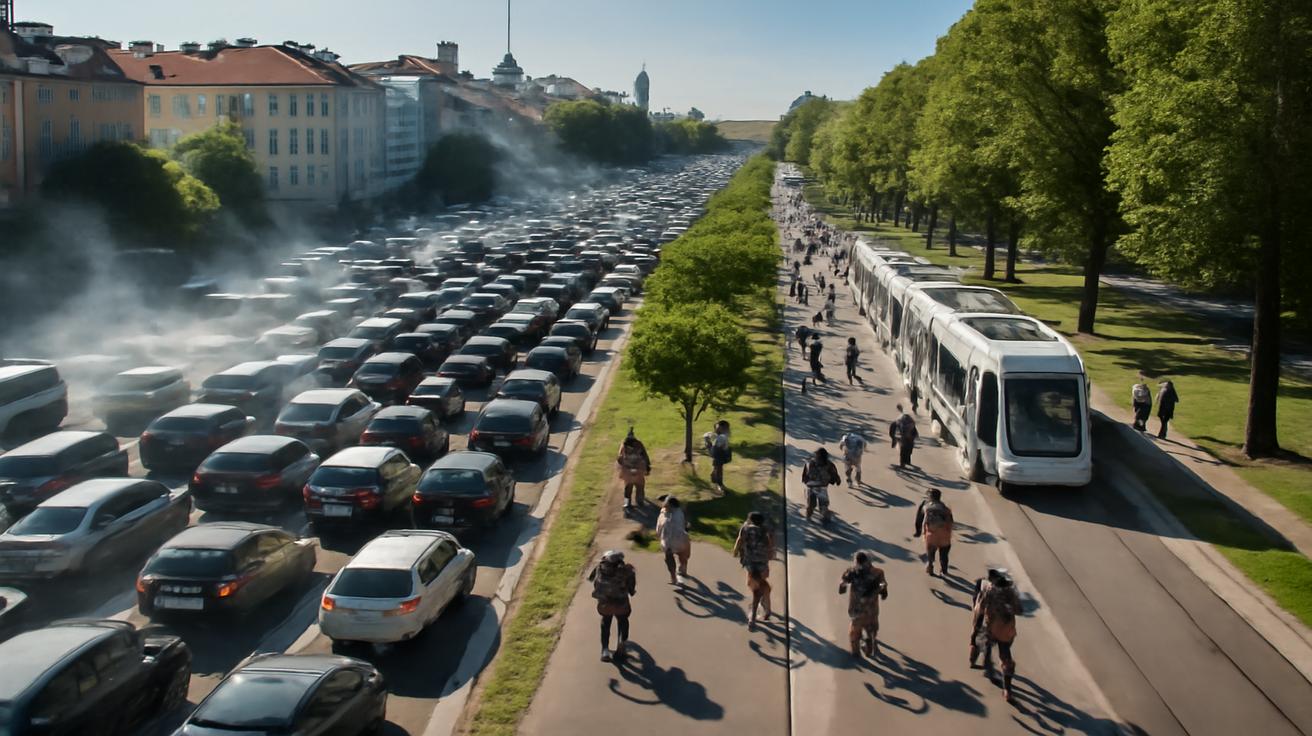
Picture two scenarios on a Monday morning. In the first, a line of 60 cars inches along, each carrying a single driver. In the second, one articulated bus glides through with 60 people on board while bike lanes hum on either side. The total number of travelers is the same, but the carbon footprint is completely different.
| Mode of Travel | Approximate CO₂ per Passenger-Kilometer* | Relative Climate Impact |
|---|---|---|
| Private car (single occupant) | High | Baseline reference |
| Bus (well-used) | Lower than private car | Often cuts emissions per passenger significantly |
| Urban rail / metro | Low, especially with clean electricity | Among the lowest-emission motorized options |
| Cycling | Very low | Near-zero direct emissions |
| Walking | Very low | Near-zero direct emissions |
*Actual figures vary by region, vehicle type, fuel or electricity source, and how full the vehicle is.
What makes buses and trains so climate-efficient isn’t just that they burn less fuel per passenger. It’s that they unlock a whole new pattern of living. When good transit is available, people tend to cluster more closely around stations and stops. That means shorter travel distances overall, fewer sprawling roads to maintain, and less pressure to pave over forests and fields for parking lots and highways. Clean mobility begets compact cities, which in turn reduce the demand for energy and materials. It’s a quiet feedback loop in the right direction.
And public transport itself is getting cleaner. Cities are rolling out electric buses that hum instead of roar, powered increasingly by renewable energy. Trams and metros already run on electricity, and as grids decarbonize, each journey emits less carbon year after year. That bus you caught on a rainy Tuesday may be powered by more wind turbines and solar panels than oil wells and gas refineries.
Walking and Cycling: The Near-Zero Emission Superpowers
Step onto a quiet side street just after sunrise and listen: the crunch of gravel underfoot, the soft swoosh of a bicycle passing, the distant call of a bird. Walking and cycling occupy a special place in the climate story because their direct emissions are almost nonexistent. Your body becomes the engine, fueled by breakfast instead of gasoline.
A bicycle is one of the most energy-efficient machines humanity has ever invented. With a light push on the pedals, your legs turn into levers that send you gliding through the air at three, four, five times your walking speed. Every meter you travel by bike instead of car is a tiny refusal to burn fossil fuels. Even electric bikes, with their small batteries, sip energy compared to the gulps taken by electric cars, let alone combustion vehicles.
Walking is even simpler. No equipment beyond a good pair of shoes and possibly a raincoat. In practice, many car trips are astonishingly short—often just a couple of kilometers, easy walking or cycling distances for many people if safe routes exist. When those short drives become footsteps or wheel turns, the climate wins twice: emissions shrink, and the infrastructure that supports driving (wide roads, parking lots, traffic lights) can gradually be rethought in favor of people-scale spaces.
Active mobility also changes how you feel in your body. That brisk walk to the bus stop on a crisp morning, the uphill pedal that warms your muscles and clears your head, the evening stroll that unwinds the workday—these small routines quietly add up to better physical and mental health. And healthier communities use fewer medical resources, which in itself carries a climate benefit in terms of reduced energy use and material consumption. The pulse of a walking, cycling city is literally good for its heart.
When Cities Choose Feet, Pedals, and Shared Wheels
The climate benefits of public transit and active mobility are not just personal; they’re systemic. When cities commit to these modes, they begin to redesign themselves around lower emissions and better quality of life. You can feel the difference when you arrive in a place that has made that choice.
Imagine a street with a tree-lined, protected bike lane, a wide sidewalk, and a dedicated bus lane running down the middle. The cars are still there, but they’re guests rather than rulers. Buses glide past traffic jams. People on bikes of all ages—kids in cargo bikes, older riders on e-bikes, office workers in regular clothes—cruise at a relaxed pace, separated from fast-moving vehicles by more than a thin strip of paint. The sidewalk is a social space, not just a margin: café chairs, benches, planters, the texture of daily city life.
In these kinds of streets, emissions drop because people have genuine choices. You’re more likely to leave the car at home when you can walk safely to a tram stop under good lighting, hop on a frequent bus that shows up when it says it will, or ride a bike without feeling like you’re risking your life at every intersection. Parents feel comfortable letting children walk or cycle to school. Employers install bike parking instead of endless car lots. The city begins to breathe differently.
Land use shifts too. Instead of vast parking lots baking under the sun, there might be community gardens, small parks, or new housing within easy reach of a transit stop. When buildings cluster around stations, they create “15-minute neighborhoods,” where most daily needs—groceries, schools, clinics, parks—are a short walk or ride away. That cuts emissions from trips before they even start.
Crucially, these changes can make cities more equitable. Car ownership is expensive, and the costs of fuel, insurance, and maintenance create invisible barriers. A strong public transport network paired with safe sidewalks and bike routes gives everyone—from teenagers to elders, from low-income workers to visitors—a fair shot at moving freely without adding to the climate crisis.
The Hidden Climate Wins in the Details
Look closely at a well-designed transit corridor and you’ll see small choices that have big implications for emissions. Bus stops with shelters make waiting in the rain or heat bearable, nudging people away from defaulting to the car. Real-time information screens reduce anxiety about delays. Integrated ticketing lets you move seamlessly from tram to bus to shared bike, making the whole system feel like one flexible organism rather than a tangle of separate parts.
Even things like street trees play a role. A shaded, leafy walking route is more inviting than a sun-baked sidewalk next to six roaring lanes. Trees also capture carbon, filter air pollutants, cool heat islands, and make walking or cycling on hot days less punishing. Climate resilience and low-carbon mobility begin to overlap.
But What About Electric Cars?
As conversations about climate and transport have heated up, electric cars have surged into the spotlight. They are, without question, cleaner over their lifetimes than gasoline cars, especially as grids shift to renewable energy. But they are not a complete answer, and they don’t replace the need for public transport, walking, and cycling.
An electric car still requires energy and materials to build—metals for batteries, plastics, steel, glass. It still takes up space on roads and in parking lots. It still contributes to traffic congestion and road safety risks. And when everyone drives, even in electric vehicles, cities must keep investing in wide roads and large parking areas, locking in patterns of sprawl that are themselves carbon-intensive.
Public transport and active travel tackle the problem at a deeper level. They reduce the number of vehicles needed in the first place. Think of it this way: decarbonizing transport is not only about swapping what powers the engine; it’s about reshaping how often we need an engine at all. In that reshaping, buses, trains, bikes, and our own two feet are irreplaceable.
Electric vehicles absolutely have a role—especially for people in rural areas, for emergency services, for freight that can’t easily be moved by other means. But when it comes to city life and day-to-day commuting, relying solely on electric cars would be like treating a fever without asking what’s causing the infection. The deeper cure lies in reducing our dependency on individual car trips altogether.
Small Daily Choices, Big Atmospheric Effects
It’s easy to feel that your personal mobility choices are tiny against the backdrop of rising seas and scorching summers. Yet climate systems respond to millions of tiny decisions, not just a few grand gestures. Each time you decide to walk, cycle, or catch the bus instead of drive alone, you’re voting for a different kind of future—and chipping away at emissions that otherwise would have silently risen.
Think of the moments in your day where movement happens: the school run, the grocery trip, the commute, the visit to a friend, the quick errand for something you forgot. Not every journey can easily shift to foot, bike, or bus. But many can, especially if you give yourself permission to experiment.
Maybe you start with one day a week of leaving the car at home. A Wednesday “walk and ride” day, where you stroll to a transit stop, earbuds in, watching the sky instead of the brake lights. Or maybe you try cycling to the office once the weather softens, realizing that the twenty minutes you used to spend trapped in traffic can become a daily dose of fresh air and movement.
Creating a Personal Climate Ritual
There’s something powerful about turning low-carbon travel into a ritual rather than a chore. That early-morning bike ride where the world feels half-asleep and the light is soft; the familiar faces on your regular bus route; the corner café you pass every day on foot and eventually decide to step into. These are not just emissions cuts; they’re threads that stitch you into the fabric of your neighborhood.
Over time, you may find that what begins as a “climate choice” becomes simply the way you prefer to live. Your lungs feel clearer. You know more of your neighbors by sight. You notice the seasons changing in subtle ways because you’re out in them, not sealed away. The act of moving gently through your city or town begins to feel less like sacrifice and more like joining a quieter, saner rhythm.
And while you’re doing this, others are too. One parent bikes their kids to school. Another group of colleagues decides to share a bus route. A local business campaign encourages “walk or roll” visits on certain days. These micro-patterns, repeated thousands of times, do something much larger than any of us can feel in a single trip: they alter the demand for high-carbon travel and build momentum for better infrastructure and policies.
Stepping Into the Low-Carbon City
Stand again at that bus stop on the gray autumn morning. Listen to the conversations around you—a student with headphones slung around their neck, a nurse on the early shift, an older man balancing a shopping bag against his cane, a teenager with a skateboard tucked under one arm. All of you are bound for different destinations, but in this moment, you’re sharing the same vehicle, the same route, the same patch of planet.
In the glow of the bus’s interior lights, the climate story narrows from melting ice sheets and distant storms to this small, familiar ritual: step on, tap your card, find a seat. Outside, a cyclist coasts by; further down, a person in a bright raincoat crosses at the light. The world keeps moving, but with fewer fumes, less noise, more room for breathing.
The climate benefits of public transportation and active mobility are as real as the air you draw into your lungs, and as tangible as the handlebars beneath your palms or the pavement underfoot. They’re measurable in reduced emissions, yes, but also in how cities sound, how streets feel, and how connected we are—to place, to each other, and to a future that still has space for a stable climate.
We don’t need to wait for some distant technology to rescue us. The tools are already trundling down our streets and leaning against hallway walls: buses and trains, bike lanes and sidewalks, our own two feet. Each trip taken this way is a small act of care—for your body, your neighbors, and the thin, shared atmosphere curling gently above the rooftops. The invitation is simple: the next time you’re going somewhere, try asking not just “How fast can I get there?” but “How lightly can I travel?” The answer, more often than not, begins with a step, a pedal, or a seat on a shared ride.
Frequently Asked Questions
Does using public transportation really make a difference for the climate?
Yes. Because buses, trams, and trains carry many people at once, the emissions per passenger can be much lower than driving alone, especially when vehicles are well-used and powered by cleaner energy. Over time, widespread transit use reduces the need for car-focused infrastructure and sprawl, which further lowers emissions.
Is walking or cycling actually better than driving an electric car?
For short trips, walking and cycling generally have a smaller climate impact than driving, even in an electric car, because they use far less energy and require less infrastructure. Electric cars are helpful for decarbonizing necessary driving, but they don’t replace the benefits of active travel and good public transport.
What if my city doesn’t have good public transportation or safe bike lanes?
You can still look for small shifts—walking for very short trips, carpooling, combining errands into one journey, or using park-and-ride services where available. At the same time, adding your voice to local campaigns for better sidewalks, safer crossings, bike lanes, and improved transit can help change the system over time.
Isn’t cycling or walking only realistic for people who are already fit?
Not necessarily. Many people start with short, easy routes and gradually build confidence and stamina. E-bikes make hills and longer distances manageable for a wider range of ages and abilities. Of course, not everyone can or should travel this way, but making cities more walkable and bike-friendly gives more people the option.
How can I start reducing my transport emissions without totally changing my life?
Begin small. Choose one or two regular trips each week to do by bus, train, walking, or cycling instead of driving. Try a “no-car day” once a week, or park a bit farther away and walk the last stretch. As you get used to these changes, you can gradually expand them. Even modest shifts, repeated over months and years, can add up to a meaningful climate impact.