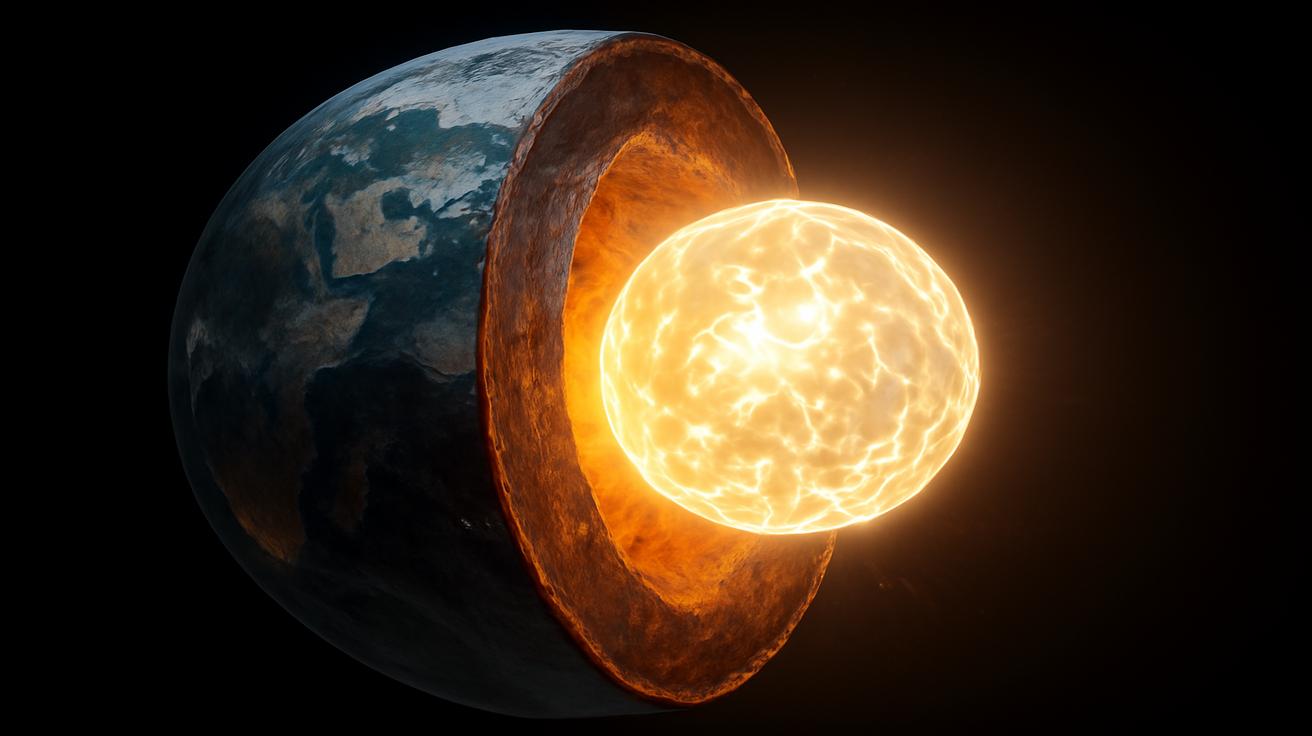
The story begins three thousand kilometers beneath your feet, where no human has ever looked with naked eyes—where rock flows like molasses, metal moves like a slow tide, and pressure turns familiar elements into something strange and almost mythic. Imagine, for a moment, that all the oceans on Earth—every rolling wave, every drop of rain, every grain of mist—are just a thin, glistening film compared with the water that could be hidden far below. Now imagine that deep in the planet’s core there may be enough hydrogen to create up to forty-five more oceans. Not on the surface, glinting in the sun, but trapped in the dark, in metal, in minerals, in a realm where water isn’t liquid or ice, but chemistry pressed to its extremes.
A Planet Built on a Secret
If you were to strip the Earth clean—scraping away the forests, cities, plains, and shifting the oceans aside—you would find layers. First the crust, that fragile eggshell we live our whole lives upon. Then the mantle, a vast zone of hot, slow-moving rock. Go deeper still and you find the core: a huge metallic heart of liquid and solid iron-nickel alloy, generating the magnetic field that shields us from the solar wind. That’s the standard picture many of us learned in school.
But the more closely scientists listen to the planet’s heartbeat, the stranger this picture becomes. Seismic waves—a kind of planetary ultrasound delivered by earthquakes—tell us that something in the core is “off” from what pure iron and nickel should look like. It’s a bit too light. Waves travel at speeds that don’t quite match the models. Something else is mixed into that metal, some lighter elements dissolved into the molten and solid iron, changing its density, its behavior, its story.
For a long time, sulfur, carbon, silicon, and oxygen have been the usual suspects. But in the last few years, hydrogen—a ghostlike, almost weightless element—has stepped into the spotlight. Not in the way we picture it near the surface, as gas or part of liquid water, but as atoms forced into iron like seeds pressed deep into clay.
That’s where the astonishing idea comes in: there could be enough hydrogen in the Earth’s core to form up to forty-five oceans’ worth of water if it were somehow brought up and combined with oxygen. It’s a number so large that it feels made up, fairy-tale big. And yet, it springs from the quiet, careful work of lab benches and supercomputers.
Listening for Clues in Metal and Earthquakes
The planet doesn’t give up its secrets easily. We can’t drill all the way to the core. We can’t send a probe. So scientists turn to two main tools: experiments that mimic the insane conditions of the deep Earth, and the messages carried by seismic waves.
In high-pressure labs, tiny samples of iron and hydrogen are crushed between the tips of diamond anvils, then blasted with lasers until they heat and shimmer like miniature stars. These experiments recreate the immense pressures—millions of times greater than the air on your skin at sea level—and extreme temperatures that exist near the core. Under these conditions, iron doesn’t behave like the familiar metal in a cooking pan; it opens its atomic lattice, allowing hydrogen atoms to slip in and occupy spaces in between.
These lab-made iron-hydrogen alloys turn out to be lighter and more compressible than pure iron. When researchers compare those properties with what seismic waves tell us about the actual core—how fast they travel, how they bend, how they reflect—they find a striking match. The numbers whisper the same conclusion: the core likely contains a substantial amount of hydrogen.
Meanwhile, every major earthquake sends tremors around and through the globe. Networks of instruments detect the arrival times of different wave types: P-waves (compressional) and S-waves (shear). Like a doctor reading an MRI, geophysicists use these timings to reconstruct the internal structure of Earth. Slight discrepancies between how waves should move through a simple iron core and how they actually move hint at light elements mixed within.
By testing different combinations—iron plus a bit of sulfur, plus a splash of oxygen, plus a pinch of hydrogen—scientists can narrow down which recipes best explain the seismic data. In many of these “recipes,” hydrogen plays a starring role. From that, you get the extraordinary estimate: perhaps as much hydrogen as would be needed to make up dozens of additional oceans.
| Feature | Surface Oceans | Hydrogen in Core (Estimated) |
|---|---|---|
| Approximate Water Volume | 1 “ocean” (current global ocean) | Equivalent of up to 45 oceans if fully converted to water |
| Form | Liquid water at the surface | Hydrogen atoms dissolved in iron and other metals |
| Accessibility | Directly involved in climate, weather, and life | Locked deep in the core, currently unreachable |
| Role in Planetary Behavior | Drives ocean currents, climate, water cycle | Influences core density, convection, and magnetic field |
Where Did All That Hydrogen Come From?
To imagine an iron core brimming with hydrogen is to rewind the planet’s history to its most chaotic days. Four and a half billion years ago, the young Earth was not a blue marble but a glowing, molten world bombarded by planetesimals and comets, wrapped in a thick atmosphere rich in hydrogen-bearing gases.
In that furnace, metal droplets sank through the magma ocean, merging and pooling to form the growing core. If hydrogen was plentiful in the surrounding environment, some of it would have been swallowed by the forming core, dissolving into the iron as conditions allowed. Experiments show that at the pressures and temperatures of those early days, iron has a surprising capacity to store hydrogen, like a sponge under unimaginable compression.
Other potential sources add layers to the story. Icy bodies and water-rich minerals delivered from space could have been dragged deep into the mantle and, over immense stretches of time, partially funneled downward. Some of that hydrogen might have hitched a ride all the way into the core. No single pathway tells the whole tale, but all of them together describe a planet that never really finished swallowing its primordial hydrogen.
Once captured, that hydrogen didn’t just sit there passively. It likely changed the way the core crystallized, the way heat moved outward, the way the geodynamo—the churning motion of molten metal that generates Earth’s magnetic field—turned on and evolved. In other words, hydrogen may be quietly intertwined with the reason your compass works, and why the atmosphere hasn’t long since been flayed away by the Sun.
Forty-Five Hidden Oceans: What Does That Even Mean?
The phrase “enough hydrogen to form up to 45 oceans” sounds like a poetic exaggeration, but it’s not meant literally in the sense that a tap deep underground could be opened to pour out ocean after ocean. It’s more like a translation of mass into imagery.
Hydrogen is a key ingredient in water: two hydrogen atoms and one oxygen atom make each molecule. When scientists talk about “ocean equivalents,” they’re converting the total mass of hydrogen in the core into how much water it could theoretically produce, if it had access to enough oxygen and could rise to conditions where water is stable as we know it.
Of course, none of that is happening. That hydrogen is locked away at the boundary of possibility, in environments where water as we understand it simply cannot exist. Instead, think of those forty-five oceans as a way of expanding your sense of scale. The ocean covering 70 percent of Earth’s surface, that seems so vast when you stand on a shoreline, is actually a very small part of the planet’s full water-hydrogen story.
There is a humbling twist in that thought: the visible, sunlit portion of our water cycle—clouds, storms, rivers—might be just the shimmering surface of a deep, hidden ocean of hydrogen silently shaping our world from below.
A New Kind of Water World
This idea forces us to reframe what it means to call Earth a “water world.” From space, the blue swirls of oceans and clouds are the giveaway sign. We think of surface seas as the defining mark of a habitable planet. But if hydrogen and water can be stored deep inside a planet, in its mantle and core, then a world might be rich in water without showing much of it on the outside at all.
Already, researchers are talking about “interior oceans”—not seas of liquid, but reservoirs of water bound into minerals and hydrogen dissolved in metals. A rocky planet can hide staggering quantities of water in its interior. That has profound implications for how we search for life beyond our own world, and how we interpret the mass and density of exoplanets circling distant stars.
When astronomers measure the size and mass of a faraway planet and try to guess its composition, interior hydrogen and water become part of the equation. A planet a bit lighter than expected might not be a puffball of gas; it could be a rocky world with hydrogen-seeded metal deep inside, quietly influencing its evolution. Earth’s secret reserves are not just a curiosity about our planet—they’re a Rosetta stone for decoding others.
The Hidden Player in Earth’s Magnetic Drama
There is another storyline running through the core’s hidden hydrogen: magnetism. Earth’s magnetic field is sustained by the slow, convective motion of liquid metal in the outer core. Lighter elements mixed into the iron—like hydrogen—help drive that motion by changing density contrasts, affecting how heat and material rise and fall.
If the core contained only pure iron and nickel, its convection patterns, its rate of cooling, and its ability to sustain a dynamo over billions of years might look very different. Hydrogen likely helps lower the melting point of core materials, influencing the growth of the solid inner core and the churning of the liquid outer core. Every adjustment to that delicate balance echoes outwards, into the strength and structure of the magnetic field we rely on to steer migrating animals, direct compasses, and protect our technology and DNA from charged particles streaming from the Sun.
In a way, those hypothetical forty-five oceans of hydrogen are part of the invisible infrastructure that keeps Earth habitable. You don’t notice it when you look up at the aurora veiling the polar night sky, but the performance you’re watching is, in part, powered by chemistry you will never touch.
Why This Changes How We See Home
Walking along a beach, waves sliding over sand and salt dried in white lines along the shore, it’s easy to feel that you are seeing the core of Earth’s water story. After all, here is the ocean: vast, deep, alive with movement. But the idea of a hydrogen-rich core turns that intuition inside out. It says that what you’re witnessing is one chapter in a much longer tale that runs from sky to sea to stone and finally into metal under crushing pressure.
It nudges us away from thinking of the planet as a static onion of layers, and toward a vision of a dynamic, breathing system, where even the deepest interior plays a role in what happens at the surface. The composition of the core affects the magnetic field; the magnetic field shapes the atmosphere; the atmosphere shapes climate and habitability; and oceans, in turn, refine the atmosphere over time. That loop may begin, in some small but crucial way, with hydrogen atoms imprisoned in a realm we’ll never see.
It also revises our sense of scale. We often speak of “running out of water,” and while accessible fresh water is indeed limited and fragile, the idea of a planet hiding many oceans’ worth of hydrogen inside it reminds us how much bigger Earth is than our immediate concerns. That doesn’t make surface water less precious; if anything, it sharpens the contrast between what is usable and what is forever out of reach.
Questions We Still Can’t Answer
For all the drama of “forty-five oceans,” the truth is still wrapped in uncertainty. The estimated range of hydrogen in the core is wide, and other light elements are undoubtedly mixed in too. Different studies, using different experimental setups and models, arrive at different numbers. Some argue for less hydrogen, some for more oxygen or silicon, some for combinations we haven’t fully explored.
The core is not a static place, and our tools are always incomplete. Diamonds break. Lasers can only simulate so much. Earthquakes don’t strike in perfectly convenient patterns. Every measurement has error bars, every model carries assumption. In that sense, the core is not just physically inaccessible; it is conceptually slippery, a place where we are always inferring, never directly seeing.
Yet, even with all these caveats, a new consensus is quietly forming: hydrogen is very likely a significant player in the deep Earth story. Whether it corresponds to ten, twenty, or forty-five ocean equivalents is a question of refining the details. The big revelation—that the Earth we stand on is far more water-rich, in a broad chemical sense, than we ever imagined—seems here to stay.
There’s a poetic comfort in that. Somewhere below, beneath the basalt and the mantle plumes, beneath the tectonic plates grinding and drifting, beyond the reach of drill bits and submarines and human ambition, lies a dark metallic sea seeded with the lightest element in the universe. It is silent, but it is part of why the sky overhead is blue, why the oceans roll, why life had a chance to take root.
You may never feel the heat of the core on your skin, never hold a piece of iron from that realm in your hand. But with every step you take, every breath of damp ocean air, you are living on the surface of a planet whose deepest secret is not fire alone, but hidden water—locked in hydrogen, buried in metal, enough to dream of forty-five more oceans that will never see the light.
FAQ
Does this mean we can access those “45 oceans” of water for human use?
No. The hydrogen in the core is not liquid water and is effectively unreachable with any technology we can imagine. It is locked inside metal under extreme pressure and temperature. The “45 oceans” figure is a way of describing how much hydrogen is there, not a practical resource.
Is there really water at the Earth’s core?
Not in the conventional sense. At core conditions, what exists is primarily iron alloyed with light elements, including hydrogen. If that hydrogen were brought to surface conditions and combined with oxygen, it could form water, but deep in the core it exists in a very different state.
How sure are scientists about hydrogen in the core?
Scientists are increasingly confident that hydrogen is one of the light elements present, based on high-pressure experiments and seismic data. However, the exact amount and precise mix with other light elements (like sulfur, carbon, oxygen, and silicon) remain uncertain and are an active area of research.
How does hydrogen in the core affect life on Earth?
Indirectly, hydrogen influences the density and behavior of the core, which in turn affects core convection and the generation of Earth’s magnetic field. That magnetic field helps shield the planet from harmful solar and cosmic radiation, playing a crucial role in preserving the atmosphere and supporting life.
What does this discovery mean for the search for life on other planets?
It suggests that rocky planets might store significant amounts of water and hydrogen in their interiors, even if they don’t show large surface oceans. This broadens our understanding of what a “water-rich” or potentially habitable world might look like and adds complexity to interpreting exoplanet data on mass and composition.