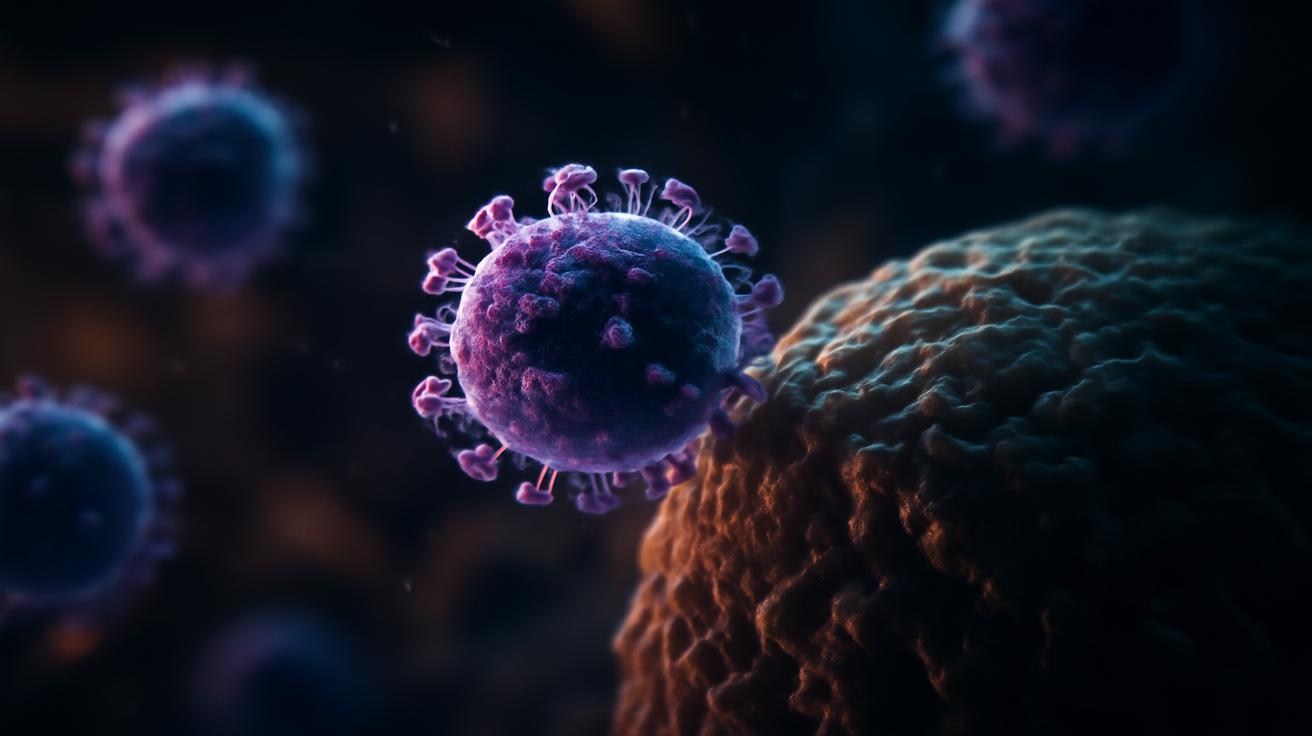
The story often begins quietly, almost forgettably: a sore throat that feels like swallowing gravel, a fever that burns for days, a weariness that sinks into the bones. Maybe it’s written off as “just mono,” the price of sharing a drink at a party or kissing someone whose name you only half remember. The Epstein–Barr virus slips into your life like that—unremarkable, unspectacular, ageless. Then it stays.
The Ubiquitous Stranger Living Inside Us
Epstein–Barr virus, or EBV, is one of those invisible characters that wanders through nearly every human life. About 9 out of 10 adults on Earth carry it. For most people, infection happens in childhood and barely registers: a low-grade fever, maybe a little fatigue, then nothing. Others meet it in adolescence or early adulthood and get the more dramatic version—infectious mononucleosis, “mono,” the so-called kissing disease.
But here’s the part that rarely makes it into the quick doctor’s office explanation: once EBV arrives, it never really leaves. It takes up residence in certain white blood cells—B cells—and goes quiet, sliding into a kind of molecular hibernation. No more fevers, no more sore throat. Just a truce, of sorts, between virus and host.
We walk through life with it lodged in our immune systems like a ghost tenant. Decades can pass in silence. You study, work, fall in love, move cities, raise children. Meanwhile, the virus is still there, coded into the choreography of your cells, a story paused mid-sentence.
For many people, that’s the end of the tale. EBV sleeps; the immune system keeps watch; the relationship remains mostly benign. But for some, the story takes a darker, more twisting turn. And that turn is what scientists are studying with a new urgency: could this ordinary, near-universal virus be quietly shaping the fate of autoimmune diseases?
The Immune System’s Mirror: How Recognition Can Go Wrong
The immune system is part detective, part warrior, part archivist. It remembers past invaders, distinguishes “self” from “other,” and dispatches cells to neutralize anything suspicious. Each immune cell carries an intricate library of molecular patterns—signatures of viruses, bacteria, and the body’s own tissues.
When EBV shows up, the immune system does what it’s trained to do: it forms antibodies and specialized T cells that recognize EBV-infected cells and keep them in check. On the surface, that looks like a success story. Infection controlled, virus constrained, life goes on.
But what happens if some of EBV’s molecular patterns—small fragments of its proteins—look eerily similar to pieces of our own body? The same antibodies and immune cells that are honed to target EBV might also start reacting to brain cells, joints, or the lining of the gut. This mistaken identity, called molecular mimicry, is like a case of friendly fire: the immune system misreads its own tissues as viral intruders.
In autoimmune diseases, this misreading becomes chronic. The body launches a prolonged, misguided campaign against itself. Nervous tissue in multiple sclerosis. Joints in rheumatoid arthritis. The thyroid in Hashimoto’s or Graves’ disease. The pancreas in type 1 diabetes.
Is EBV the spark? The fuel? Or just a witness at the scene? Over the past decade, the scientific whispers have grown louder: EBV may not simply be a bystander. It might be one of the central plotlines.
When Patterns Converge: The Emerging Link to Autoimmune Disease
Picture this: a massive, years-long study tracks hundreds of thousands of people, watching as their health unfolds in real time. Blood samples are stored, their immune histories frozen in vials. Years later, some of those people develop multiple sclerosis, an autoimmune disease where the body attacks the protective myelin sheath around nerve fibers in the brain and spinal cord.
When researchers go back to those earlier blood samples, one thing stands out. Before developing multiple sclerosis, nearly every one of these individuals had a clear EBV infection. Infection wasn’t just common—it was almost universal among those who went on to develop the condition, far more so than in those who didn’t.
That doesn’t mean EBV acts alone, or that infection guarantees disease. It does mean that, for some people, EBV may be one of the crucial switches that flips latent risk into active illness.
Other studies have found antibodies that attack the body’s own proteins but seem to be triggered by EBV-like proteins. In some patients with multiple sclerosis, certain immune cells that should be targeting EBV instead cross-react with brain tissue. It’s as if the immune system learned the wrong lesson from its encounter with the virus—and never forgot.
This pattern isn’t limited to multiple sclerosis. Researchers have found EBV hiding in the B cells of people with lupus, rheumatoid arthritis, and other autoimmune conditions. The virus appears to warp the conversation among immune cells, nudging some into overactivity and others into silence. It can tinker with gene expression inside its host cells, subtly influencing which proteins are made and which pathways are switched on.
Not every person with autoimmune disease has a dramatic history of mono. Many never knew they were infected at all. But at the microscopic level, the footprints of EBV keep turning up, again and again, like a recurring character in a story we’re only beginning to read correctly.
The Quiet Saboteur in B Cells
B cells, the white blood cells that make antibodies, are EBV’s preferred hiding place. Under normal conditions, B cells are like the memory keepers of the immune system, producing tailored antibodies against everything from flu viruses to childhood infections.
EBV slips inside these cells and lingers. It can gently steer them toward rapid growth, survival, and activation. In the short term, that might simply help the virus maintain its hidden reservoir. But over years, an altered B cell population could mean a more irritable immune system—one that’s quicker to produce rogue antibodies, slower to shut down unnecessary responses.
In autoimmune diseases such as lupus, certain B cells go into overdrive, creating a storm of self-targeting antibodies that deposit in organs and joints. In multiple sclerosis, misdirected B cells can contribute to the breakdown of nerve insulation. Some scientists now wonder whether the long shadow of EBV inside these cells acts as a primer—a subtle, ongoing nudge that makes autoimmune misfires more likely.
A Story Written in Risk: Genes, Environment, and a Common Virus
Of course, EBV alone is not destiny. If it were, we’d see autoimmune disease in nearly everyone, and we don’t. So what separates the millions of people who live peacefully with EBV from those whose immune systems eventually turn inward?
This is where the story widens to include family histories, geography, diet, stress, and the quiet influence of genes. Autoimmune diseases tend to cluster in families—not in a neat, predictable way, but enough to suggest that some immune systems are born a bit more twitchy, a bit more prone to overreaction.
Certain genetic variations affect how immune cells recognize viral proteins, how inflammation is regulated, and how efficiently immune responses wind down after an infection is resolved. If your genes tilt the playing field in the direction of overreacting, a viral encounter could be enough to send things sliding into chronic autoimmunity.
Then add environment. Sunlight, vitamin D levels, gut microbes, early childhood infections, exposure to pollution or cigarette smoke—all of these can quietly sculpt the immune system over time. In someone with a sensitive genetic setup, EBV might arrive as one environmental hit among several, the one that tips the balance.
So rather than thinking of EBV as a lone villain, it may be more accurate to picture it as a catalyst, interacting with a script already sketched in light pencil by genes and life experience. For some, the pencil marks stay faint; for others, EBV darkens the lines into something more permanent and harder to erase.
What the Numbers Suggest
Scientists use large population studies and immune profiling to understand patterns. While the numbers vary by country and method, some broad patterns are emerging. Below is a simplified overview of how EBV and autoimmune conditions intersect at a population level.
| Condition / Group | Estimated EBV Exposure | Notes |
|---|---|---|
| General adult population | ~90–95% | Most infected in childhood, often without symptoms. |
| People with multiple sclerosis | ~99% or higher | Nearly all patients show past EBV infection in large cohort studies. |
| People with lupus (SLE) | Very high (often >95%) | Elevated EBV antibody levels frequently observed. |
| People with rheumatoid arthritis | High, similar to or above general population | Evidence suggests altered immune responses to EBV. |
| Children with no EBV exposure yet | Lower, <50% in early childhood | Infection often increases with age and social contact. |
These numbers don’t prove causation—but they are hard to ignore. When a nearly ubiquitous virus shows up almost universally in people with specific autoimmune conditions, scientists take notice. The question shifts from “Is EBV involved?” to “How, and in whom, does it matter most?”
The Body Remembers: Symptoms, Flares, and Invisible Triggers
Talk to someone living with an autoimmune disease and you’ll hear a language of waves and weather: flares, crashes, clouds lifting, storms returning. Symptoms wax and wane, sometimes with obvious triggers like infection or stress, sometimes with no apparent reason at all. Fatigue can feel like walking through knee-deep water. Pain can flicker or gnaw. Vision blurs, joints swell, skin erupts.
What’s eerie is how often infections in general—not just EBV, but colds, flu, even stomach bugs—precede or amplify these flares. Each infection calls the immune system back into high alert. If that system is already predisposed to confusion, the renewed activity can spill over into misdirected attacks on the body’s own cells.
Some people describe a kind of “before” and “after” around a specific viral illness. They remember a bad bout of mono in their teens or twenties, followed months or years later by subtle changes—strange tingling, unexplained exhaustion, joints protesting simple tasks. It’s not always a straight line, and memory is fallible, but the pattern recurs often enough to be haunting.
Still, millions who had EBV never develop these problems. And millions with autoimmune disease don’t remember any dramatic EBV episode. That’s the unsettling subtlety of this virus: its effects may be less like a lightning strike and more like a slow, nearly invisible erosion. A few genes nudged here, a few immune pathways tilted there, the full consequences emerging only when enough pieces fall into place.
The Hope in New Questions
Within this unsettling story, there’s a thread of hope. If EBV is a key player—not the only one, but a meaningful one—then it represents something we might be able to change. You can’t rewrite a person’s genes, and you can’t go back in time to undo childhood infections. But you can imagine vaccines that block EBV infection in the first place or therapies that specifically target EBV-infected cells before they push the immune system over the edge.
Researchers are already working on EBV vaccines, not just to prevent mono, but potentially to lower the long-term risk of multiple sclerosis and other autoimmune diseases. Others are exploring drugs that could disrupt the virus’s ability to manipulate B cells or hide in its dormant form. These are early days, and nothing is guaranteed. But it’s the kind of upstream thinking that could one day turn down the volume on autoimmune disease for future generations.
Even now, simply recognizing EBV’s role may help clinicians take infections and post-viral symptoms more seriously in people at risk for autoimmune disease. It might shape recommendations about monitoring, rest, and follow-up after a significant viral illness. It reframes the narrative from one of mysterious bad luck to one of intricate cause and effect—still complex, but not entirely arbitrary.
Living with the Hidden Companion
For those already living with autoimmune disease, the idea that an almost-forgotten virus might have helped set the stage can stir mixed emotions. There’s validation: a sense that the illness is not random or imagined, but rooted in a deep biological story. There’s frustration, too: why me, if almost everyone has this virus? Why did my body, out of all the bodies EBV has passed through, respond this way?
There aren’t easy answers, but there is a kind of quiet solace in understanding. To know that your fatigue, your pain, your foggy mornings and careful pacing, are part of a larger map that scientists are steadily filling in. That your body’s betrayals are less about personal failure and more about inherited vulnerabilities, environmental collisions, and a virus that learned, long ago, how to live inside us.
It also invites a gentler relationship with one’s own immune system—this complex, often overzealous guardian. It has been negotiating with microbes since long before you were born. Sometimes it miscalculates. Sometimes, in its determination to protect, it harms. But it is also what allows you to walk through a world teeming with invisible life and survive.
EBV’s story inside us is not a simple one of villain and victim. It is a story of coexistence gone wrong in some, of adaptation and uneasy harmony in others. It forces us to rethink what it means to “get over” an infection, and to appreciate how long the echoes of a single illness can resound through a lifetime.
Somewhere inside your blood, if you are like most adults, remnants of Epstein–Barr are resting in the shadows of your immune cells. You may never feel its presence again. Or, under the right mix of genes and circumstance, its quiet influence may ripple outward in ways no one intended. The more we learn to read those ripples—the molecular mimicry, the B cell rewiring, the complex dance of genes and environment—the closer we get to changing the story for those whose lives have already been rewritten by autoimmune disease.
Frequently Asked Questions
Does having Epstein–Barr virus mean I will develop an autoimmune disease?
No. Most people on Earth are infected with EBV at some point, and the vast majority never develop an autoimmune disease. EBV appears to be one factor among many—genes, other infections, environmental exposures, and chance all contribute. It may increase risk in some people, but it is not a guarantee.
Can I be tested to see if I have Epstein–Barr virus?
Yes. Blood tests can detect antibodies that show whether you have a current or past EBV infection. However, because EBV is so common, a positive result usually doesn’t change medical care unless you have specific symptoms like suspected mono or complications.
If I had mono in the past, should I worry about autoimmune disease?
Mono is one way EBV infection shows up, but having had mono does not mean you will develop autoimmune disease. It may slightly raise the risk of certain conditions, such as multiple sclerosis, especially in people with other risk factors. If you notice persistent neurological issues, joint pain, unusual fatigue, or other ongoing symptoms, it’s worth discussing them with a healthcare professional.
Can Epstein–Barr virus be cured or removed from the body?
Current treatments cannot fully eliminate EBV once it is established. The virus typically remains dormant inside certain immune cells for life. Medical care focuses on managing symptoms during active infection and treating any complications or associated conditions rather than eradicating the virus itself.
Are there vaccines or treatments specifically targeting Epstein–Barr virus?
There is no widely available EBV vaccine yet, but several vaccine candidates are under development and testing. Researchers are also exploring therapies that might target EBV-infected cells more precisely. These approaches are still experimental, but they hold promise for reducing the burden of EBV-related diseases in the future.
What can I do to lower my risk of autoimmune disease if I already have EBV?
You cannot remove EBV, but you can support your overall immune health and reduce other risk factors. This includes not smoking, managing stress, getting enough sleep, staying physically active within your limits, and treating infections promptly. If you have a family history of autoimmune disease or concerning symptoms, regular medical follow-up and early evaluation can help detect issues sooner.
Can lifestyle changes reverse the effects of EBV in autoimmune disease?
Lifestyle changes alone cannot reverse EBV infection or fully cure autoimmune diseases, but they can meaningfully influence how you feel and how active the disease is. Many people find that balanced nutrition, stress management, gentle movement, and adequate rest help reduce flare frequency and intensity. These measures work best alongside, not instead of, appropriate medical treatment.