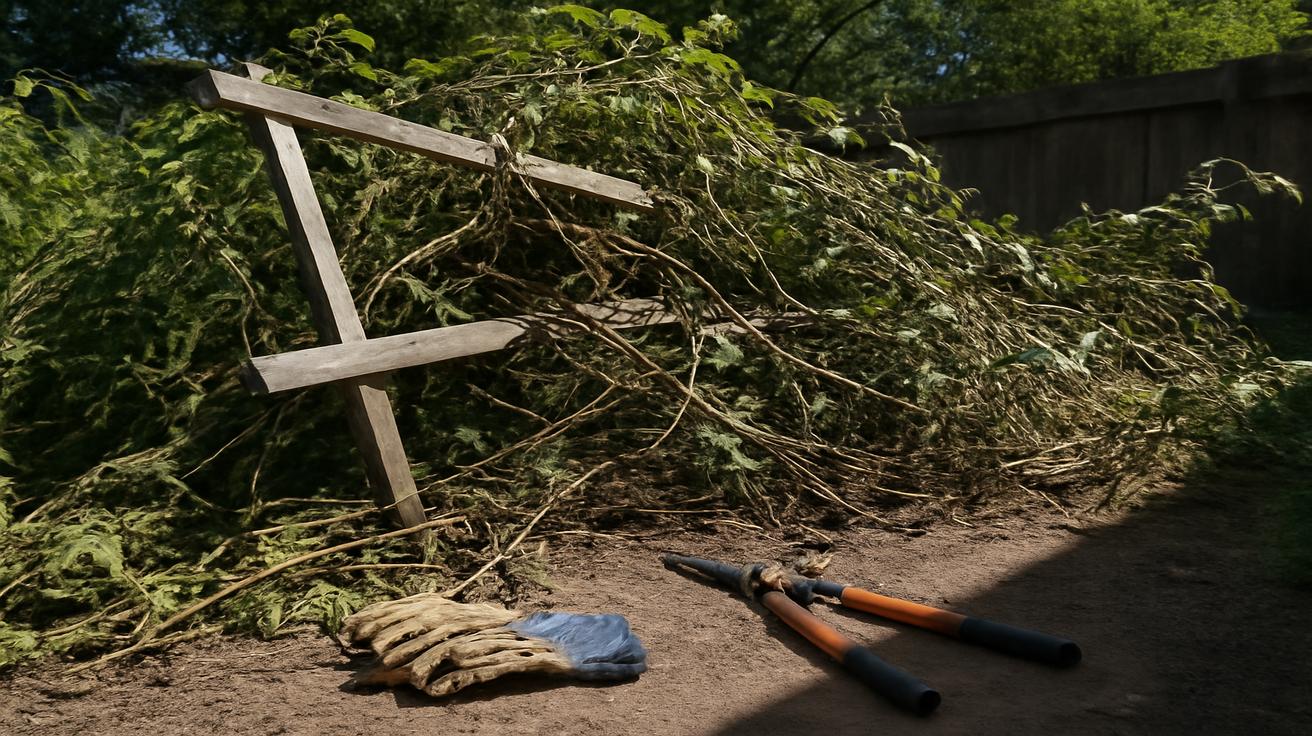
The first time my blackberry trellis collapsed, it didn’t fall with drama. It sighed. A slow, sagging surrender in the middle of a July heatwave, when the canes were bowed with glossy fruit and the air smelled like hot sugar and dust. One minute, it was the picture-perfect grid I’d copied from some cheerful YouTube gardener. The next, the posts leaned like tired old men, the wires bowed into a sad hammock, and my blackberries sprawled across the path, daring me to pretend I hadn’t been warned by the laws of physics.
The YouTube Dream vs. Backyard Reality
If you’ve spent any time online dreaming about berry patches, you already know the script: “Blackberries are easy! Just put in a few T-posts, run a couple of wires, and boom—instant trellis. Look how neat everything is!” There’s upbeat music, tidy rows, clean clothes, not a single thorn mark on their forearms.
What you don’t see: the year after that video, when those elastic little canes turn to woody monsters and the “simple trellis” starts listing like a sinking ship. You don’t see the posts that heave in spring after a freeze-thaw cycle, or the wires that loosen just as the heavy fruit sets in. No one clicks on a thumbnail titled “I Underbuilt My Trellis and Now I Live with Regret.”
Instead, you and I get sold the dream of a delicate little support structure for a plant that is basically a botanical freight train. Blackberries are vines with ambition. They are not cucumbers. They are not peas. They do not care how cute your garden layout looks on Instagram or how many tutorials you watched before lunch.
What almost no one on YouTube is honest about is this: blackberries don’t need a trellis; you do. The trellis is not for them—it’s your line of defense. It’s the only thing standing between you and a wall of thorns that will swallow your paths, your patience, and possibly your favorite garden hat.
The Inconvenient Truth About Weight, Wind, and Wood
Here’s the truth most tutorials skip: a mature row of trellised blackberries is heavy. Not “oh that’s a bit saggy” heavy. We’re talking dozens and dozens of pounds of canes, leaves, and fruit, all acting like a giant sail every time the wind gusts. Now stack that weight onto flimsy posts and thin wires buried in loose summer soil and you’ve just engineered a slow-motion disaster.
Stand near a blackberry row on a windy day. Listen. The canes whisper and tap. The wires hum. The whole system moves—not a little, but in great slow arcs, like the deck of a ship. Each gust torques the posts just a bit more. Each storm rocks them in their holes, until even the sturdiest installation begins to lean.
This is where so many “simple trellis” videos lie by omission. They show you the day the thing is built: straight, pretty, optimistic. They don’t show you year three, when the posts tilt just enough that you start walking at an angle to pretend it’s fine. Or the moment you realize your “savings” on shorter posts and fewer braces will now be repaid in hours of sweaty repair work with blackberry thorns gripping at your sleeves.
The real inconvenient truth? Building a blackberry trellis that actually works is not a lazy Saturday project. It is overbuilding on purpose. It’s treating this like a permanent structure, not a garden accessory. The canes will test everything you put in the ground. And they will win if you cut corners.
The Quiet Problem of Soil and Depth
YouTube rarely talks about the part you can’t see: how deep the posts need to go. In many videos, you’ll see posts tapped in with a mallet or pushed in by hand. That’s not a trellis. That’s wishful thinking.
Most backyard soils loosen dramatically when they’re warm and dry, especially after you’ve lovingly mulched and improved them. Great for plants. Not great for trying to anchor a vertical structure that’s fighting gravity and wind. Shallow posts rut and wobble. One unusually wet spring, one big storm, and suddenly your perfect row kinks in the middle like a broken toy.
No one tells you: if you’re not sweating or cursing at least once while setting those posts, they’re probably not deep enough.
The Table Nobody Puts in Their How-To Video
Here’s the part that should be in every “easy blackberry trellis” tutorial: a sober little table that acknowledges reality. So let’s do what they don’t.
| Trellis Choice | What YouTube Says | What Actually Happens |
|---|---|---|
| Light-duty T-posts (6 ft) | “Cheap, fast, works great for berries!” | Leans by year 1–2, bows under fruit, hard to tighten wires without bending posts. |
| Thin wooden stakes | “Use what you have lying around.” | Rots, snaps in storms, canes collapse, emergency repair in peak season. |
| Proper 8 ft posts, 2–3 ft deep | “Overkill for a backyard.” | Actually holds up, handles wind and weight, lasts for many seasons. |
| No cross-bracing on end posts | “Just tamp the soil well.” | End posts get pulled inward by wire tension, whole row slowly caves in. |
| Strong end braces + tensioners | “Extra if you feel like it.” | Lets you keep wires tight, holds form even under a full crop and rough weather. |
None of this is glamorous. There’s no upbeat music for tamping soil again and again around a post, for checking level three times, for coming back the next day when the ground has settled and tightening everything again. But this is the difference between a trellis and a prop in a photo shoot.
The Hidden Labor of “Low-Maintenance” Berries
One of the most seductive lines you hear is that blackberries are “low-maintenance.” And, to be fair, the plant itself sort of is. It wants to grow. It wants to fruit. It will do both with very little encouragement from you. The maintenance isn’t in the blackberry. It’s in managing where all that enthusiasm goes.
Each year, new canes surge up while old ones die back. Without strong structure, you end up with a living knot: old and new wood twisted together, canes flopped over paths, fruit hidden inside a mass of thorns. Harvesting becomes a blood sport. Pruning becomes a slow negotiation with plants that have no concept of personal space.
This is the other thing glossy tutorials don’t show you: the third or fourth year, when everything matures. When that pretty, minimal trellis has to hold not just a few hopeful green tendrils but a thicket of two-year-old wood and miles of new growth. The moment you step back, look at the chaos, and realize you do not have a trellis problem. You have an infrastructure problem.
What a Real Blackberry Trellis Actually Needs
Let’s step away from the frustration and into the sensory details for a second. Imagine walking down a blackberry row that’s built the way the plant actually grows. The canes are parted into neat fans, each arch held up by firm wires that don’t sag when you run your hand along them. Sunlight slices between leaves, lighting up the red and black fruit like stained glass. You can step in close without fighting a wall of branches. When the wind comes up, the whole structure sways slightly, but you can feel its solidity under your palm.
That feeling isn’t an accident. It comes from a few non-negotiable choices that don’t always make it into quick garden videos:
- Posts that are taller and deeper than you think. For most home trellises, an 8-foot post with at least 2 feet in the ground is the real starting point, not the “overkill” option. In very loose or wet soil, 2.5–3 feet deep matters.
- End posts that are built like anchors. The ends bear the pull of the whole system. Without bracing (angled supports or proper H-braces), they’re just waiting to bow inward as soon as the wires are tensioned and the canes fill in.
- Wires that are thick enough to resist sag. Thin wire may look tidy at first, but load it with heavy fruiting canes and a thunderstorm, and it remembers every strain as a permanent bend.
- A plan for where each year’s canes will live. YouTube rarely shows the winter layout, but this is everything: will primocanes be tied to one side, floricanes to the other? Are you using a T-trellis, V-trellis, or simple vertical? There should be an actual system, not just “tie it up where it fits.”
None of this is particularly complicated, but it isn’t quick. It asks you to shift your mindset from “trellis as accessory” to “trellis as long-term infrastructure,” the way you’d think about a fence or a shed foundation. Blackberries aren’t annuals. They’re more like a stubborn tenant who never moves out—and keeps bringing more furniture.
The Moment You Start Designing for the Plant, Not the Video
Once you stop copying screenshots and start watching the plant itself, everything changes. You notice how far the canes really arch in a season. You measure the space they want to occupy, not the space you wish they’d stay in. You run your hand along a loaded cane in late summer and feel the true weight of the crop your trellis has to shoulder.
That’s when decisions shift. You might space your posts closer than the video suggested, because you’ve actually seen a storm twist your neighbor’s “minimal” setup. You might add an extra wire higher than the template called for, because that’s where the canes naturally lean. You decide you’re fine with the trellis looking a bit more agricultural and less dainty, because what you really want isn’t a Pinterest shot—it’s ten years of blackberries without constant rebuilding.
No One Talks About Failure, but You Learn More from It
If you walk through older homesteads or long-used gardens, you can sometimes spot the history of trellis failure: a line of crooked posts half-buried in weeds, wires snapped or rusted, a sagging shape hidden under self-sown berries. It’s like seeing the ghost of someone’s optimism.
What the internet hides in the editing room, real gardens keep on display. You can trace the story: the first too-small attempt, then the second, somewhat sturdier version a few feet away. Maybe a final, solid structure that looks almost boring in its simplicity—but still stands, while the others quietly rot into the soil.
That’s the part of this story YouTube rarely wants to show you: the messy middle, the “I got this wrong” years. The sagging phase. The post-with-a-rope-tied-to-a-tree phase. The confession: “I didn’t realize how strong this plant would be, how heavy, how determined.”
But that confession is exactly where good trellises are born. From the day you stop asking, “What’s the least I can get away with?” and start asking, “What would I build if I expected this to actually last?”
The Feel of a Trellis You Can Trust
There’s a specific kind of quiet satisfaction that comes in late summer when your trellis has done its job. The canes are tied, the fruit hangs in easy reach, and the paths are still wide enough to walk without side-shuffling through thorns. The structure feels almost invisible in that moment, because nothing is broken, nothing is sagging, nothing is demanding attention. It just works.
Run your fingers along a taut wire. Lean your weight gently on a post and feel it push back, solid and calm. This is the harvest the videos rarely show because it doesn’t look dramatic: the absence of crisis. The ordinariness of something that was built to match the reality of the plant, not the aesthetic of a thumbnail.
That’s the story buried under all the quick tutorials and cheery claims of “just a few posts and some wire.” The inconvenient truth about blackberry trellises isn’t that they’re impossible. It’s that doing them right asks for more than a weekend, more than a shopping list, more than a pretty shot at golden hour.
It asks you to listen to the plant, trust your future self enough to spare them a collapse, and be honest about what nature will ask of wood and steel over years, not minutes.
A Better Kind of Advice
So if no one else on your screen is going to say it plainly, let this be the voice that does: yes, you probably need bigger posts than you were planning. Yes, you should bury them deeper than that video suggested. Yes, you really will be grateful for those braces and heavier wire and the extra hour spent tightening and leveling when you’re out there in August, filling bowl after bowl with fruit, unbothered by sagging supports.
Because in the end, blackberries will keep their side of the bargain. They will sprawl, climb, arch, and fruit with a kind of wild generosity that can feel almost indecent. They will paint your fingers purple, stain your shirt, insist you taste just one more sun-warmed berry before you go inside.
All they ask in return is space and something worthy to lean on. The internet will keep insisting that “simple” is the same as “enough.” The vines will keep telling the truth every time the wind blows.
FAQ
Do I really need tall, heavy posts for a small backyard blackberry row?
Yes. Even a short row becomes surprisingly heavy after a few seasons. Taller, deeper posts prevent leaning and reduce the need for constant repairs. It’s easier to build strong once than to keep propping up a weak structure.
Can I get away with cheap T-posts if I already bought them?
You can use them in the middle of the row for lighter support, but your end posts should still be much stronger and well-braced. The ends take most of the tension and are where failure usually starts.
Why do my blackberry wires keep sagging every year?
Likely causes are wires that are too thin, posts that are too weak or shallow, or no proper end bracing. As canes grow and fruit loads increase, tension rises, and underbuilt systems simply stretch and tilt.
Is a trellis absolutely necessary for blackberries?
No—but without one, you’ll get a sprawling, thorny thicket that’s hard to harvest and maintain. A good trellis keeps fruit clean, improves airflow, and makes pruning and picking much less painful.
What’s the biggest mistake people make copying YouTube trellis designs?
Underestimating long-term weight and wind. Many designs look fine in year one but don’t account for the mature size of the plants. The result is leaning posts, loose wires, and a lot of mid-season frustration that never makes it into the videos.