The onions had been there for twenty-eight days. I knew because I’d written the date on the little brown paper bag with a blunt pencil, half-convinced I was wasting my time. Late winter light angled through the kitchen window, catching the faint papery sheen of their skins. I reached in, expecting that familiar soft give of an onion past its prime—the sag, the hidden wet spot, the disappointment you can’t see until your thumb sinks in. Instead, the bulb pushed back, firm as if it had just rolled out of a wooden crate at a farm stand.
The quiet heartbreak of a spoiled onion
If you cook even occasionally, you probably know this scene: you picture dinner—maybe a slow, caramelized tangle of onions under a roast chicken, or a sharp bite of red onion tucked into a salad. You reach into that basket or bowl where the onions live, only to find one has collapsed into a damp, translucent mess. Another is sprouting a wild green shoot like a hopeful houseplant. A third looks fine, until you slice in and meet the gray fuzz of mold at the core.
There’s a particular frustration when it’s onions. Potatoes can be cut around. Carrots soldier on for weeks. But an onion gone bad has a way of taking neighbors with it, quietly exhaling moisture and rot into the small, shared world of your pantry. It’s not just the waste of money—it’s the little shudder you feel tossing food into the trash or compost, the half-whispered promise that next time, you’ll store things better, plan meals smarter, buy less on impulse.
For years, I tried all the usual methods. I kept onions in a pretty ceramic bowl on the counter, because it made the kitchen look like a cooking show. I tucked them into a wire basket in a dark cabinet, because that’s where my grandmother stored hers. I left them in those red mesh bags from the store, hung from a pantry hook, because someone online swore by it. None of it worked for long. So when an older neighbor mentioned a “pantry trick” that kept her onions good for nearly a month, I was skeptical—right up until I tried it.
The pantry trick, in one simple sentence
Here it is, without fanfare: store your dry onions individually in breathable paper, in a cool, dark place with good air circulation—never touching, never trapped with moisture, and never near potatoes. That’s the trick. No gadgets, no expensive bins, no elaborate hacks.
But that sentence hides a surprisingly rich story—a quiet choreography of air, light, and time. Done right, this simple approach can keep your onions firm and fresh for three to four weeks, sometimes even longer. It’s less of a “hack” and more of an invitation to pay attention: to how onions breathe, how they age, and what they’re trying to do the moment they arrive in your kitchen.
Step 1: Let them breathe like the living things they are
An onion looks like a finished object—sealed, tidy, complete. In reality, it’s a living, breathing storage organ, designed by nature to wait out a season and then burst into green life when the moment is right. Even after harvest, it’s still respiring, slowly releasing moisture and gases, still reacting to the world around it.
The first part of the trick is to respect that quiet, ongoing life. Plastic is the enemy here. Those glossy produce bags from the store? The shrink-wrapped bundles? They trap humidity like a tiny greenhouse, and onions do not appreciate being turned into houseplants with no drainage. Moisture beading inside a plastic bag is your advance warning: rot is already scouting the door.
Instead, when you bring onions home, give them space. If they came in a tight plastic bag, free them. If they’re piled together in a deep bowl, separate them. The goal is to let air slide easily around each bulb, carrying off the moisture they release and keeping their papery skins dry and intact.
That’s where paper comes in. Not heavy cardboard, not laminated bags—just simple, breathable paper. A lunch-size paper bag. A strip of brown packing paper. Even the torn-back top of a grocery sack. The paper absorbs just enough humidity but doesn’t smother. It creates a small, personal climate for each onion: shaded, ventilated, and calm.
Wrapping onions like little treasures
This is the part that feels almost ceremonial, like tucking seeds into soil or folding dough before a slow rise. It takes a few quiet minutes, but it changes how you relate to the food that passes through your hands.
Step 2: Wrap, but don’t suffocate
Lay a strip or square of paper on your counter. Place one onion near the edge. Roll it gently, just enough that the onion is covered, then fold or twist the ends loosely—no tight knots, no tape, nothing sealed. You want a loose cocoon, not a candy wrapper. The paper should hold its shape but still feel airy, like a curtain, not a raincoat.
Repeat with each onion, one by one. As you work, you might start to notice their small differences: the way one is slightly flatter, another richly purple, another light and gold. Food that was previously a bulk item suddenly turns individual, particular, almost personal. This simple act of wrapping does two things: it cushions each onion from bruising and keeps neighborly rot at bay. If one onion quietly begins to fail, it can’t as easily infect the rest. You’ve just built a barrier of time.
It’s here, in this patient wrapping, that the everyday cook diverges from the rushed shopper. Instead of tossing a bag into a corner and forgetting it, you’re saying: stay, rest here, I’ll use you. And the onions respond by waiting—calmly, quietly, with far less drama.
Finding the right corner of your home
Once wrapped, the question becomes: where should these paper cocoons live? The inside of a modern home is warmer and brighter than the food-storage spaces our grandparents used. But somewhere between the refrigerator and a sunlit counter, there’s usually a sweet spot.
Step 3: Cool, dark, and gently undisturbed
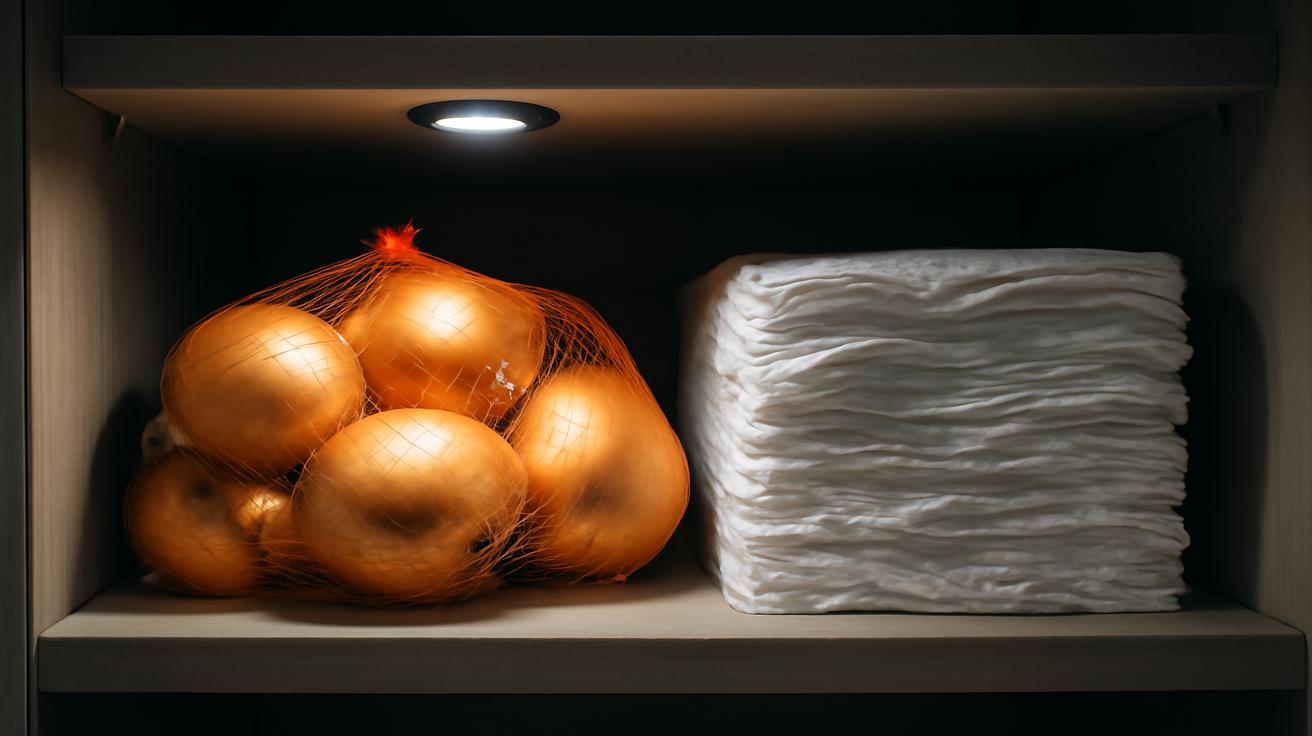
The ideal home for onions is cool but not cold—somewhere around 10–18°C (50–65°F). The fridge is too cold and too damp; the countertop is often too warm and too busy. Instead, think of places that feel like a quiet breath: a pantry shelf away from the oven, the bottom of a cupboard near the floor, a closet corner that doesn’t share a wall with a heater or hot water pipe.
Darkness matters more than we tend to think. Light is a signal to sprout, especially for onions whose inner clock is already drifting toward the next growing season. Even the indirect glow from a nearby window can be enough to nudge them from storage mode into “let’s grow” mode. Your paper wraps already help here, softening light, but a dark shelf completes the picture.
Then there’s the subtle magic of air. A cramped, closed plastic bin might seem tidy, but it’s a stagnant pool of moisture and trapped gases. A single layer of paper-wrapped onions on a slatted shelf or a wire rack? That’s a miniature landscape of moving air, tipping the balance in favor of firmness instead of collapse.
There is one more quiet rule, easy to overlook: keep onions away from potatoes. The two look good together in a basket, but they don’t age well as roommates. Potatoes exhale moisture; onions prefer dry air. Both release gases that nudge the other toward sprouting. Set them on separate shelves, give them their own corners, and they’ll reward you with weeks more of good behavior.
A quick, mobile-friendly overview
Here’s how this pantry trick comes together at a glance, in a way that’s easy to skim while you’re actually standing in your kitchen with a bag of onions in hand.
| Step | What to Do | Why It Helps |
|---|---|---|
| 1. Unpack | Remove onions from plastic or tight packaging. | Prevents trapped moisture and early rot. |
| 2. Sort & Check | Set aside bruised or cut onions to use first. | Stops one bad onion from spoiling the rest. |
| 3. Wrap in Paper | Loosely wrap each onion in a small piece of paper. | Absorbs humidity, protects skins, lets air flow. |
| 4. Store Separately | Place wrapped onions in a single layer, away from potatoes. | Reduces sprouting and cross-contamination. |
| 5. Choose the Spot | Keep in a cool, dark, well-ventilated pantry or cupboard. | Slows aging and keeps onions firm for weeks. |
Living with slower onions
A week after I first tried this, I found myself doing something I hadn’t done in years: I forgot about my onions. Not in the tragic way of discovering a liquefied bulb months later, but in the comfortable way you forget about something reliable. I no longer had to plan meals around the fear that the bag in the pantry might have gone bad overnight.
Every few days, usually while waiting for water to boil, I’d open the cupboard and feel along the row of casual paper parcels. A gentle squeeze here, a light press there. They remained solid, their skins dry and faintly rustling. The kitchen smelled faintly of dust and spice, not the sharp, acrid scent of decay.
By day twenty-eight, that original skeptical onion still felt firm, ready for the knife. I peeled it, half expecting some hidden wound, but the layers slid away clean and dry, revealing a crisp, milky-white interior. When it hit the hot pan, it sizzled instead of weeping, the scent rising in that deep, sweet way that announces the beginning of dinner.
In that moment, the trick felt less like a storage method and more like a tiny gesture of respect—an acknowledgment that the path from field to plate doesn’t end at the checkout line. It continues quietly in your pantry, one wrapped onion at a time.
Reading the quiet signs of a tired onion
Even with careful storage, no onion is immortal. But when you store them thoughtfully, they signal their fatigue more slowly and more clearly. A weekly check-in—just a minute or two—is usually enough.
Step 4: Check, rotate, and use with intention
Peel back a corner of paper and listen to what the onion is telling you. Does the skin still feel papery and dry? Good. Does it look slightly shiny or feel tacky under your fingers? That’s early warning. Are there soft spots when you press gently along the sides? Use that one tonight. A faint green tip just beginning to peek out from the top? Time to dice it into a soup or roast it before it channels all its energy into a sprout.
When you find one that’s on the edge—still usable, but not for long—choose a simple dish that lets it go out with grace. Slice it into thick rings and let them brown slowly in butter for a grilled cheese. Toss it, chunked, around root vegetables in a roasting pan, where sweetness matters more than perfection. Chop and gently soften it as the base of a pot of beans, letting its last energy thicken and flavor the broth.
One of the quiet delights of this method is how it shapes your cooking rhythm. Instead of emergency scrambles to use a bag of nearly bad onions in a single day, you get a more even, forgiving cadence: one or two onions moving from pantry to cutting board each week, their aging process slowed to match your actual habits.
A small act with larger ripples
There’s something quietly radical about slowing down the way food spoils. In a world where so much is built around speed—fast delivery, instant meals, planned obsolescence—the act of coaxing another two weeks of freshness from a humble onion feels almost subversive.
It’s not a flashy sustainability gesture. Nobody will see your paper-wrapped onions lined up on a dark shelf and applaud. But every bulb that lives its full, flavorful life in your kitchen instead of dissolving unseen in the bottom of a bag is a small victory: less waste in the bin, less guilt humming at the back of your mind, more meals that begin with the satisfying weight of a good onion under your palm.
Most of all, this pantry trick invites you into a slower, more tactile relationship with your ingredients. You notice the change in seasons as onions shift from thin-skinned summer varieties to thicker, sturdier winter stock. You feel the difference between a red onion’s shiny, tight jacket and the looser, paler skins of a yellow storage onion. You learn, almost without trying, which ones last longest in your particular climate, in your particular pantry.
And somewhere between wrapping and unwrapping, checking and chopping, you might find that the act of cooking begins earlier than you thought—not when the pan hits the flame, but when you stand in the quiet of your kitchen, hands brushing over paper, choosing which onion’s time it is today.
FAQ: Keeping Onions Firm and Fresh
How long can onions really last with this method?
In a cool, dark, well-ventilated pantry, individually wrapped in breathable paper, most dry onions stay firm and usable for about three to four weeks. Some well-cured storage onions can last even longer, while thin-skinned or very fresh onions may have a shorter window.
Can I store onions in the refrigerator instead?
You can, but it’s not ideal for whole dry onions. The fridge is cold and humid, which can make onions soft and encourage mold. Once an onion is cut, though, refrigerate the leftovers in a sealed container and use within a few days.
Do I really need to keep onions away from potatoes?
Yes, if you want them to last. Potatoes release moisture and gases that can encourage onions to sprout and spoil faster, and onions can do the same for potatoes. Separate shelves or different cupboards make a noticeable difference in how long both will keep.
What kind of paper works best for wrapping?
Plain, uncoated paper works best: brown paper bags, kraft paper, or even sections of a paper grocery bag. Avoid glossy, waxed, or heavily printed paper, which may not breathe well or could transfer ink when damp.
Should I wash onions before storing them?
No. Extra moisture is the enemy of long storage. Brush off any loose dirt gently with your hands or a dry cloth, but leave the skins dry. Wash onions only right before you use them.
What should I do with onions that start to sprout?
Use them soon. A small green sprout doesn’t make an onion unsafe, but it does draw energy and flavor away from the bulb. Cut away the sprout and any soft or bitter parts, and cook the rest in dishes where the onion will be well-cooked, like soups, stews, or roasted vegetables.
Does this method work for all types of onions?
It works best for dry storage onions: yellow, white, and many red onions. Very sweet onions with thin skins (like some seasonal varieties) generally have a shorter life no matter how you store them, but wrapping and proper pantry conditions will still help them last closer to their best potential.
How often should I check on stored onions?
Once a week is usually enough. Give each onion a quick squeeze through the paper and open any that feel suspiciously soft, damp, or unusually light. Use those first, and keep the rest wrapped and undisturbed.