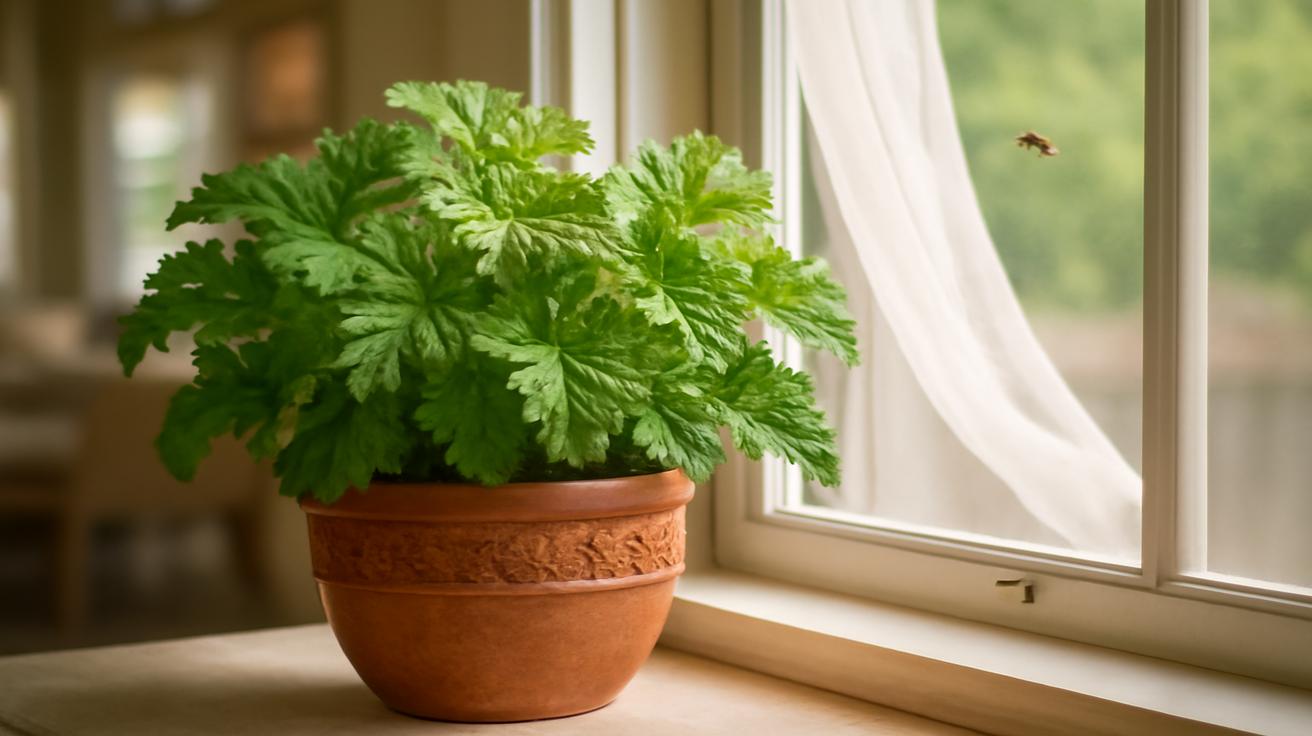
The first time I saw it, it wasn’t in a nursery or a glossy catalog, but on a chipped windowsill in an old stone house at the edge of a village. The afternoon light fell through thin curtains, and right there, in a simple clay pot, a green fountain of leaves spilled over the rim. When I brushed my hand lightly across the foliage, the air changed. It was as if someone had peeled a lemon, crushed a handful of mint, and opened a window to a spring garden all at once. Outside, the mosquitoes were already tuning their high, whining song. Inside, there were none. That was the day I learned that some plants don’t just decorate a home—they protect it, perfume it, and quietly transform the way we live in it.
The little “mosquito plant” everyone is suddenly talking about
The plant with the big springtime reputation goes by a handful of friendly names: mosquito plant, citronella geranium, citrosa, or simply “that lemony one in the terracotta pot.” Botanically, it’s usually a type of scented geranium (Pelargonium citrosum and close relatives), but most people fall in love with the smell long before they care what the label says.
Run your fingers lightly across its softly textured leaves and you’ll feel tiny hairs release a bright, citrusy aroma that drifts into the room. It’s clean but not sharp, herbal but not heavy—like lemon zest, a hint of rose, maybe even a whisper of pine. That scent is more than a charming detail; it’s part of the plant’s defense system, rich with natural oils that mosquitoes would rather avoid.
Spring is when this plant steps into the spotlight. As days lengthen and we slide open balcony doors and crack bedroom windows, the first insects appear, seemingly from nowhere. We’re caught in that lovely, delicate overlap of seasons: cool evenings, fresh breezes, and, unfortunately, the return of buzzing intruders. The mosquito plant arrives right on cue—a green companion that says, “Open the window. I’ll handle the rest.”
What makes it so broadly beloved is not just utility but presence. It sits there quietly on a sill, on a tiny balcony table, or beside your favorite chair, constantly releasing a subtle fragrance when brushed or warmed by the sun. Unlike sprays or plug-ins that feel like seasonal armor, this is a living solution—something you water, move, trim, and grow along with the changing light of the year.
The secret fragrance: what your nose loves and mosquitoes hate
Behind the plant’s lemony aura is a small cocktail of aromatic compounds that make it so intriguing. The leaves, when touched or slightly crushed, release essential oils that contain elements similar to those in traditional citronella oil. To us, this smells like fresh linens and squeezed citrus. To a mosquito, it’s an invisible wall.
Mosquitoes don’t see the world the way we do. They “smell” with their antennae, reading a complex cloud of signals: the carbon dioxide we exhale, the lactic acid in our sweat, the warmth of our skin. When the air is filled with certain strong, natural scents, those signals get muffled and confused. The mosquito plant doesn’t kill them; it simply makes the neighborhood less appealing.
You’ll notice the effect most clearly in the intimate radius where the scent is strongest: around a window, by the bed, near a chair on the balcony. Put your plant right where you sit with a book at dusk and pay attention. The lazy, spiraling approach of mosquitoes slows, then veers off, as if they’ve hit a border they’re not keen to cross.
Of course, no plant can offer the ironclad forcefield of a lab-tested repellent lotion. But what the mosquito plant does offer is something more gentle, more gradual: a background fragrance that nudges mosquitoes elsewhere while making your home smell like a garden after rain. In many households, people find that a combination works best—this plant for everyday ambience and basic deterrence, and other methods only when the situation truly demands it.
A fragrance that belongs to the house, not the store shelf
There’s something deeply satisfying about a scent that comes from soil and leaves instead of a synthetic bottle. Over time, you begin to learn the moods of your plant’s fragrance. On a cool, overcast morning, it’s soft and faint, like a distant memory. On a bright, warm afternoon when the sun has been kissing the pot for a few hours, the scent wakes up, rolls through the room, and quietly takes charge.
Sometimes, as you move through your space, you’ll catch it unexpectedly: a lemony brush along the hallway, a herbal whisper in the kitchen. You remember with a little start that this presence is alive. You’ve watered it, rotated it, maybe whispered to it when no one was watching. There’s a subtle intimacy in that exchange—the plant cleans your air and calms your nights, and in return you give it light, water, and the simple dignity of being noticed.
Spring rituals: how a single plant can change the feel of a room
For many people, spring starts not with the date on a calendar, but with a ritual: dragging pots back out to the balcony, brushing cobwebs off railings, and bringing home the first new plant of the season. The mosquito plant has become a spring favorite because it isn’t just decorative—it sets the tone for how a space is going to feel over the coming months.
Picture a small city apartment. The balcony is barely wider than the door that leads to it. You can’t fit a dining table, or even a full-size chair. But you can fit a few terracotta pots. One of them holds your citronella-scented geranium. On the first warm evening, you slide open the door, let the sounds of the street in, and sit on a cushion by the threshold. A faint citrus smell curls around you as the plant’s leaves are ruffled by the gentle outside air. You listen to footsteps, voices, the occasional bicycle bell, and you realize your little concrete ledge has become a seasonal room of its own.
In a country house, or just a place with a slightly larger patio, the ritual is similar but amplified. The mosquito plant goes where the people will linger: near the outdoor table where friends gather as the sky fades, beside the bench where someone always ends the night with one last glass of wine. Children learn quickly that if they rub the leaves and then smell their hands, they’ll carry a bit of that protective perfume with them as they run back and forth between indoors and out.
Indoors, the plant quickly earns a few favorite spots. Near a kitchen sink where a window cracked open invites afternoon light. On a bathroom shelf, where steam from a shower encourages the fragrance to softly bloom. On a desk, where a tired mind can periodically reach out, pinch a leaf, and inhale a burst of bright focus.
| Where to Place | Best Time of Day | Benefits You’ll Notice |
|---|---|---|
| Bedroom windowsill | Late afternoon to evening | Gentle citrus fragrance, fewer mosquitoes drifting indoors |
| Balcony or terrace table | Sunset and early night | More comfortable outdoor sitting, natural mood-lifting scent |
| Kitchen counter near light | Midday to afternoon | Fresh aroma that cleanses cooking smells, handy leaves to rub for quick repellence |
| Desk or reading nook | Any time | Calming green presence, occasional scent bursts when you touch the foliage |
The beauty of this plant is that it asks very little in exchange for its services. A reasonably bright spot, some water when the top of the soil is dry, and a gentle trim when it starts to sprawl. In return, it rewrites the personality of a room in ways you only fully realize the day you move it somewhere else and feel that something invisible is missing.
Caring for the plant that cares for you
Caring for a mosquito plant in spring is less about rigid rules and more about paying attention. The plant itself will tell you what it needs if you know how to read it.
Start with light. It loves brightness, but not harsh, scorching midday sun—especially through glass. A few hours of direct morning sun or gentle evening light suits it beautifully, with filtered or bright indirect light the rest of the day. Too much strong sun and the leaves may crisp at the edges, turning papery and dull. Too little and the stems stretch, reaching thinly toward any available brightness, and the fragrance weakens.
Water is a quiet balancing act. Let the top layer of soil dry before you reach for the watering can, then water thoroughly so that excess moisture can drain away. Standing water at the bottom of the pot is an invitation to root rot, and this plant prefers to dry out a bit between drinks rather than sit with “wet feet.” In spring, as temperatures warm and new growth appears, you’ll find it asking for water more often, like an athlete in training.
Then there is the art of touch. This is not a plant that punishes handling; it responds to it. When you gently pinch back the tips of longer stems, it answers with new side shoots, becoming bushier and more generous with its leaves. Each little pruning moment releases a burst of scent that fills the nearby air. A small, slow haircut now and then keeps it in the exuberant, rounded shape that looks so inviting on a windowsill.
Propagating small pieces of spring
One of the quiet joys of the mosquito plant is how easily it multiplies. A single mother plant can become a small family in just one season. In early or mid-spring, when the stems have a bit of firmness, cut a short piece just below a leaf node, remove the lower leaves, and place that cutting in a glass of water or into moist soil. Given warmth and patience, tiny roots begin to appear, a soft white fuzz of potential.
Watching a cutting take root is like watching spring unfold in miniature. You check on it each day, noticing the water growing slightly cloudier as life stirs beneath the surface, or the soil gently dimpling where roots are pushing down. When the cutting finally has enough strength to stand on its own in a small pot, you’ve done more than create another attractive plant. You’ve bottled a bit of spring’s clean energy and given it a new address in your home—or in someone else’s, if you decide to gift it.
Myths, magic, and realistic expectations
As the fame of this plant has spread, so have the legends around it. Some people speak as though a single pot near the door will guarantee a mosquito-free home all summer, like hanging a charm above the threshold. Reality is more nuanced—but no less interesting.
The plant does not create an invisible dome of safety over your entire home. Its power is intimate and local. The fragrance is strongest within a small radius, most effective when the plant is near the places mosquitoes might enter or where your skin is most exposed. Think of it as a subtle bodyguard: best stationed close by where you sleep, read, or eat, not forgotten on a distant shelf.
Another misunderstanding lies in the difference between the plant and its distilled oil. When people hear “citronella,” they often picture candles and torches with a very strong, sometimes overwhelming smell. The live plant is gentler. It releases its scent in whispers instead of shouts, and often needs a little stimulus—your touch, a warm draft, a brush of fabric—to fully exhale its perfume.
Combining tradition with modern comfort
In many regions, the idea of perfumed plants that also repel insects is not new. Grandparents remember bunches of aromatic herbs hung in doorways, or crushed and rubbed on skin before bedtime. The mosquito plant simply updates this old wisdom for modern homes. Instead of bundles of dried leaves, you have a living sculpture in a pot, renewing itself, adjusting to your space, becoming part of your daily routines.
The most satisfying approach is to see it as one layer in a comfortable, mosquito-conscious home. Screens on windows, water emptied from places where insects might breed, maybe a fan that keeps the air moving in the evenings—and then, in the middle of it all, this graceful, lemon-scented plant on your table or sill. Technology and tradition, side by side.
Why everyone suddenly wants it in spring
There’s a deeper reason this plant has become a seasonal must-have that goes beyond repelling mosquitoes or perfuming a room. Spring reminds us that life can be renewed, refreshed, simplified. The mosquito plant captures that feeling in miniature: a single, manageable piece of nature you can invite into your home and actually live with.
People are craving ways to make their living spaces feel alive, not just decorated. A bottle of room spray can imitate the smell of citrus and herbs, but it can’t offer the subtle changes of a living plant—how its fragrance deepens after you water it, the way new leaves unfurl a slightly brighter green, the way the entire pot leans gradually toward the window as the seasons shift. There’s a simple magic in waking up one morning and noticing tiny new shoots you didn’t see the night before.
We are also, collectively, a bit tired of chemicals we don’t understand. The idea that a plant might help keep mosquitoes at bay feels reassuringly old-fashioned, like something your great-grandmother might have known and quietly practiced, even if she couldn’t explain the science. You can sit with your feet tucked beneath you on a chair, the plant by your side, and feel like you’re doing something kind for your body and your environment just by choosing this soft, green companion over a harsher alternative.
In an age of screens and alerts, caring for a mosquito plant asks you to switch registers. It pulls you into slower rhythms: checking soil instead of messages, noticing light instead of notifications, inhaling fragrance instead of scrolling. These moments of grounded attention are part of the plant’s gift, just as much as its scent or its insect-deterring charm.
When someone places a citronella geranium in the center of their spring table, they’re not just decorating. They’re declaring what they want the season to feel like: open windows, long evenings outside, the lazy buzz of insects kept at a respectful distance, and a home that smells faintly of gardens, even in the heart of a city. They’re choosing a living ally—modest, beautiful, quietly powerful.
In the gentle tug-of-war between humans and mosquitoes, this plant doesn’t promise victory. But it does offer a truce of sorts: a little more comfort, a little less whining in the dark, and a home that feels freshly washed by citrus and green notes each time you pass by and brush your fingers along its leaves. That’s why, when spring arrives and the first truly soft evening rolls in, everyone suddenly seems to want one: a pot of perfumed leaves on the sill, standing guard as the season opens its doors.
Frequently Asked Questions
Does the mosquito plant really repel mosquitoes?
It helps, but within a limited range. The plant’s citrusy scent can make the immediate area less attractive to mosquitoes, especially near windows, doors, and sitting areas. It won’t completely eliminate mosquitoes from a large space, but it can reduce their presence close to where you place it.
Do I have to crush the leaves for it to work?
You don’t need to crush them completely, but gently rubbing or brushing the leaves releases more fragrance and increases the repellent effect around the plant. Many people do this just before sitting outside or going to bed.
Is the mosquito plant safe for pets and children?
It’s generally considered low-toxicity, but like many ornamental plants, it shouldn’t be eaten in quantity. Place it where curious pets and very young children won’t be tempted to chew the leaves, and supervise any contact.
Can I keep the plant indoors all year?
Yes. It does well indoors if it gets enough light, ideally near a bright window. In colder climates, it’s often kept as a houseplant in winter and moved outdoors or closer to open windows in spring and summer.
How often should I water my mosquito plant?
Water when the top of the soil feels dry to the touch. In spring and summer, this might be once or twice a week, depending on light and temperature. Always ensure excess water can drain and avoid leaving the pot sitting in standing water.
Why is my plant getting tall and leggy?
This usually means it isn’t getting enough light, or it hasn’t been pruned regularly. Move it to a brighter spot and pinch back the longer stems to encourage bushier growth.
Can I use the leaves to make a natural repellent?
You can rub fresh leaves lightly on exposed skin for a short-lasting, gentle scent that may help deter mosquitoes, especially when you’re also sitting near the plant. Always test on a small patch of skin first in case of sensitivity.