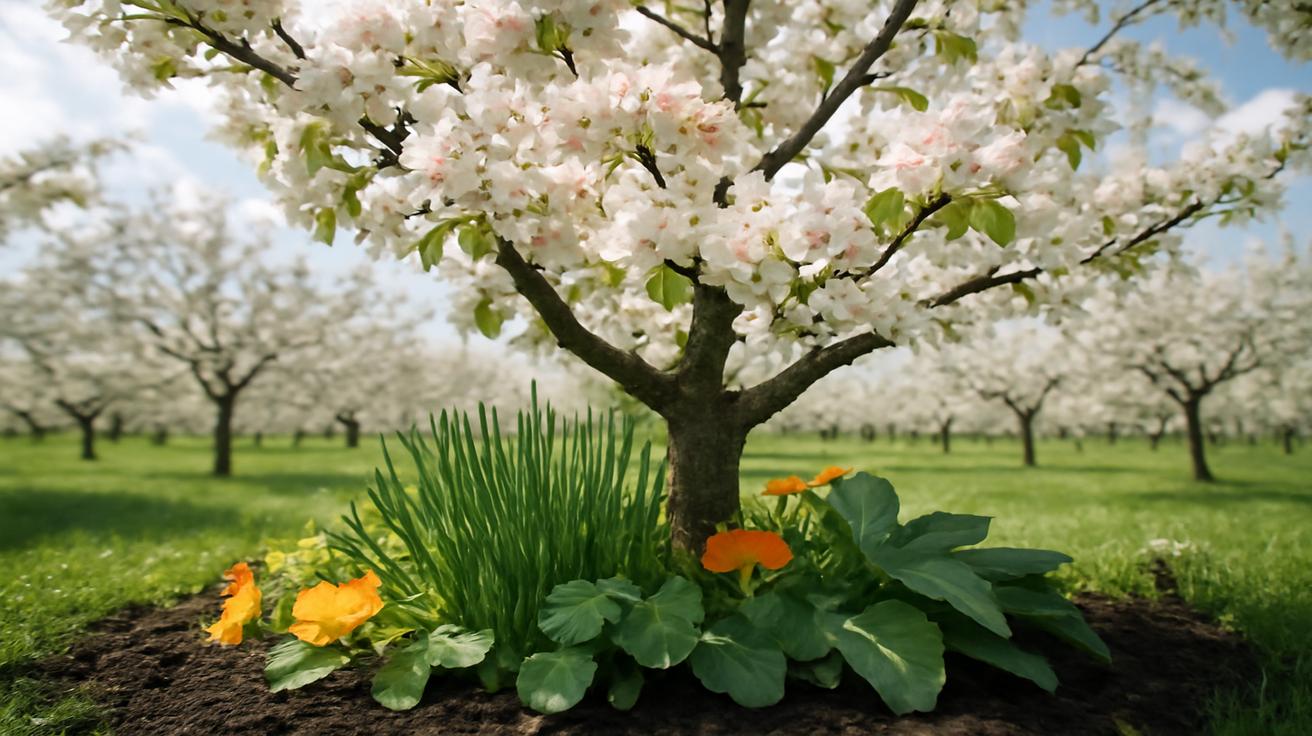
On a late-winter afternoon, when the sky is the color of old tin and the soil still holds the memory of frost, there is a special kind of quiet in an orchard. The trees look like a gathering of old storytellers, bare-armed and patient, watching the seasons turn. This is the moment experienced gardeners love best—when the world still seems asleep, but they know it’s not. Under the surface, roots are whispering, sap is starting to stir, and this is when the decisions you make—what you plant, where you tuck it in, what partners you choose—will decide whether spring arrives as a polite knock or a joyful, unruly parade of blossom and bees.
The Secret Architecture of a Spring Orchard
Talk to a gardener who’s kept an orchard for more than a few seasons, and they’ll tell you: flourishing spring isn’t an accident. It’s architecture. It’s design. It’s knowing which plants are more than just decorations—who helps whom, who feeds whom, who stands guard when the last frost creeps in like a thief.
In a young orchard, it’s easy to think only of trees. Apple, pear, cherry, plum—names that taste like dessert. But an experienced grower sees a layered community: canopy, understory, shrub, herb, groundcover, even bulb. The plantings they never skip aren’t always the glamorous ones covered in blossoms on postcard-perfect days. Some are humble, low to the ground. Some bloom early and vanish by summer. Some spend their lives quietly fixing nitrogen, breaking up heavy soil, or luring in the first sleepy bumblebee of the year.
The magic of a flourishing spring orchard comes from these supporting characters, planted in the slivers of space between trunks, along fence lines, beneath branches, and even in the ragged edges where mowers can’t reach. When you walk into such an orchard in April, the feeling is almost mischievous: everything is happening at once. Blossoms, scents, hums, soft movement of wings, a tapestry of life that feels less like a garden and more like a small living country of its own.
Spring Pollinator Magnets: The Bloom Before the Bloom
Experienced gardeners don’t wait for the fruit trees to open their petals to start feeding the insects that make the whole show possible. The secret is to offer flowers before the main orchard comes into bloom, like setting the table before guests arrive.
Early Bulbs at the Feet of Giants
Picture this: bare apple branches overhead, but at your feet a constellation of crocuses, snowdrops, and early daffodils pushing through the chilled soil. These small bulbs are often the very first beacons for hungry pollinators emerging from winter hideaways. Bumblebees in particular will blunder from flower to flower, legs dusted with pollen long before the fruit trees are ready.
Gardeners in the know scatter bulbs generously in autumn, tucking them into the drip line of trees, along pathways, at the edges of beds. They choose varieties that bloom in succession—snowdrops first, then crocus, then miniature narcissus and muscari—to stretch the season of nectar. By the time the orchard trees start to blush with buds, the insect community is already awake, fed, and lingering nearby.
Flowering Shrubs as Orchard Cornerstones
Along the margins, seasoned orchard keepers plant flowering shrubs that begin their show just as the soil warms. Currants and gooseberries, for example, are quiet powerhouses: their dangling clusters of early blossoms lure bees closer to the heart of the orchard. Blackcurrant flowers may not look spectacular to human eyes, but to a bee that’s just tasted the first sweetness of the year, they’re a clear invitation.
Other shrubs—like serviceberry (also called Juneberry) or sloe (blackthorn)—bridge the gap between wild and cultivated. They resemble hedgerow plants from an older countryside, but their blossom timing and dense habit make them ideal partners for fruit trees. Plant a mixed row of them along a boundary, and watch how your orchard suddenly gains depth—visual, ecological, and seasonal all at once.
| Plant | Role in Spring Orchard | Best Planting Spot |
|---|---|---|
| Crocus & Snowdrops | Very early nectar for pollinators | Under trees, along paths |
| Currants & Gooseberries | Early blossoms, wildlife habitat | Orchard edges, partial shade |
| Comfrey | Dynamic accumulator, pollinator haven | At drip line of trees |
| Clover | Nitrogen fixer, living mulch | Between tree rows, paths |
| Yarrow & Fennel | Beneficial insect habitat | Sunny patches, borders |
Underground Alchemists: Soil Builders You Can’t See
Spring blossom dazzles the eyes, but experienced gardeners spend as much time thinking about what the roots are feeling. If the soil is compacted, lifeless, or starved of nutrients, no amount of blossom can save the harvest. That’s why certain plantings are non-negotiable, even if they never make an appearance on seed catalog covers.
Clover: The Gentle Carpet
Walk into a well-kept orchard and look down. Instead of bare soil or rough grass, you might find a soft, buzzing carpet of clover threaded between the trees. White clover, crimson clover, and even subterranean clover are quiet revolutionaries. They fix atmospheric nitrogen and gently share it with their neighbors, turning air into plant food.
When clover flowers, it draws bees into the orchard at a steady hum, long after the fruit trees have finished their brief cloud of bloom. It also keeps soil covered, cooler, and less prone to erosion. Experienced orchardists will overseed clover into paths and open spaces, mowing it lightly to keep it dense and low, letting the blossoms rise here and there like tiny white lanterns on a green sea.
Comfrey: The Deep Diver
Comfrey is one of those plants that, once you learn its secrets, becomes almost impossible to garden without. To the uninitiated, it’s a sprawling mound of leaves and a flurry of purple or white bells in late spring and early summer. To seasoned growers, it’s a deep-rooted miner, reaching into subsoil and bringing up minerals most shallow-rooted plants can’t access.
Planted near the drip line of fruit trees, comfrey becomes a living nutrient pump. Cut the big, soft leaves several times a year and lay them as mulch beneath the tree. They break down with satisfying speed, feeding the soil food web, inviting earthworms, and gently nourishing the roots. In spring, those nodding blossoms are irresistible to bee species that sometimes ignore the main fruit blossoms in favor of their tubular flowers—so you get added pollinator activity too.
The Guardian Guild: Plants That Protect and Defend
A flourishing spring orchard isn’t only about abundance; it’s also about resilience. Experienced gardeners know that pest and disease pressure tends to spike just as young leaves unfurl and petals fall. Instead of reaching for chemical “solutions,” they reach for plants—clever companions that confuse, repel, or distract the troublemakers.
Aromatic Allies: Herbs as Scented Shields
Planting herbs among fruit trees might look whimsical, but there’s strategy in that romance. Think of the powerful scent of lavender on a hot day, the sharpness of thyme when you brush past it, or the licorice note of fennel seeds crushed underfoot. These aromas are part of a quiet war being waged in spring.
Under and around fruit trees, you’ll often find patches of:
- Thyme – a creeping, bee-beloved groundcover whose flowers feed pollinators and whose scent can mask the chemical “signals” pests use to find trees.
- Chives – their purple spring pom-poms draw beneficial insects, and the sulfurous scent of their foliage has long been associated with healthier apple and pear trees.
- Calendula – cheerful orange and yellow faces that trap aphids and lure predatory insects.
- Mint (contained in pots or strict borders) – a beneficial insect magnet that doubles as a deterrent for some pests with its pungent oils.
These herbs blur the edges between “orchard” and “kitchen garden,” and well-seasoned orchardists are perfectly happy with that. They know an orchard is healthiest when it behaves more like a diverse ecosystem than a plantation.
Decoy and Diversity: Flowers That Invite the Right Guests
A spray of simple, open flowers beneath the trees in early to mid-spring can change the entire energy of an orchard. Not just the mood—though the sight of drifting California poppies and cornflowers swaying between rows could lift the heaviest heart—but the biology.
Plants like yarrow and fennel send up flat-topped umbels of tiny blooms that may look modest from a distance, but up close they seethe with life: hoverflies, lacewings, parasitic wasps, and tiny beetles, all of them hunting. Many of these hunters lay eggs on or near orchard pests, turning small outbreaks into free buffets for their larvae.
Meanwhile, sacrificial plants—nasturtiums, for instance—can be encouraged to tumble and sprawl at edges. Aphids love them, perhaps more than your young fruit shoots, and experienced gardeners cheerfully sacrifice a few leaves as decoy buffets. In spring, an orchard layered with these flowering defenders is busy in all the best ways: something is always watching, eating, balancing.
Edible Edges and Layered Abundance
If you look at a thriving spring orchard from the perspective of someone who has planted and replanted for years, you’ll notice a refusal to waste edges. No bare fences, no sterile margins. Everything becomes an opportunity for another layer of life—and more often than not, that layer is delicious.
Berries Beneath and Between
Why allow the spaces between young trees to lie idle when they could be bearing fruit of their own? Many experienced gardeners underplant with berries—strawberries forming a fragrant, jewel-studded carpet in late spring; raspberries or blackberries rising in loose hedgerows just beyond the reach of spreading branches.
Strawberries, in particular, shine in the bright but still-gentle light of spring. Tucked around the sunny side of young trees, they offer nectar to early bees with their small white flowers, then reward human caretakers with red sweetness just as the fruit trees are finishing blossom and turning their energy toward setting fruit.
Elsewhere, a row of autumn-fruiting raspberries might look unassuming in spring, but their new canes are already pushing up, and their tender foliage offers shelter for beneficial insects. By the time summer comes, that same planting will offer shade at ground level, cooling the soil and preserving moisture for neighboring trees.
Living Fences and Hedges of Plenty
At the edges of orchards, where wind can slash through and late frosts creep in, long-time gardeners plant living fences. Instead of stark boards or wire alone, they weave in hazel, elder, hawthorn, rugosa roses, and other hardy shrubs and small trees. In spring, these boundary plants erupt in blossom—elderflowers frothing like lace, hawthorn glowing white along the thorned arms, wild rose buds unfurling at eye level.
Not only do these hedges slow wind and soften temperature swings, they also become corridors for birds and insects that keep pest numbers in check. And they add an extra chapter to the orchard’s edible story: hazelnuts in autumn, rosehips for winter syrups, elderflowers for fragrant cordials.
The Rhythm of Planting: When Wise Gardeners Move
What makes an experienced gardener’s spring orchard so captivating isn’t just which plants they choose—it’s when and how they place them. They think in overlapping seasons, like layers of transparent paint building depth on a canvas.
In the quiet weeks of late winter, before buds swell, they’re already at work. Bare-root trees arrive and are heeled in; shrubs are planted while the soil is moist and cool. Bulbs went in months ago, of course, but now there’s time to sow hardy annual flowers at the orchard edge, to sprinkle clover seed in bare paths, to tuck in a few new comfrey crowns where last year’s harvest was generous.
As soon as the ground can be worked, they move among the rows with armfuls of herbs from divisions—splitting clumps of chives, segmenting thyme mats, gently relocating self-sown calendulas to better spots. This is a kind of editing, a spring pruning of plants as much as branches, guiding the orchard’s living understory into a more harmonious pattern.
They’ve learned by feel when the ground is ready, when the frost is mostly a memory, when the birds start singing differently, when the bees begin to test the air. They plant not just for this spring, but for the springs five, ten, fifteen years ahead—knowing that shrubs will thicken, comfrey will expand, hedges will knit themselves together, until the orchard becomes a cohesive, living organism.
Living the Orchard, Not Just Owning It
Stand in such an orchard on a mild April morning. Above you, branches are a blur of white and pink and faint green, humming with bees. At waist level, shrub flowers dangle like lanterns. At your feet, violets, clover, and strawberries weave a soft, patterned rug between the trees. When you kneel and press your fingers into the soil, it comes up dark and crumbly, smelling not of emptiness but of forests and rain.
This is what experienced gardeners are really planting for when they tuck in those extra companions every spring: not only baskets of fruit, but a place that feels alive in every direction. A place where you can pick a handful of berries with one hand and a sprig of thyme with the other, where you can watch a ladybird hunting aphids on a nearby leaf while a thrush sings in the hedgerow.
The plantings they never skip—bulbs, clovers, comfrey, herbs, flowering shrubs, hedges, sacrificial flowers—are the threads that hold the orchard’s fabric together. They ensure that spring doesn’t arrive as a thin, single note of blossom and then pass, but as a full, complex chord that rings on through summer and into autumn.
If you’re just beginning your own orchard—or coaxing new life into an old one—start with these quiet allies. Think in layers: something blooming when almost nothing else is, something feeding the soil under every tree, something sheltering the helpful insects and diverting the harmful ones, something holding the edges and catching the wind.
With time, as you walk your own rows in late winter, planning where to slip in another comfrey crown, another drift of bulbs, another row of currants, you’ll start to feel it—that sense that you aren’t just planting trees, you’re building a small, breathing world. And when spring finally rushes in, all at once and more than you thought possible, you’ll know: this is the quiet craft long-time orchard keepers were talking about, the one that turns a collection of trees into a flourishing spring orchard that feels, unmistakably, alive.
FAQs
When is the best time to plant companion plants in an orchard?
Most perennial companions—like comfrey, herbs, berry shrubs, and hedging plants—do best when planted in late winter to early spring while the soil is moist and cool but workable. Bulbs go in during autumn, and clover or other groundcovers can be sown either in early spring or late summer, depending on your climate.
Will companion plants compete with my fruit trees for nutrients?
If chosen and placed well, they usually help more than they compete. Deep-rooted plants like comfrey mine nutrients from lower layers, while clover adds nitrogen. Keep vigorous plants just outside the tree’s trunk zone (near the drip line) and avoid allowing woody shrubs to crowd the main root flare.
How close should I plant flowers and herbs to the base of my trees?
A good rule is to keep a small ring—20–30 cm—around the trunk mostly clear to protect bark and avoid moisture buildup. Beyond that, especially out near the drip line, you can plant low herbs, bulbs, and groundcovers freely. Taller shrubs and vigorous perennials should sit just beyond that outer circle.
Can I convert an existing grass orchard into a more diverse planting?
Yes, and it’s often done gradually. Start by cutting small rings or keyhole beds around a few trees and replacing turf with mulched areas planted with bulbs, herbs, and clover. Over several seasons, expand these beds, add shrubs at edges, and overseed clover in pathways. A slow transition is easier on soil and on you.
Which companion plants are best for beginners?
For a simple start, plant white clover between trees, a few comfrey plants at tree drip lines, spring bulbs under your sunniest trees, and hardy herbs like chives and thyme near trunks (but not touching). These choices are forgiving, highly beneficial, and will quickly change the feel and function of your spring orchard.