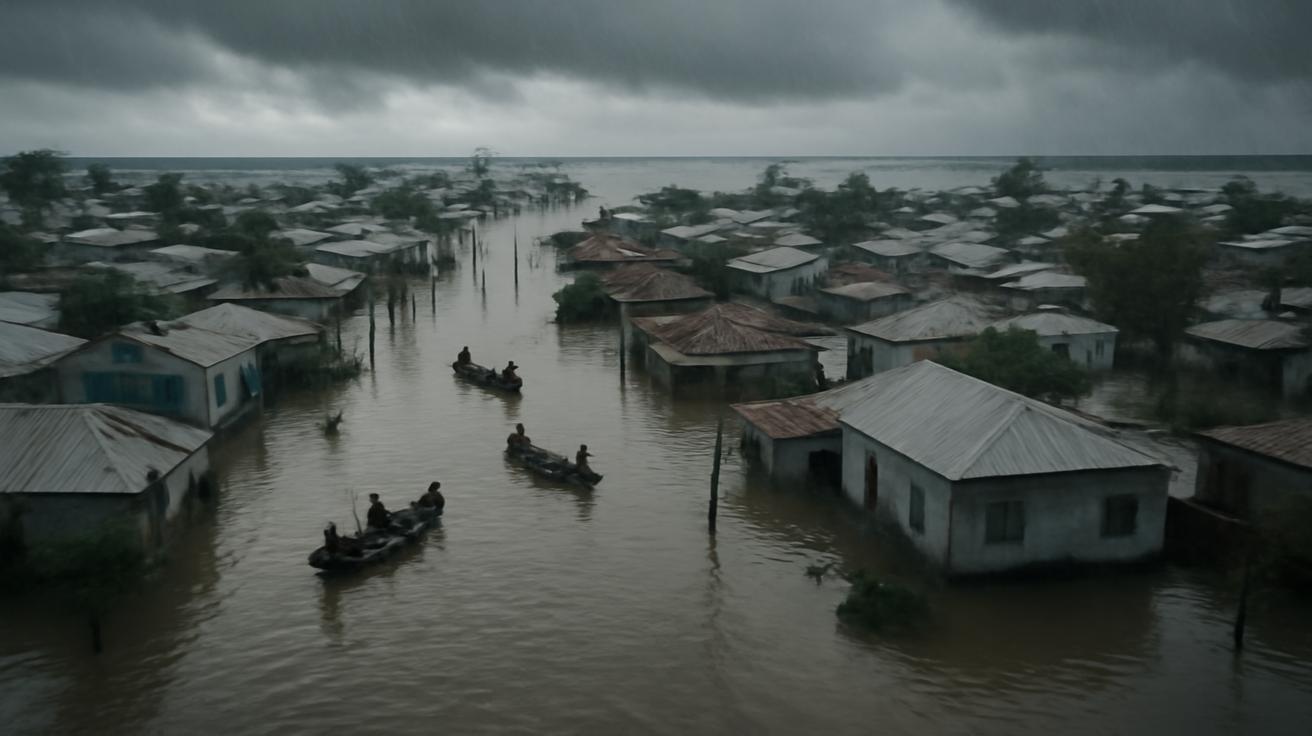
On a breathless August evening in 2073, the rain over Dhaka did not fall; it roared. It was the kind of rain that erased distances and swallowed sound, a solid gray wall that turned streets into blind corridors and stairwells into waterfalls. Families on the third floor watched in disbelief as the water rose past balcony railings, carrying refrigerators, tuk-tuks, and tangled masses of plastic like a new kind of river life. Somewhere in the darkness a generator exploded; the city blinked once and went black. Later, officials would call it a one‑in‑five‑hundred‑year storm. The trouble was, the last one‑in‑five‑hundred‑year storm had happened only three years before.
When the Sky Refuses to Close
By the late 21st century, some scientists say, the most dangerous threat in many parts of the world will not be drought, but water—too much of it, falling too fast.
Extreme rainfall is a quiet phrase for a violent thing. It’s the hurricane stalled over a coastline for days, dumping a year’s worth of water in a weekend. It’s the monsoon that forgets to move on, sitting heavy over a river basin until the rivers climb over their banks and keep climbing. It’s the late‑night storm that swells into a “training” line of thunderstorms, each one marching over the same town like a regiment of gray soldiers.
Our atmosphere, warmed by greenhouse gases, can hold around 7% more water vapor for every degree Celsius of warming. That seems like a modest number on paper. In real life, it means storms that used to feel apocalyptic now arrive with bureaucratic regularity, showing up in flood damage statistics, in insurance payouts, in the bone‑deep weariness of people who have carried their children through chest‑high water one too many times.
By 2100, if emissions continue on their current path, several countries may become effectively uninhabitable in their most densely populated areas not because the sea swallows them in slow motion, but because the sky refuses to close.
The New Cartography of Too Much Water
When people imagine climate maps of the future, they often picture red heat blobs swelling over continents. The unspoken assumption is that “uninhabitable” means too hot to work outside, too dry to grow food. Yet another, wetter story is unfolding in the data—one where the lines of habitability are drawn by water depth instead of thermometers.
Across the tropics and subtropics, climate models are converging: intense rainfall events are likely to become more frequent and more severe. Some regions will swing wildly between drought and deluge, but others will be locked into a pattern of increasingly extreme downpours, especially during monsoon or cyclone seasons. For low‑lying megadeltas, narrow coastal plains, and crowded river valleys, that pattern is not merely inconvenient. It is terminal.
Imagine trying to live in a city where, every few years, a third of the homes are flooded beyond repair. Where sewage treatment fails so often that tap water is a health gamble. Where farmers lose entire harvests in a single 48‑hour storm. At some point, it’s not called “rebuilding” anymore. It’s called leaving.
Asia’s Drowning Giants
South and Southeast Asia sit at the crossroads of heat, humidity, and some of the world’s most powerful monsoons. From the Ganges‑Brahmaputra Delta to the Mekong, these river systems once made dense human settlements possible. They offered rich soils and easy transport, weaving whole civilizations along their banks. Now, they are the front lines of the rainfall wars.
Bangladesh is often the first name mentioned in quiet conversations among climate planners. The country is a flat, fan‑shaped delta, as if the land itself were a hand reaching into the Bay of Bengal. It is routinely lashed by tropical cyclones that are now supercharged by warmer air and warmer seas. Higher sea levels push storm surges further inland, slowing drainage and turning every extreme downpour into an inland sea. By 2100, large portions of coastal Bangladesh could be underwater or so flood‑prone that permanent habitation becomes a grim joke. How do you anchor a life to a place when the ground itself turns liquid several times a decade?
To the east, the Mekong Delta of Vietnam faces a similar double bind: sea level rise nibbling at its edges, and increasingly explosive monsoon rains pouring down from upriver. Once the rice bowl of Southeast Asia, the delta is sinking under sediment loss, groundwater extraction, and the sheer weight of its own infrastructure. Add intense rainfall to that recipe, and you get a landscape where roads disintegrate, salinity creeps into once‑fresh fields, and rural families must decide whether to raise their houses another meter or just pack up for Ho Chi Minh City—only to find that the city itself is flooding more often.
Indonesia and the Philippines add another chapter. Jakarta, already sinking and flooded by rivers that overflow in heavy rains, is planning to move its capital to higher ground. But many of its poorest residents cannot move with it. In the Philippines, tropical cyclones like Haiyan have shown how rainfall and storm surge together can rip apart coastal communities. Future storms, armed with even more moisture, will be capable of dropping staggering amounts of rain inland, turning hillsides into landslides and valleys into fleeting, deadly lakes.
Africa’s Flash Flooded Future
On the other side of the Indian Ocean, the pattern repeats in a new key. Africa, often framed in climate discussions as a continent threatened by drought, is also dangerously exposed to extreme rainfall. The paradox is cruel: the same countries that endure food‑killing dry spells can, within weeks, be drowning.
East African cities like Dar es Salaam and Mombasa hug low‑lying coastlines where rainfall‑intensifying Indian Ocean storms crash ashore. The combination of poor drainage, rapid urbanization, and informal settlements built in floodplains sets the scene for disaster. A future storm season in the 2080s might bring a series of “once‑in‑a‑century” deluges within a single decade. For families whose homes are made of corrugated metal and mud, “uninhabitable” doesn’t begin with total abandonment; it begins with exhaustion, with the slow realization that each return home is temporary.
In West Africa, the Niger and Volta river basins are projected to experience more intense rainfall events, even as overall rainfall patterns grow more erratic. Mega‑cities like Lagos sprawl over wetlands and reclaimed land, their drainage systems already overwhelmed by heavy storms. The city’s famous traffic jams turn lethal when cloudbursts arrive: underpasses become instant ponds, and drainage canals overflow into markets and homes. Now extend that reality into 2100, with heavier rainfall and more people. It’s hard to map a version of Lagos that is both prosperous and standing still in the same place.
Meanwhile, in the Horn of Africa and the Sahel, swings between multi‑year droughts and catastrophic floods are sharpening. When desiccated soil is finally hit by a corridor of intense storms, it often doesn’t soak up the water; it shunts it rapidly downstream, encouraging flash floods that rip out what little vegetation remains. Nomadic and semi‑nomadic communities, already forced to move in search of water and pasture, may find certain valleys and seasonal riverbeds too risky to cross or settle near at all.
Coastlines Crumbling Under Cloudbursts
Extreme rainfall is not just a tropical story. Around the Mediterranean, scientists are recording fiercer downpours, often delivered by “medicanes”—Mediterranean storms that behave like compact tropical cyclones. Mountain villages in Italy and Greece have seen entire slopes give way under intense rainfall, while coastal towns watch waves and stormwater tag‑team their infrastructure.
In Central America and parts of South America, narrow strips of low‑lying land are sandwiched between mountain backbones and the sea. Here, increasingly intense rainfall shakes loose rock and soil on steep slopes, while swollen rivers rush toward already eroding coasts. Countries like Honduras, Guatemala, and parts of Colombia face the risk of entire municipalities being squeezed out: too steep and landslide‑prone uphill, too flood‑threatened and storm‑lashed at the water’s edge.
In the Caribbean, small island states confront a brutal arithmetic. More intense hurricanes mean more extreme rainfall, and there are only so many times you can rebuild a town crushed by floods before the money, the patience, or the population gives out. In some scenarios for 2100, a handful of low‑lying islands could be left with high, flood‑safe ridgelines that are technically habitable, but stripped of the ports, roads, and freshwater supplies that made them functional nations.
Cities on the Front Line
Municipal planners, often quietly, already speak of triage. Not every neighborhood can be saved from water. Not every floodplain can remain a place where people live.
Some of the world’s most vulnerable cities share a set of features: low elevation, river or delta locations, high population density, and inadequate drainage. Add extreme rainfall trends on top, and a grim shortlist emerges—places where, by 2100, severe flooding will be so frequent that meaningful, continuous habitation may be nearly impossible without staggering levels of investment.
| Country/Region | Key High‑Risk Zones | Main Rainfall‑Driven Threats by 2100 |
|---|---|---|
| Bangladesh | Coastal Ganges‑Brahmaputra Delta, Dhaka region | Monsoon megafloods, cyclone rainfall, prolonged inundation |
| Vietnam | Mekong Delta, Ho Chi Minh City | River floods from intense monsoon storms, drainage collapse |
| Nigeria | Lagos and coastal lagoon systems | Urban flash floods, lagoon overflow, infrastructure failure |
| Indonesia | Jakarta and northern Java coast | River flooding, extreme rainfall on subsiding land |
| Philippines | Luzon lowlands, Visayas coastal cities | Typhoon rainfall, landslides, compound coastal flooding |
| Central America | Honduras, Guatemala, Caribbean coasts | Mountain floods, landslides, storm‑driven deluges |
| Small Island States | Low‑lying atolls and coastal capitals | Hurricane/typhoon rainfall, loss of freshwater lenses, repeated destruction |
On paper, engineers can sketch levees, pumping systems, giant stormwater tunnels. In reality, the price tags are staggering, and the maintenance demands never cease. Rich nations are already grappling with this: New York and London are upgrading flood defenses, while parts of the Netherlands constantly reinvent water management. For poorer countries, the gap between what’s needed and what’s possible yawns wider every year.
Consider the mental map of a child born in 2090 in one of these places. They might learn that certain districts are “wet zones”—areas where families once lived but where, now, only warehouses or mangrove forests remain. They might hear their grandparents talk about old bus routes that no longer exist because the roads flood too often. Uninhabitability, in this sense, is not always cinematic loss; it’s a slow retreat, a set of daily inconveniences hardening into permanent abandonment.
Can We Outbuild the Storms?
Humans are stubborn animals. We build in floodplains, on delta edges, on precarious slopes, often with full knowledge of the risks, because those places are fertile, beautiful, or tied to our histories. The instinct, when faced with encroaching water from the sky and sea, is to build higher and stronger.
There is a whole arsenal of tools to confront extreme rainfall: permeable pavements that drink up cloudbursts instead of shunting them into sewers; “sponge cities” with parks and wetlands designed to flood safely; elevated houses and floating schools; early‑warning systems that text residents before a storm hits. Massive projects—sea walls, diversion canals, multi‑billion‑dollar pumping networks—offer protection for some of the densest urban centers.
Yet these defenses have limits. They can fail, they can be overtopped by storms stronger than expected, or they can simply be outgrown by climate change that moves faster than planned. Critically, they also require money, stable governance, and long‑term maintenance—the very things often in short supply in the most vulnerable countries.
By the late 21st century, the world is likely to be scarred by two distinct geographies of extreme rainfall. One will be lined with fortifications, its wealthy cities protected—unevenly, and imperfectly—behind walls of concrete and software. The other will be defined by improvisation: raised furniture instead of raised homes, informal canals dug by residents, plastic barrels lashed under wooden floors to help houses float. In between are the places that decide, reluctantly, that the water has won, and begin to plan their exit.
Who Gets to Stay?
There is a harsh politics embedded in every conversation about uninhabitable futures. Uninhabitable for whom? For tourists, for investors, for those with passports that open other doors? Or for the people whose families have lived along these rivers and coasts for centuries?
Extreme rainfall does not distribute its damage evenly. Wealthy households can elevate homes, buy insurance, install backup pumps and generators. Poor communities often occupy the most flood‑prone land—riverbanks, canalsides, informal settlements near drainage ditches—because that is the only space left. When the floods come, their losses are total: homes, documents, tools, sometimes entire livelihoods, gone in a single night of pounding rain.
By 2100, some national maps may look the same from space, but the human geography beneath will have shifted. Coastal belts thinned out. Interior highlands more crowded. A silent migration within borders, driven not just by rising seas but by the violent, repeated insult of water dropping from the sky.
And beyond borders? If swaths of low‑lying Bangladesh, Vietnam, Nigeria, or Central American nations become marginal for permanent settlement, the pressure for cross‑border migration will rise. Some people will be described as “flood refugees,” but the language will always lag behind the reality: whole communities moving not because their country vanished, but because their homes became too soggy to hold a future.
Choosing the Story of 2100
There is another evening, in another possible 2073, where the rain does come—but the city stays. In this version, Dhaka—or Lagos, or Manila—has more parks than parking lots, more canals than culverts, more mangroves than concrete seawalls. Stormwater is absorbed and slowed, not shamed and shoved aside. Alerts go out in clear language, people know where to go and how to help, and afterwards the cleanup is hard but manageable, not catastrophic.
This is not a fantasy; it is a choice. It depends on how rapidly we cut greenhouse gas emissions now, on how much funding we channel into adaptation for vulnerable countries, on whether we treat human movement as a problem to be contained or a reality to be managed with dignity.
Some places will still become uninhabitable in the strict sense—permanently waterlogged deltas, narrow coastal strips eaten from both sides by sea and sky. But the size of that uninhabitable map is not fixed. It is being drawn, pixel by pixel, by policies passed in parliaments and decisions made in boardrooms, by the efficiency of drainage ditches and the survival of an upstream forest that slows the rain.
Standing in a downpour today, feeling the first cold drops on your face, it can be hard to imagine that rainfall itself could one day be the thing that pushes entire countries to the edge of viability. Yet around the world, the outlines of that future are already visible in emergency shelters, in cracked dam walls, in the furrowed brows of farmers staring at flooded fields.
Uninhabitability is not an on/off switch waiting to flip in 2100; it is a gradient we are already walking down. The question is how far we choose to go—and who we insist on bringing back with us to higher, safer ground.
Frequently Asked Questions
Are entire countries really expected to become uninhabitable by 2100?
It is unlikely that a whole country will be completely uninhabitable in a literal sense. What is more probable is that large, densely populated parts—especially low‑lying deltas, coastal cities, and floodplains—will become extremely difficult or unsafe to live in regularly because of repeated, severe flooding from extreme rainfall and sea level rise. This can effectively force mass relocation within or beyond national borders.
Why is extreme rainfall increasing with climate change?
As the planet warms, the atmosphere can hold more water vapor—about 7% more for each degree Celsius of warming. This extra moisture fuels storms, making heavy downpours more intense and, in many regions, more frequent. Warmer oceans also provide more energy for cyclones and hurricanes that can deliver enormous rainfall totals in short periods.
Which regions are most at risk from extreme rainfall by 2100?
High‑risk regions include low‑lying river deltas in South and Southeast Asia (such as Bangladesh and the Mekong Delta), rapidly growing coastal cities in West and East Africa (like Lagos and Dar es Salaam), parts of Central America and northern South America, and many small island states in the Caribbean and Pacific that sit in cyclone pathways.
Can infrastructure and technology fully protect vulnerable areas?
Infrastructure—levees, pumps, drainage systems, “sponge city” designs—can dramatically reduce risk, especially when combined with good planning and early‑warning systems. However, in many low‑income countries the scale of required investment is enormous, and maintenance is challenging. Even in wealthy nations, defenses have limits and can be overwhelmed by storms stronger than they were designed for.
What can be done now to reduce the risk of places becoming uninhabitable?
Two broad strategies are essential. First, rapidly cutting greenhouse gas emissions to limit further warming will reduce the intensity and frequency of extreme rainfall events over the long term. Second, investing in adaptation—such as improved drainage, protected wetlands, flood‑resistant housing, early‑warning systems, and thoughtful land‑use planning—can help communities live more safely with heavier rains. In some locations, this also means planning for gradual relocation from the most flood‑prone areas before disasters force chaotic displacement.