The old man moved like a river in slow motion. I watched him from the corner of the small community gym, his hands wrapped loosely around a pair of battered dumbbells, his face calm in the way of someone who has made peace with time. Every lift was deliberate, every breath measured. Later, over the clink of water bottles and the low hum of the air conditioner, he told me he was seventy-six, with a family history that read like a medical textbook of dementia and Alzheimer’s. “I can’t change my genes,” he said, tapping his bicep instead of his head. “So I work on what I can. Maybe the secret’s in here, not up there.”
Rethinking Where the Story of Alzheimer’s Really Begins
For decades, Alzheimer’s has been framed as a tragedy that begins and ends in the brain. The story we’ve been told is one of sticky plaques, tangled proteins, shrinking memory centers, and neurons slowly losing their ability to talk to one another. It’s a story of the skull as a sealed universe, of mystery and inevitability. When we hear “Alzheimer’s,” we picture MRI scans, neurology labs, and the dim corridors of long-term care homes.
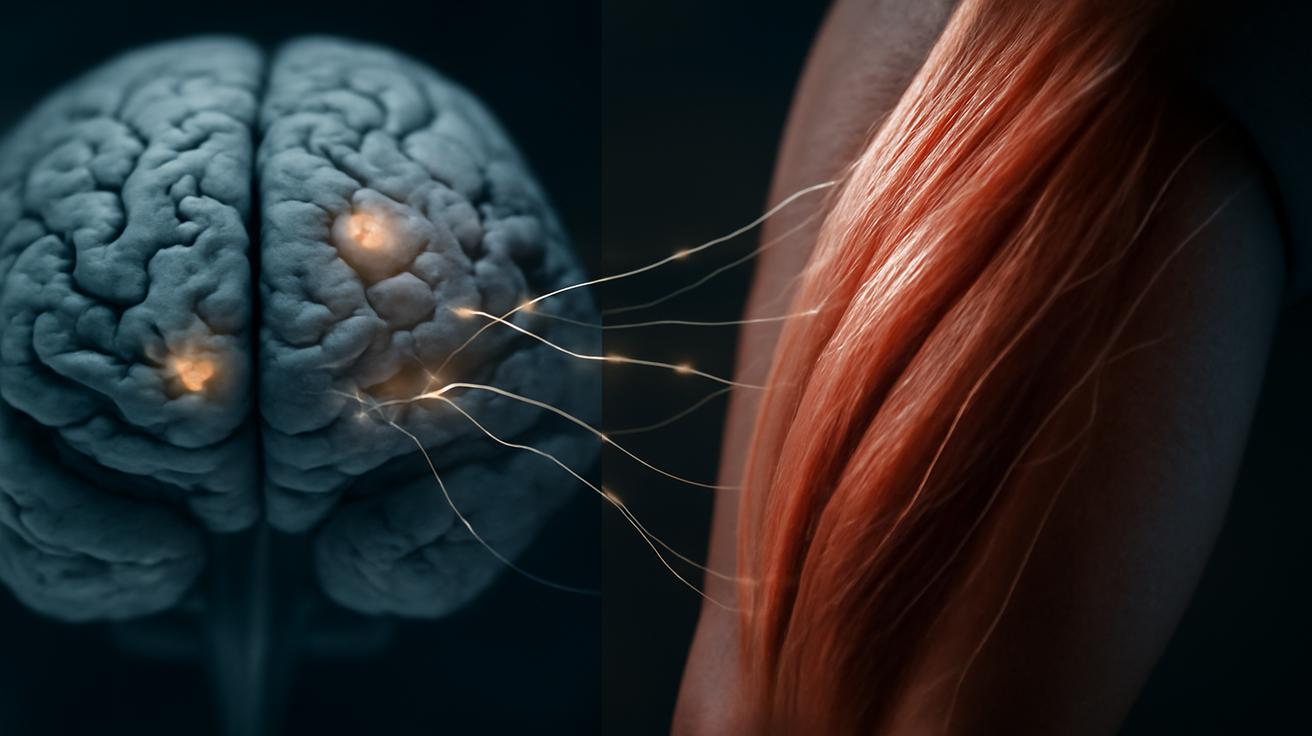
But what if this story is missing a major character? What if, instead of looking only at what’s happening beneath the bone of the skull, we stepped back and followed the invisible threads tying the brain to the rest of the body—especially the muscles that move us through the world?
In recent years, a quiet revolution has been taking place in labs and clinics around the globe. Researchers are finding that muscle is not just meat, not just machinery for walking and lifting. It behaves like an organ, a chemical factory and communication hub, sending powerful messages throughout the body—messages that may help protect, repair, and even sharpen the brain itself. And that changes everything about how we might think of Alzheimer’s prevention and support.
The Silent Conversation Between Muscles and Mind
Imagine your body as a city at night. The brain is often depicted as the glowing downtown skyline, busy and bright. Muscles, in that metaphor, are the suburbs—quiet, functional, easy to overlook. But hidden in that simplicity is a network of roads, cables, and signal towers carrying information back and forth, second by second. Every time you move, tiny chemical messengers spark into life inside your muscle fibers and travel through your bloodstream like letters in a vast postal system.
Scientists call some of these messengers “myokines”—hormone-like molecules released by working muscles. They have names that sound like secret codes: irisin, BDNF (brain-derived neurotrophic factor), IGF-1, and others. What matters is not the jargon but their destination. Many of these chemical letters are delivered straight to the brain, where they may encourage brain cells to grow new connections, help clear toxic proteins, and reduce inflammation—the very things we struggle to fix when Alzheimer’s begins its quiet work.
For years we’ve talked about “exercising for your heart.” Now the evidence is mounting that we may just as urgently need to “exercise for your brain”—and that the muscles are not simply passengers in this process, but drivers. The brain and body, once treated as separate kingdoms, turn out to be in constant, intimate conversation.
Why Muscles Might Matter More Than We Ever Imagined
Look at people who live long, sharp, independent lives into their eighties and nineties, and patterns begin to emerge. Many of them, even if they are not athletes, keep moving: walking, gardening, lifting groceries, climbing stairs, dancing in living rooms. Population studies have started to confirm what observant eyes have seen: older adults with stronger muscles and more daily activity tend to have a lower risk of cognitive decline.
That doesn’t mean muscles are magic shields. Alzheimer’s is a complex, many-headed creature, shaped by genetics, environment, lifestyle, stress, sleep, and plain luck. But the connection between muscle health and brain health is becoming hard to ignore.
Some researchers talk about “sarcopenia,” the loss of muscle mass and strength with age, as a kind of early warning light on the dashboard. As muscles fade, people tend to move less. With less movement comes poorer blood flow, more inflammation, higher blood sugar, and weaker resilience to stressors. These changes don’t stay politely below the neck; they seep into the brain’s delicate networks.
Now flip the script. When muscles are challenged—by lifting something heavy, by walking briskly, by climbing a hill—they send a different kind of message. Blood vessels open up. Blood sugar is used instead of stored. Myokines surge. In some animal studies, blood taken from active individuals and given to sedentary ones improved brain health and memory. It’s as if the active body is brewing a kind of internal brain tonic every time it moves.
Inside the “Muscle–Brain” Chemical Symphony
To really feel the wonder of this, imagine a simple scene: you decide to go for a brisk walk. It’s late afternoon, the sun low and molten in the sky, the air with that faint metallic smell that means rain is waiting somewhere behind the clouds. You lace up your shoes, step outside, and start moving.
Within minutes, your leg muscles begin contracting in a steady rhythm. To you, it just feels like walking. To your body, it’s a full-scale event. Oxygen demand spikes. Your heart responds, drumming harder, pushing blood out to the limbs. Each working muscle fiber starts to release myokines.
Some of these molecules whisper to nearby fat cells: “Be generous—release energy.” Others knock on the door of the liver: “Help manage blood sugar more smoothly.” And some drift farther, hitching a ride in the bloodstream through the winding highways that lead to your brain.
Once there, they encounter the blood–brain barrier, a sort of tightly guarded gate. Some myokines are allowed to pass, where they nudge brain cells into action. They may encourage the birth of new neurons in the hippocampus—the region deeply involved in learning and memory, and one of the first casualties in Alzheimer’s disease. They may help microglia, the brain’s cleanup cells, do a better job of clearing out damaged proteins and calming harmful inflammation.
All of this is happening while you’re simply listening to the crunch of gravel beneath your shoes or the push-pull of your breath. It feels ordinary. Inside, it is anything but.
The Emerging Science: Patterns We Can’t Ignore
Human studies are painting a complementary picture. People who regularly engage in physical activity, especially activities that challenge the muscles—like resistance training, climbing stairs, or carrying loads—are more likely to maintain their cognitive abilities as they age. They’re also less likely to progress from “mild cognitive impairment” to full-blown dementia.
In imaging studies, physically active older adults often show thicker brain regions involved in thinking and memory, and more robust networks connecting different parts of the brain. Muscle strength, measured simply by how hard someone can squeeze a handgrip or how easily they can rise from a chair, turns out to correlate with something as intangible as mental sharpness.
It doesn’t prove causation, not yet. But together with animal experiments and biochemical findings, it forms a tapestry of evidence suggesting that when we work our muscles, we are also quietly tending to the garden of the mind.
From Lab Bench to Living Room: What Might This Mean for Us?
Step away from the microscopes and into a living room on a Tuesday evening. A daughter is watching her mother, once sharp and quick with numbers and names, struggle to remember where she put the television remote. Photo albums lie open on the coffee table, faces smiling up from another decade. There is love in the air, and there is also fear—a question pressed between the lines of every day: is there anything we can still do?
If Alzheimer’s were only about the brain itself, answers might feel narrower. But if muscles are part of the story, the space for action opens up, even if only a little. Not as a cure, not as a miracle, but as a way to tilt the odds, to slow the slope, to build resilience for as long as possible.
That may look surprisingly simple in practice: short walks, light resistance exercises, stretching, everyday movement woven into daily life. The magic is not in perfection, but in persistence. Activity that’s realistic, safe, and consistent can help muscles keep sending their messages.
For some, this might be bodyweight exercises at the kitchen counter. For others, carrying groceries in two trips instead of three. For someone with mobility challenges, it could be chair-based strength training, slow and supervised. The point is not athletic performance. The point is communication: keeping the muscle–brain conversation alive.
Small Steps, Real Signals: Everyday Movements That May Help
You don’t need a complicated routine to begin. Think instead in terms of signals you send your body each day. Are you telling your muscles they are still needed? Are you giving your brain reasons to adapt, to renew its connections?
| Everyday Activity | Muscle Signal | Potential Brain Benefit |
|---|---|---|
| Brisk 10–15 minute walk | Activates leg muscles and boosts circulation | Improved blood flow, myokine release, clearer thinking |
| Slow sit-to-stand from a chair (5–10 times) | Strengthens thighs and hips | Supports mobility, confidence, and independence, reducing cognitive risk linked to frailty |
| Carrying light grocery bags | Engages arms, shoulders, and core | Challenges balance and coordination, which are tied to brain health |
| Gentle stair climbing | Builds leg and glute strength | Raises heart rate, potentially helping brain oxygenation |
| Simple resistance band exercises | Stimulates multiple major muscle groups | May support myokine release and brain plasticity |
None of these actions looks dramatic. Compared to high-tech brain scans or experimental drugs, they might even seem ordinary, almost laughably small. Yet inside, they stir a biochemical storm—one that could shape how the brain weathers the storms of aging.
Rewriting the Story of Aging: From Decline to Dialogue
There is a powerful cultural script that tells us aging is a simple downward slope. In that story, the mind gradually dims, the body grows weaker, and dementia feels like an almost inevitable final chapter for many. The science of muscle–brain communication interrupts that script. It suggests that aging is more like a conversation—ongoing, malleable, influenced by the choices and environments that surround us.
Consider how differently we might design homes, cities, and daily routines if we took this seriously. Sidewalks and parks become more than scenery; they become public health tools. Community centers with light weights and safe exercise classes become quiet frontline defenses against cognitive decline. Celebrating older adults who stay strong and active turns from simple admiration into a societal strategy.
It also changes the way we might sit with fear. If you’ve watched a parent or grandparent slip into Alzheimer’s, you may carry a private dread about your own future. The idea that muscles—something you can still touch, train, and feel working—play a role gives that fear a counterweight. Not a guarantee, but a lever.
And for those already living with early stages of Alzheimer’s or mild cognitive impairment, viewing the body as an ally rather than a bystander can be deeply empowering. Movement, customized by doctors or therapists, becomes not just rehabilitation but communication: a way of reminding the brain, “You are still connected. You are still part of this moving, adapting system.”
Hope, Without Illusion
Of course, we have to be honest. Exercise and muscle strength are not cures. There are people who run marathons and still develop dementia, and people who avoid illness despite leading quiet, sedentary lives. Biology is a braided thing, not a simple thread.
But between helplessness and cure lies a vast middle ground: influence. The emerging science suggests that by respecting our muscles—not as vanity projects, but as endocrine organs and neurological allies—we may be able to delay onset, blunt severity, or preserve more of ourselves for more years.
Hope lives in that space, not as a blinding optimism, but as a steady, grounded light. It says: your actions matter. Your body matters. Even now.
Standing in the Doorway of a New Understanding
Return, for a moment, to the old man in the gym. He lifts, rests, lifts again. Around him, younger people scroll on phones between sets or chase personal records. He is not chasing numbers. He is chasing time—years of remembering names, of knowing where his keys are, of recognizing the faces that gather around his table at holidays.
Does he know the names of the molecules surging through his veins as he curls those weights? Likely not. Does he need to? Not really. What he knows is something simpler and older than any modern study: when he moves, he feels more alive, more present, more himself. He is making a quiet bet that his muscles hold part of the key to keeping his mind.
We stand at the threshold of understanding a profound truth: the brain is not an island. It is a peninsula, deeply rooted in the continent of the body. Muscles, so often dismissed as mere movers, are turning out to be storytellers too—sending signals that may shape how our later chapters unfold.
What if, in the years to come, a standard Alzheimer’s prevention plan always included a thoughtful strength and movement routine? What if neurologists and physiotherapists worked side by side, prescribing walks and resistance bands along with medications and cognitive exercises? What if communities treated benches, railings, stairs, and open spaces as part of a grand, shared effort to keep one another’s minds bright?
The question that began as a whisper—“What if the key to fighting Alzheimer’s wasn’t in the brain, but in the muscles?”—may not have a single, definitive answer yet. But it has already changed the conversation. It invites us to live differently in the bodies we have, to honor strength not as vanity but as a form of care for the most delicate organ we own.
Tonight, or tomorrow morning, you might feel the weight of that question in your own limbs. You might stand up a little more slowly and then decide to sit and rise three more times, just because you can. You might choose the slightly longer route to the mailbox, the stairs instead of the elevator, the short walk after dinner instead of the couch straightaway. Not as punishment. As a love letter to your future mind, written in the language of muscle fibers and heartbeat and breath.
Your brain is listening. It has been, all along.
Frequently Asked Questions
Does exercise really lower the risk of Alzheimer’s disease?
Regular physical activity is strongly associated with a lower risk of cognitive decline and dementia in many studies. It doesn’t guarantee protection, but people who stay active—especially with activities that challenge the muscles and raise the heart rate—tend to maintain better thinking and memory skills as they age.
Is strength training more important than cardio for brain health?
Both matter, and they work in different but complementary ways. Aerobic exercise (like walking or cycling) improves blood flow and cardiovascular health, which benefits the brain. Strength or resistance training keeps muscles strong and stimulates the release of myokines that may support brain function. A mix of both is ideal.
Can exercise help someone who already has early-stage Alzheimer’s?
Yes, in many cases movement can still be beneficial. While it will not cure the disease, tailored exercise programs may help maintain independence, mood, mobility, and possibly slow functional decline. It’s important to work with healthcare professionals to ensure activities are safe and appropriate.
How much movement is realistic for older adults or people with limited mobility?
Even small amounts of gentle, regular movement can help. Chair exercises, short supervised walks, slow sit-to-stands from a stable chair, and light resistance bands can be surprisingly effective. The key is consistency and safety, not intensity.
If my family has a history of Alzheimer’s, is building muscle still worth it?
Absolutely. Genetics may raise risk, but lifestyle factors like physical activity, sleep, stress, and nutrition still influence how those genes play out. Building and maintaining muscle is one of several realistic, accessible ways to support your brain over time.