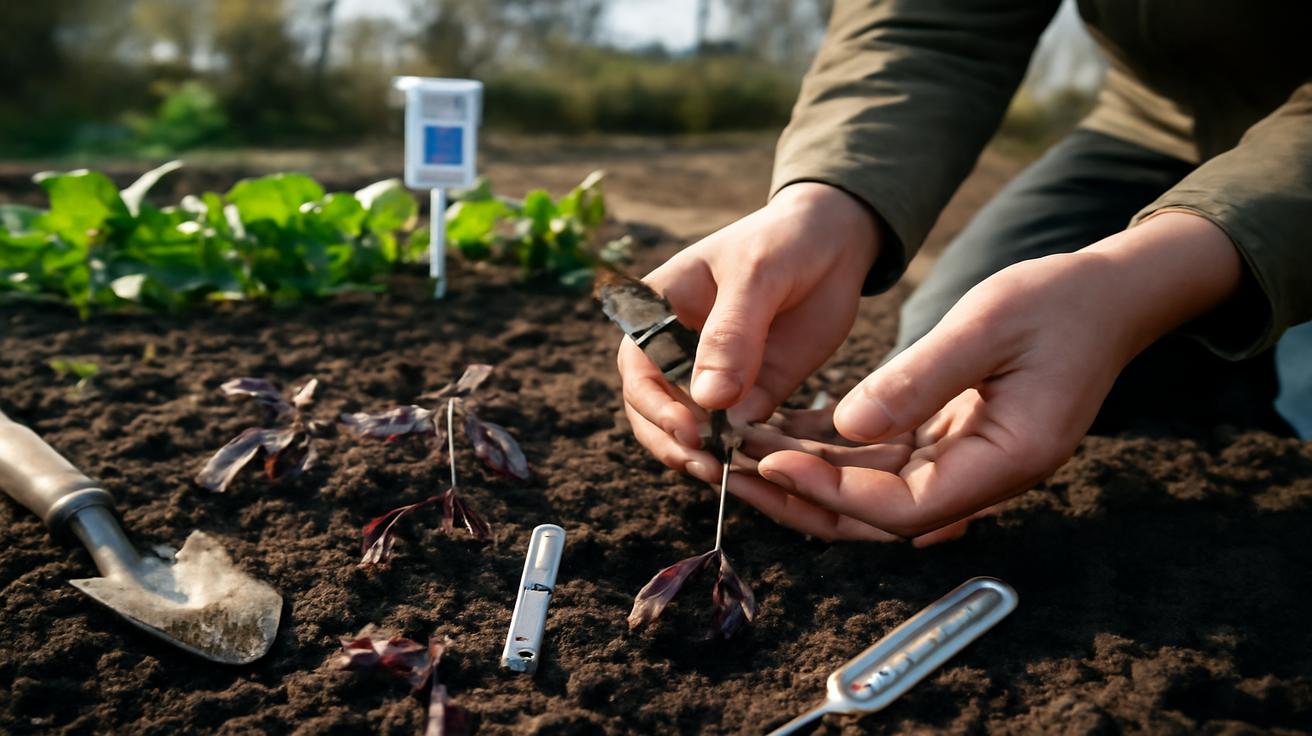
The first warm day sneaks up on you. One minute you’re tugging your coat tighter against a biting wind; the next, you’re standing in the garden in a T‑shirt, soil thawed, sun lingering just a little longer on your shoulders. You bend down, crumble a handful of earth between your fingers, and think: “It feels ready.” Trays of seedlings wait by the window, their leaves pressed against the glass like children at a locked door. You imagine them out here, fanned by breezes, bathed in real sunlight instead of the weak glow of your living room. It feels almost cruel to keep them in. So you don’t. You plant them.
Two days later, the sky has turned the color of old pewter, and the warmth has fled without a goodbye. A chill settles in after sunset, seeping through your sleeves as you hurry out to check your new little transplants. Their once-perky leaves now droop a bit, their green dimmed. The soil looks the same. The air feels only slightly colder than it did when you tucked them in. But something invisible has shifted, and the young plants know it long before you do.
When “Nice Weather” Lies to You
Gardeners, especially new ones, trust two storytellers more than any others: the thermometer and their own skin. If the air feels pleasant and the days stay above freezing, it’s easy to believe the danger has passed. Mild weather reads like a promise. But in the language of plants, “mild” is a slippery word.
Young plants live close to the edge of what their bodies can handle. The seedlings you’ve pampered indoors have grown up in a world of stable temperatures, gentle light, and regular water—more like a climate-controlled nursery than the rough, swinging moods of spring. Out there, beyond the glass, the soil heats and cools at a different rhythm than the air. Night drops far lower than your thermostat ever would. Wind leans harder, dragging moisture from tender leaves. These tiny shifts add up to a kind of stress that doesn’t show up on the weather app.
So while you’re thinking, “It’s gorgeous out, they’ll love this,” your plants are whispering, “We’re not ready.” If they had a voice, they’d ask you not about how the air feels at noon, but about what the soil feels like at dawn. About how often the wind gusts. About whether tomorrow’s sunny afternoon will end in a sneak-attack frost.
We tend to imagine plants as stoic, patient beings. In some ways they are. But young plants are more like teenagers dropped into boot camp halfway through freshman year—technically alive, technically capable, but absolutely overwhelmed by the sudden demand to toughen up.
The Hidden World Beneath Those Fragile Roots
Beneath the surface, where we rarely look, the comfort level for a young plant isn’t defined by how warm your face feels in the sun. It’s defined by the thin halo of soil around each root hair—the microclimate where water, nutrients, and temperature come together to either nourish or punish.
When you plant too early, even in what seems like “mild” spring weather, the soil may still be clinging to winter. Reach down early in the morning, press your fingertips into the earth, and you’ll feel it: that deep, cellar‑like chill. For a young plant, cold soil is like trying to live with your feet in ice water. It doesn’t always kill them outright, but it slows everything that matters.
Roots are the quiet engines of growth, pulling in water and dissolved minerals, feeding the rest of the plant. In cool soil, those engines sputter. Nutrient uptake stutters. Metabolism slows. The leaves above may be bathed in light, begging to photosynthesize, but the roots below are sending back a miserable reply: “We can’t keep up.” That mismatch creates stress long before you see visible damage.
Meanwhile, the microorganisms that usually make soil such a generous place—bacteria that break down organic matter, fungi that form helpful partnerships with roots—are sluggish in chilly ground. Their slowed activity means fewer nutrients are released, fewer allies are available. Early-planted seedlings land not in a bustling underground city but in a sleepy town that hasn’t fully woken up yet.
Even water behaves differently. Cold soil stays wet longer, less eager to release moisture back into the air. For seeds, that can mean rotting before they ever sprout. For young transplants, it can mean suffocating roots kept too long in saturated, oxygen‑poor pockets. On the surface, everything looks pleasantly damp and mild; below, the plant is wading through a bog of compromises.
The Silent Damage of Chilly Nights
The real betrayal of “mild” weather lies not in the daytime highs, but in the nighttime lows. You might never see frost sparkle on the lawn, yet temperatures can easily slide low enough to bruise tender tissue. A night that hovers at just a few degrees above freezing doesn’t look dramatic from a distance, but inside a young plant’s cells, it’s a different story.
Plant cells are tiny water balloons, their walls taut with pressure. Rapid cooling makes that water contract, while the surrounding cell wall doesn’t adjust nearly as quickly. Micro‑tears appear. Membranes, those delicate barriers that keep everything in its proper place, start to lose their integrity. You won’t always see blackened leaves like you do after a hard frost. Instead, you’ll see a subtle stalling: new growth halts, leaves become dull or slightly translucent, and the plant takes on a hunched look, like someone bracing against a wind you can’t feel.
Even worse, this kind of damage is cumulative. One chilly night a seedling might shrug off. Five in a row, and you may have a survivor whose future harvest has already been cut in half. Early planting often doesn’t kill outright; it steals energy quietly, stealing not just this week’s growth but the plant’s eventual size, resilience, and yield.
When Comfort Becomes a Curse
If you’ve raised seedlings indoors, you’ve likely done your job a little too well—from the plant’s point of view, anyway. Under lights or in a bright window, they grow in still air, steady warmth, and regular watering. Their stems don’t have to flex against wind. Their leaves have never known the grit of real sunlight, which arrives in a broader, harsher spectrum than even the best grow lamps. They’ve never had to search for water, never been told “not yet” by a cold sunrise.
This protected upbringing makes them lush and soft, like someone who has spent all winter on a couch then suddenly signs up for a mountain hike. Taken directly from their cushioned life and plunged into a garden—even one that feels mild—they face a cascade of “firsts” all at once: first cold night, first gusty day, first unfiltered noon sun, first day when the soil at their feet is not the same temperature as the air on their leaves.
Plants can adapt to these things. They are remarkably plastic beings, capable of adjusting leaf thickness, root depth, even the chemistry of their cells. But that adaptability takes time. When we plant too early, we rob them of that time, asking them to perform under pressure before they’ve had a training season.
Gardeners call the adjustment process “hardening off,” but what it really means is teaching your plants how the world works, slowly. When that teaching doesn’t happen—or happens too quickly—the comfortable life indoors flips from blessing to curse. What looked like health in the seed tray (tall, lush, tender growth) becomes a liability in the open bed, where stockier, slower-grown seedlings would handle stress more gracefully.
The Subtle Shock of the Real Sun
There is another tiny drama playing out on the leaves themselves, one we often overlook. Sunlight indoors is a filtered, weakened cousin of the real thing. Glass cuts out some wavelengths, distance softens intensity, and artificial lights, for all their efficiency, deliver a controlled spectrum. Seedlings raised this way grow leaves tuned to that gentle light.
When you set them outside too abruptly, even on a day that feels pleasantly mild, the full force of sunlight can burn them—not with heat alone, but with sheer radiance. It’s like stepping out of a dim room into a bright photo flash that never ends. The chlorophyll inside each leaf, the very pigment you want for photosynthesis, can be damaged if it goes from “library lighting” to “desert noon” overnight.
The result looks like sunburn: pale, bleached, or crispy patches appearing within a day or two. The plant must then spend precious energy repairing damage before it can dedicate itself to growth. Again, it may survive, but the invisible cost is time and strength lost to recovery.
The Calendar in the Soil
You can circle a date on the calendar, scroll through a forecast, and read last year’s notes. But plants keep time in a more grounded way. To them, the year turns not on pages but on degrees: soil temperature creeping upward, day length stretching, night lows lifting slowly like a curtain.
Different types of plants listen for different cues. Cool-season crops—peas, lettuces, spinach, brassicas—are like early risers, stirring when the soil is still cool and the sky still pale. Warm-season crops—tomatoes, peppers, squash, beans—are late risers, refusing to move until the bed beneath them feels like a warmed blanket.
Putting a warm-season seedling into coldish ground is like shaking someone awake at 3 a.m. and urging them to run a marathon. They might manage a few steps, but they won’t thank you for it. Their roots will sulk, their leaves may turn a purple or yellow tinge from disrupted nutrient uptake, and they’ll sit motionless for weeks. Ironically, plants set out later, once the soil truly warms, often overtake their early-planted siblings that spent so long in a kind of chilly suspended animation.
This lag can be surprising. You might proudly point to your early May tomatoes standing twice as tall as your neighbor’s seedlings planted two weeks later. Come July, the tables turn: their stocky, later-planted tomatoes are loaded with blossoms while yours are still recovering from a stressed childhood. Mild weather made an empty promise; the soil’s slow calendar had the final word.
Reading the Ground, Not Just the Air
Learning to plant “on plant time” means paying attention to the textures and signals of your garden, not just the numbers on a screen. Push your hand deep into the soil in the morning. Is it merely cool, or biting cold? Does it cling wetly to your fingers or crumble and fall away? Notice how the smell changes from winter’s dull, mineral scent to spring’s rich, earthy exhale as microbes wake up.
These are your real clues. Air can flirt and tease—warm one day, sharp the next. Soil moves more slowly, holding the memory of winter even as the first bees buzz overhead. When that underground memory has finally faded, when the earth itself no longer flinches at night, your young plants will find a world that welcomes rather than tests them.
How Young is “Too Young”?
Not all seedlings are equal in their readiness to face the elements. Two plants in the same tray may be the same age in days, but vastly different in their maturity. A spindly tomato with four oversized, floppy leaves is like a tall child with no muscle; a compact seedling with thick stems and several sets of true leaves is more like a small but strong teenager.
Young plants need a few basic tools before they can handle the outside world with grace: a solid root system, sturdy stems, and leaves that have tasted at least a little bit of stress. Without those, mild weather is still too wild for them. With them, even a slightly imperfect spring poses far less danger.
You can think of transplant age in terms of readiness instead of dates. Has the plant filled its cell or pot with roots, but not yet begun to circle or become root‑bound? Are the stems thick relative to the height, able to sway in a breeze without snapping? Has the plant had at least a week of gentle hardship—cooler temperatures, light wind, real sunlight in small doses?
These qualities matter more than any calendar or seed packet guideline. A seedling that has been thoughtfully trained for stress can step into the garden earlier and thrive. One that’s been coddled in constant comfort may falter even if you plant on the “right” day.
| Plant Type | Soil “Feels Like” | Young Plant Response |
|---|---|---|
| Cool-season greens (lettuce, spinach) | Cool but not shocking, moist but not soggy | Settle in slowly, tolerate chilly nights, may bolt if heat arrives too soon |
| Brassicas (kale, cabbage, broccoli) | Cool to comfortably cool, consistent moisture | Handle early planting better, but still stressed by repeated near-freezing nights |
| Tomatoes & peppers | Distinctly warm to the touch, drains well | Sulky and stunted in cold soil; thrive when planted after nights stay reliably mild |
| Squash, cucumbers, beans | Warm and loose, no lingering chill at dawn | Seeds and seedlings rot or stall if planted into cold, wet beds |
Why Waiting Feels Harder Than Planting
There’s a quiet impatience at the heart of gardening. We endure winter with seed catalogs and daydreams, fingers itching to touch soil again. When that first warm spell arrives, it feels like a door swinging wide—and it takes real restraint not to rush through.
Planting gives us the satisfying sense that we’re doing something, moving things along. Waiting, by contrast, can feel like idling at a green light while the cars behind you tap their horns. But in the pace of living things, waiting is often the most active choice you can make. It’s the choice that says, “I care more about how you grow than how soon I can say I planted you.”
The irony is that waiting for truly suitable conditions—warm soil, settled nights, hardened seedlings—often buys you not only healthier plants but earlier harvests. A seedling that hits the ground running will race ahead of one that spent its first weeks outdoors simply learning how to cope.
Listening Closer to What Young Plants Need
When you crouch beside a bed in early spring, hand hovering over a tray of seedlings, you stand at the edge of a quiet conversation. On one side: your eagerness, your schedule, your interpretation of “nice weather.” On the other: the plant’s reality—its root zone temperature, its barely tested leaves, the unseen tension of its cells facing real wind, real dark, real cold.
The struggle young plants face when set out too early, even in what feels like gentle weather, is mostly an argument between comfort and readiness. We see a pleasant afternoon and think that’s enough. The plant lives in a 24‑hour cycle and measures survival in subtler units: a degree of soil warmth here, a gust of wind there, the stretch of darkness when the last of the day’s heat seeps back into the sky.
To plant well is to honor that difference. It means letting your fingers learn the language of the soil, letting your eyes grow sharp to the small signs of a hardened seedling versus a coddled one, and letting your patience outweigh your impulse to hurry the season along. When you do, those same young plants that once wilted under “mild” conditions will stride into the garden as if they were always meant to be there—because now, finally, they are.
And when you walk out on a late spring evening and see them standing firm after a blustery day, leaves unbowed, you’ll understand: you didn’t just plant them later. You planted them wiser.
Frequently Asked Questions
Why did my seedlings stop growing after I planted them outside?
They likely went into shock from cold soil, chilly nights, stronger sun, or wind. Even if the daytime air felt mild, the underground and nighttime conditions may have slowed their roots and damaged delicate tissues, causing growth to stall while they try to recover.
Can “mild” temperatures still damage young plants?
Yes. Repeated nights just above freezing, or sudden swings from warm days to cold evenings, can stress cells, reduce nutrient uptake, and stunt growth. The damage is often subtle and cumulative rather than dramatic like a hard frost.
How can I tell if the soil is warm enough to plant?
Use touch and timing. Early in the morning, push your hand into the soil: it should feel cool but not sharply cold, and not soggy. For warm-season crops, the earth should feel distinctly warm and crumbly. A soil thermometer helps, but your senses are a good guide.
What is hardening off, and why does it matter?
Hardening off is the gradual process of exposing indoor-raised seedlings to outdoor conditions—real sun, wind, and cooler temperatures—over 7–10 days. It lets plants build thicker leaves and stronger stems so they can handle the garden without going into shock.
Is planting earlier always better for a bigger harvest?
No. Stress from cold soil and unstable spring weather often delays growth so much that early-planted seedlings are overtaken by those set out later under better conditions. Healthy, well-timed planting usually beats rushed, stressed planting in the long run.